An equilibrium constant belongs to one specific balanced equation. Flip the equation, scale it, or add it to another one, and K changes in a predictable way. These rules let you find K for a reaction nobody measured, by building it out of reactions whose K values you know. They also let you write one overall equilibrium expression for a process that happens in several steps. Everything here works the same way for Kc, Kp, and the reaction quotient Q.
K goes with the equation, not the mixture
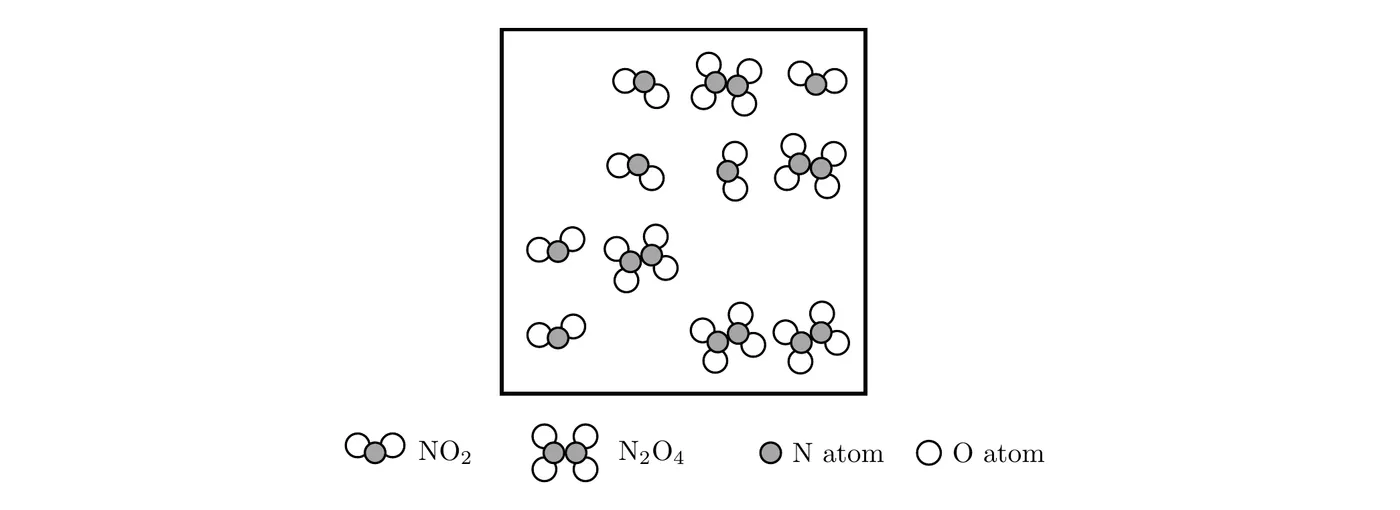
Picture a sealed flask of N2O4 and NO2 at equilibrium, at the same temperature as in Topics 7.1 to 7.4. Each molecule in the diagram represents 0.0500 M, so [N2O4]=5×0.0500=0.250 M and [NO2]=6×0.0500=0.300 M.
The mixture is a physical fact. But you can describe it with more than one balanced equation, and each equation has its own K expression:
Equation
K expression
Value
N2O4(g)⇌2NO2(g)
[N2O4][NO2]2
0.250(0.300)2=0.360
2NO2(g)⇌N2O4(g)
[NO2]2[N2O4]
(0.300)20.250=2.78
21N2O4(g)⇌NO2(g)
[N2O4]1/2[NO2]
(0.250)1/20.300=0.600
2N2O4(g)⇌4NO2(g)
[N2O4]2[NO2]4
(0.250)2(0.300)4=0.130
Same flask, four different K values. Nothing about the mixture changed, only the bookkeeping. That's why a K value means nothing unless you know which equation it goes with. The four values are also related: 2.78=1/0.360, 0.600=0.360, and 0.130=(0.360)2. Those relationships are the rules below.
Rule 1: Reversing a reaction inverts K
When you reverse a reaction, products and reactants trade places, so the K expression flips upside down:
So a reaction with a very large K has a reverse reaction with a very small K. That fits Topic 7.5: if the products are strongly favored one way, they're still strongly favored when you write the equation backward, where they're now called reactants.
Rule 2: Multiplying the coefficients by c raises K to the power c
Multiply every coefficient in an equation by a factor c, and every exponent in the K expression gets multiplied by c too. That raises the whole expression to the power c:
The factor can be a fraction. Multiplying by 21 means taking the square root of K, and multiplying by 31 means taking the cube root. You never multiply K itself by c: doubling the equation squares K, it doesn't double it.
Example 1: Flipping and scaling one reaction
At 430 °C, Kc=54.3 for
H2(g)+I2(g)⇌2HI(g)
Find Kc at the same temperature for each equation below.
(a)2HI(g)⇌H2(g)+I2(g). This is the reverse, so invert:
Kc=54.31=0.0184
(b)21H2(g)+21I2(g)⇌HI(g). Every coefficient is multiplied by 21, so take the square root:
Kc=(54.3)1/2=7.37
(c)HI(g)⇌21H2(g)+21I2(g). This is reversed and halved, so do both:
Kc=(54.3)−1/2=7.371=0.136
Each answer keeps 3 significant figures, the same as 54.3.
Rule 3: Adding reactions multiplies their K values
When you add two reactions to get an overall reaction, the overall K is the product of the individual K values:
Koverall=K1×K2
This is how you represent a multistep process with one overall equilibrium expression. Nitrogen monoxide reacts with oxygen in two steps:
The [N2O2] term cancels in the K expressions for the same reason N2O2 cancels in the equations. The setup should look familiar from Hess's law (Topic 6.9), with one key difference: when equations add, their ΔH values add, but their K values multiply.
Change to the equation
Effect on K
Effect on ΔH (for comparison)
Reverse it
K becomes 1/K
ΔH changes sign
Multiply all coefficients by c
K becomes Kc
ΔH is multiplied by c
Add two equations
Koverall=K1×K2
ΔHoverall=ΔH1+ΔH2
Example 2: Building a target reaction (AP-style)
At a certain high temperature, these two reactions have the Kp values shown:
Find Kp at the same temperature for the breakdown of nitrogen dioxide into its elements:
NO2(g)⇌21N2(g)+O2(g)
Step 1: Plan. In the target, NO2 is a reactant and N2 is a product, the opposite of the given reactions. NO doesn't appear in the target, so it has to cancel. The moves: add (1) and (2), reverse the sum, then multiply by 21.
Answer:Kp=1.0×10⁵. The order of the moves doesn't matter; any order gives (Kp1Kp2)−1/2. Since K is large, the breakdown of NO2 into N2 and O2 is product-favored at this temperature (Topic 7.5), even if it's slow.
Two checks: both given values are Kp, so the answer is a Kp (never mix Kc and Kp in one combination), and both have 2 significant figures, so the answer does too.
Q follows the same rules
The reaction quotient Q has exactly the same form as K, just with the concentrations (or pressures) at any moment instead of at equilibrium. So every rule on this page applies to Q too: reversing the equation turns Q into 1/Q, multiplying by c turns Q into Qc, and adding equations multiplies their Q values.
Example 3: Same prediction, either direction
For N2O4(g)⇌2NO2(g), Kc=0.360 at the temperature of the flask above. Another flask at that temperature contains 0.500 M N2O4 and 0.300 M NO2. Which way will it shift? Answer with the equation written forward, then reversed.
Forward.
Qc=0.500(0.300)2=0.180<Kc=0.360
Q<K, so the net reaction runs forward (Topic 7.7): N2O4 breaks apart and more NO2 forms.
Reversed. For 2NO2(g)⇌N2O4(g), both values invert:
Qc′=0.1801=5.56>Kc′=0.3601=2.78
Now Q>K, so the reversed equation runs in reverse, which means N2O4 turns into NO2. Same prediction. Flipping the equation flips both Q and K, so their comparison flips too, and the chemistry stays the same. Halving the equation gives the same result: Q1/2=0.424 is still less than K1/2=0.600.
Common mistakes
Multiplying K by c instead of raising it to the power c. Doubling an equation squares K.
Adding K values when you add reactions. K values multiply; it's ΔH values that add.
Reversing a reaction but keeping the same K. A reversed reaction always gets 1/K.
Forgetting that a fractional coefficient means a root: multiplying by 21 gives K1/2, not K/2.
Mixing Kc and Kp values in one combination.
Using a K value without checking which equation (and which temperature) it belongs to.