

7.12 - Common-Ion Effect
Overview
A salt dissolves less in a solution that already contains one of its ions. That's the common-ion effect. You can explain it with Le Châtelier's principle and calculate it with . It matters in the lab whenever you want a precipitate to stay solid, and it comes back in Unit 8, where the same idea makes buffers work.
Why a common ion lowers solubility
Start with saturated silver chloride:
Now dissolve in a solution instead of pure water. is a common ion: it's already in the solution, and it's also a product of the dissolving. By Le Châtelier's principle, the extra shifts the equilibrium left, so less dissolves. In terms of Q, the extra makes Q = larger than , so precipitation wins until Q comes back down to .
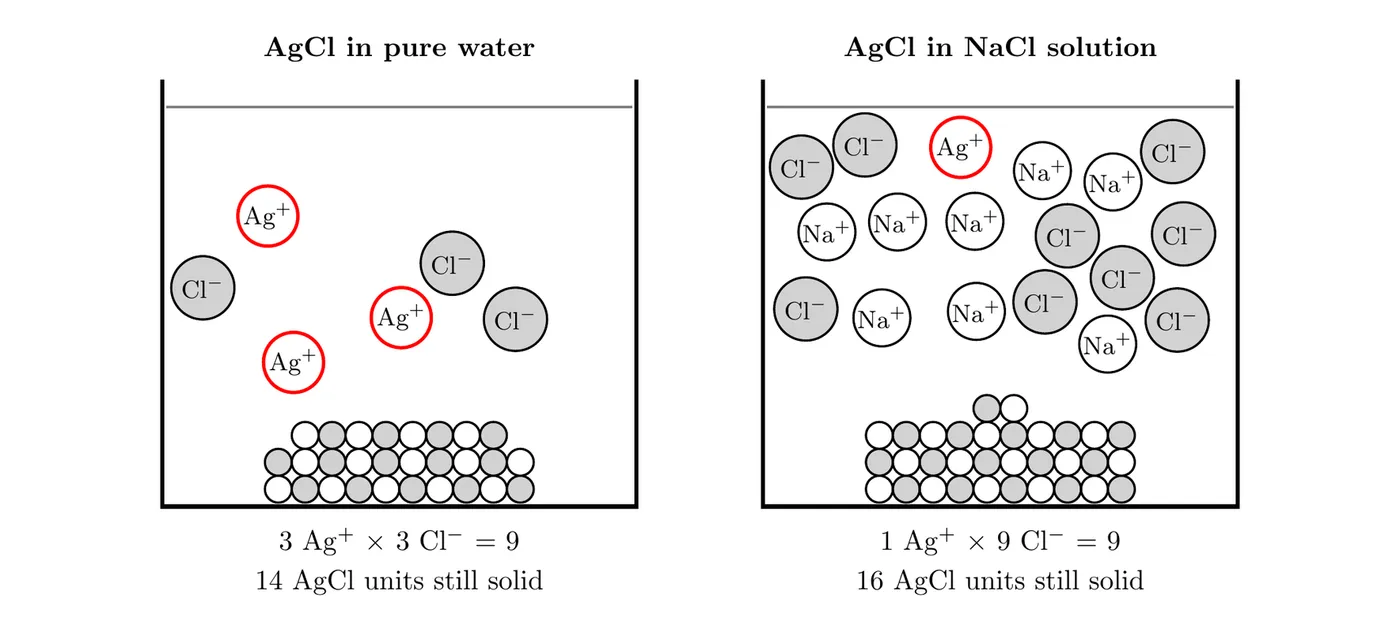
Both beakers started with the same amount of . In both, the number of ions times the number of ions is 9, because is the same at the same temperature. With lots of around, the number of ions has to be small to keep that product fixed. Every unit that dissolves releases exactly one , so the count shows how much dissolved: 3 units in pure water but only 1 in the solution. The ions are spectators and don't affect the equilibrium.
Key point: a common ion doesn't change . It changes the solubility, how much of the salt dissolves.
Calculating solubility with a common ion
Set up the problem the same way as in pure water, but start the common ion at the concentration it already has:
- Write the dissolution equation and the expression.
- Write the ion that only comes from the salt as (or , and so on). Write the common ion as its starting concentration plus what the salt adds.
- Since is small, the salt adds very little of the common ion. Approximate the common ion's concentration as just its starting value.
- Solve for . Then check that what the salt adds is less than about 5% of the starting concentration.
Example 1: in sodium fluoride
for is , and its molar solubility in pure water is M (Topic 7.11). Calculate its molar solubility in 0.0100 M .
is a sodium salt, so it's fully dissolved and supplies = 0.0100 M before any dissolves.
(M) | (M) | |
Before dissolves | 0 | 0.0100 |
Change | ||
Equilibrium |
will be tiny next to 0.0100, so :
Check: M, which is 0.007% of 0.0100 M, so the approximation is fine.
Answer: The molar solubility drops from M to M, about 600 times lower.
Example 2: in calcium nitrate
Now calculate the molar solubility of in 0.0100 M , where the common ion is . At equilibrium, = and = :
Check: is 0.29% of 0.0100 M. Fine.
Answer: M, about 7 times lower than in pure water. The same 0.0100 M of common ion lowered the solubility about 600 times as but only about 7 times as , because is squared in the expression.
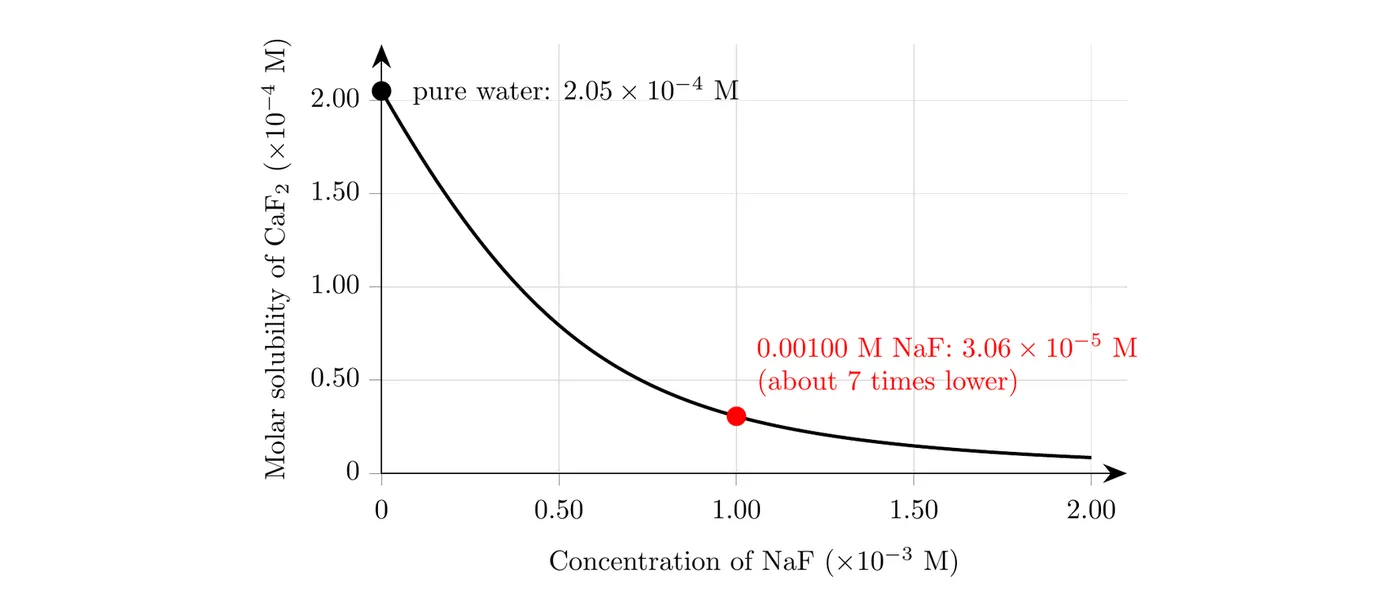
The graph shows the molar solubility of as the concentration rises, solved exactly (without the approximation). Even 0.00100 M cuts the solubility about 7 times, and 0.0100 M (off the right edge) cuts it about 600 times.
Finding from solubility with a common ion
The calculation also runs backward. If you know how much of a salt dissolves in a solution with a known concentration of a common ion, you can find . Just remember to include the common ion.
Example 3: Barium fluoride in sodium fluoride
At 25 °C, 3.23 mg of dissolves in 1.00 L of 0.100 M to make a saturated solution. Calculate for .
Step 1: Molar solubility, with g/mol:
Step 2: = = M. = = 0.100 M (the from changes 0.100 M by less than 0.04%).
Step 3:
If you forgot the and used = , you'd get , off by a factor of millions.
The common-ion effect in the lab
AP questions often ask how a change to a lab procedure changes the results. Common-ion reasoning answers a lot of them:
- Adding excess precipitating agent. In a gravimetric analysis, adding more than the stoichiometric amount of the precipitating ion leaves a common ion in the solution. Less of the product stays dissolved, so the measured mass is closer to the true value.
- Washing a precipitate. Every rinse with pure water dissolves a little of the solid, so the measured mass comes out too low.
- Water that already contains a common ion. If you measure the solubility of in water that contains some fluoride, the measured solubility is too low, and a calculated as if the water were pure () comes out too low.
Example 4: Keeping the sulfate in the solid (AP-style)
A student finds the sulfate content of a fertilizer by adding solution to precipitate , then filtering, drying, and weighing the solid. After precipitation, the mixture's volume is 250.0 mL. for is .
(a) If the student adds exactly enough to react with the sulfate, the liquid left over is just a saturated solution. What mass of stays dissolved? (b) If the student adds excess so that = 0.010 M after precipitation, what mass stays dissolved? (c) Explain how washing the precipitate with a large volume of distilled water would affect the calculated percent of sulfate.
(a) In a saturated solution, = = . Keep an extra digit in , and use g/mol for :
About 0.61 mg of is lost in the liquid.
(b) Now is about 0.010 M, so
The excess cuts the loss about 1,000 times, thanks to the common-ion effect.
(c) Distilled water has no common ion, so each rinse dissolves some , up to about mol per liter of rinse water. The measured mass of is too low, so the calculated mass of sulfate and the percent of sulfate in the fertilizer are too low. Using excess and rinsing with small volumes of water keeps this error small.
Common mistakes
- Forgetting the common ion. If the solution already contains one of the salt's ions, that ion's equilibrium concentration is its starting value plus what the salt adds.
- Putting the 2 in the wrong place. In 0.0100 M , = . Don't write . The 2 belongs to , not to the .
- Thinking changes. A common ion lowers the solubility. stays the same at a given temperature.
- Skipping the approximation check. Make sure what the salt adds is small next to the common-ion concentration.
- Including spectator ions. and don't appear in the expression for .