

7.7 - Calculating Equilibrium Concentrations
Overview
If you know the balanced equation, the starting amounts, and K, you can predict exactly what the mixture will look like at equilibrium. The work has two parts: compare Q with K to decide which way the reaction has to go, then use an ICE table to find how far it goes. This skill shows up on both sections of the AP exam, and it's the foundation for the acid-base calculations in Unit 8.
Which way will the reaction go?
Start by comparing the reaction quotient Q (Topic 7.3) with K. Q uses the concentrations or partial pressures right now; K is the value Q will have once the system reaches equilibrium. Q always moves toward K.
Comparison | What happens | Why |
The net reaction runs forward: reactants are used up and products form until Q rises to K. | There are too few products compared with equilibrium, so the forward rate is faster than the reverse rate. | |
The net reaction runs in reverse: products are used up and reactants form until Q falls to K. | There are too many products, so the reverse rate is faster. | |
No net change. The system is at equilibrium. | The forward and reverse reactions still happen, at equal rates, so the proportions of reactants and products stay constant. |
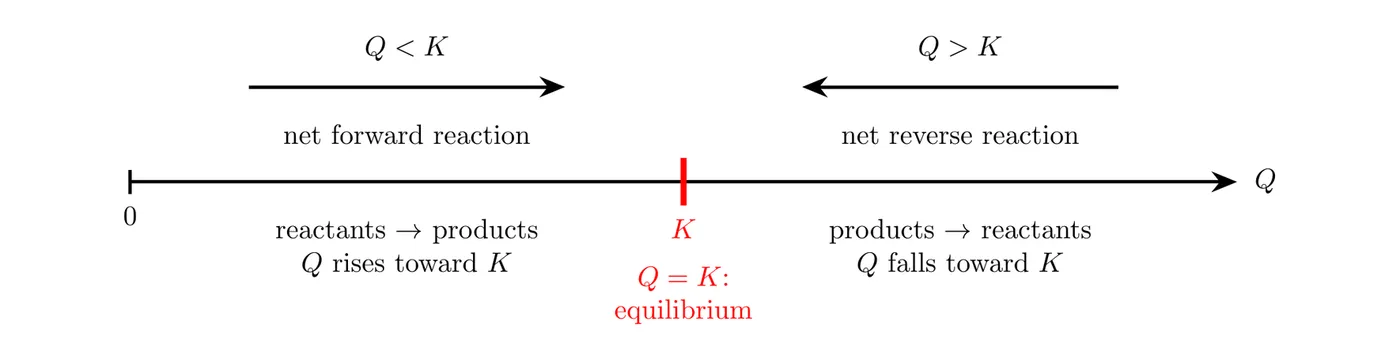
A quick way to remember it: products are on top of the Q expression. If Q is too small, the system makes more products to raise it. If Q is too big, it makes more reactants to lower it.
Write Q exactly the way you'd write K: products over reactants, each raised to its coefficient, leaving out solids and pure liquids. If no product is present, and the reaction must run forward. If a reactant is missing, Q can't be calculated (you'd divide by zero), but the reaction clearly must run in reverse.
Example 1: Predicting the direction
At 1000 K, for
Predict the direction for each mixture at 1000 K.
(a) M, M, M.
(500 > 280), so the net reaction runs in reverse: some breaks down into and .
(b) 0.40 mol , 0.20 mol , and 0.60 mol in a 4.00 L flask. Convert to molarity first: M, M, and M.
, so the net reaction runs forward, making more . (Plugging in moles instead of molarity gives 11, which is the wrong value. It happens to point the same way here, but it won't always.)
(c) M, M, M.
, so this mixture is already at equilibrium. Both reactions keep running at equal rates, and the concentrations stay constant.
Finding equilibrium concentrations with an ICE table
In Topic 7.4 you used an ICE table to find K from measured data. Here it runs the other way: K is known and the equilibrium concentrations are the unknowns. ICE stands for Initial, Change, Equilibrium.
- Write the balanced equation and the K expression.
- Fill in the Initial row with concentrations in M (for ) or partial pressures in atm (for ). Convert moles to molarity first.
- Decide the direction by comparing Q with K. If one side starts at zero, the reaction can only go one way.
- Fill in the Change row with one unknown, . Each species changes by its coefficient times : minus on the side being used up, plus on the side being made.
- Write the Equilibrium row as Initial + Change.
- Substitute into the K expression and solve for . Then calculate every equilibrium concentration.
- Check by plugging your answers back into the K expression. You should get K back, within rounding.
Coefficients show up twice, and it's easy to forget one: once as the multiplier in the Change row ( for a coefficient of 2), and again as the exponent in the K expression ().
Example 2: A reaction that runs in reverse
At 430 °C, for
A flask at 430 °C starts with M and M. Find the equilibrium concentrations.
Step 1: Direction.
(400 > 54.3), so the reaction runs in reverse: HI breaks down, and and form.
Step 2: ICE table. Let be the concentration of (and of ) that forms. Each that forms uses up 2 HI, so HI drops by .
(M) | (M) | (M) | |
Initial | 0.0200 | 0.0200 | 0.400 |
Change | |||
Equilibrium |
Step 3: Solve. Both the top and bottom of the expression are perfect squares, so take the square root of both sides instead of using the quadratic formula:
Step 4: Equilibrium concentrations.
Step 5: Check.
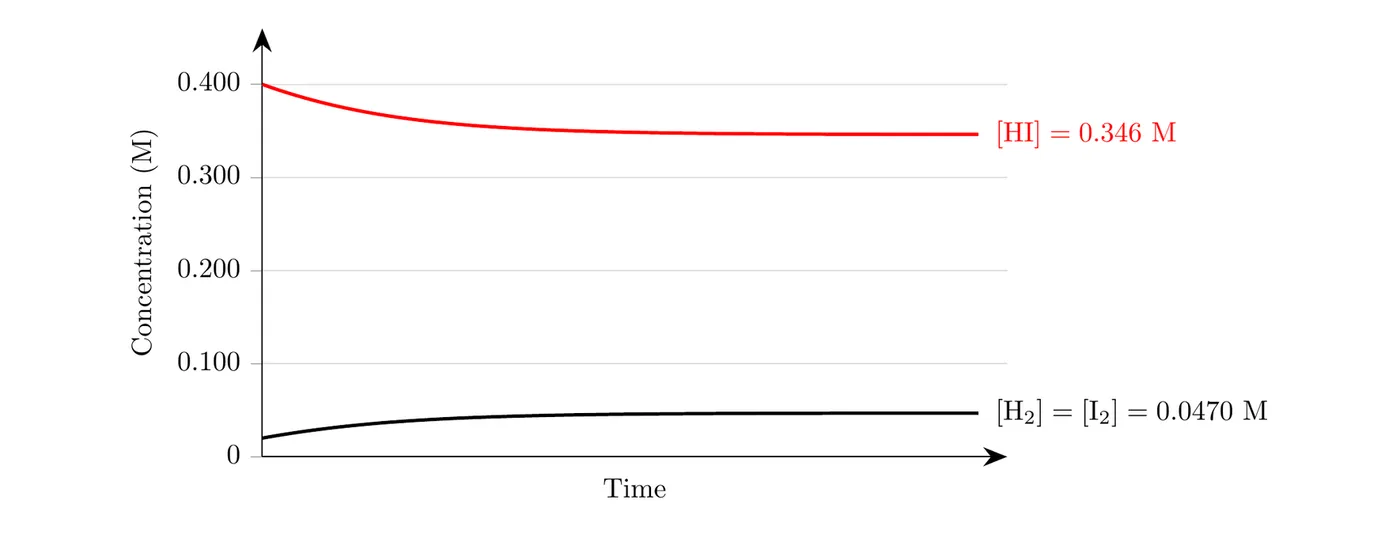
The tiny difference comes from rounding. Because , the reactants went up and the product went down, the opposite of what you might expect from the words "reactant" and "product." The graph shows the concentrations moving to their equilibrium values and leveling off.
When K is small: the small-x approximation
Many equilibrium problems lead to a quadratic (or worse) equation. When K is small, there's a shortcut. A small K means the reaction barely proceeds (Topic 7.5), so is tiny compared with the starting concentration, and you can drop it where it's subtracted from (or added to) a much larger number:
The approximation has to be justified, so always check it afterward with the 5% rule:
If is less than 5% of the starting value, the approximation is fine: the error it adds is smaller than the uncertainty in a typical K value. If not, go back and solve the full equation. A calculator is allowed on the whole AP exam, so solving a quadratic is always an option.
Only drop where it's added to or subtracted from a larger number. Never drop an that stands alone, like the for a product that started at zero; that is the answer you're looking for.
Example 3: The approximation works
Phosgene breaks down into carbon monoxide and chlorine:
At a certain temperature, . (This is the reverse of the phosgene reaction in Topic 7.5, Example 2, so its K is .) A 0.600 L flask starts with 0.300 mol of and nothing else. Find the equilibrium concentrations.
Step 1: Initial concentration and direction. M. No products are present, so and the reaction runs forward.
Step 2: ICE table.
(M) | (M) | (M) | |
Initial | 0.500 | 0 | 0 |
Change | |||
Equilibrium |
Step 3: Approximate. K is tiny, so assume :
Step 4: Check the approximation.
That's far below 5%, so the approximation holds.
Answer: M and M (0.500 minus 0.000010 still rounds to 0.500). As Topic 7.5 predicts for a K this small, the reaction barely proceeds: only about 0.002% of the phosgene breaks down.
Example 4: When the approximation fails (AP-style)
At a certain temperature, for
A rigid container is filled with at a pressure of 1.000 atm and no , then held at that temperature. (This uses pressures and is for a different temperature from the used elsewhere in this unit, so the two numbers don't need to match.)
(a) Which way will the reaction go? No is present, so . The reaction runs forward.
(b) Set up the ICE table. This is , so work in partial pressures (atm). Each that reacts makes 2 .
(atm) | (atm) | |
Initial | 1.000 | 0 |
Change | ||
Equilibrium |
(c) Try the approximation. Assume :
That's well over 5%, so the approximation fails. This makes sense: isn't far below 1, so a lot of reacts.
(d) Solve the quadratic.
Take the positive root. The other root is negative, which would mean a negative pressure.
(e) Check.
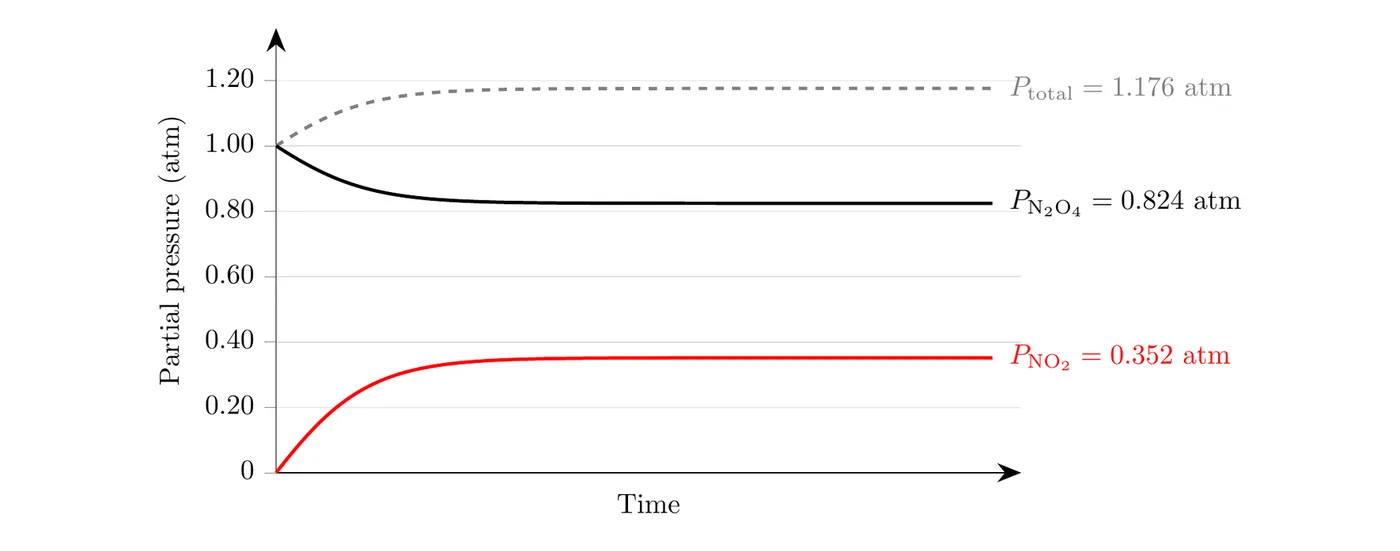
(f) Explain why the total pressure changed. At equilibrium, atm, higher than the starting 1.000 atm. Each molecule that reacts becomes two molecules, so the number of gas particles in the fixed volume goes up. At constant volume and temperature, pressure is proportional to the number of gas particles.
(g) Graph it. The partial pressures change until Q reaches K, then level off. The curve rises twice as much as the curve falls, because of the 1 : 2 ratio in the equation.
Common mistakes
- Plugging moles into the K expression. Use molarity (mol/L) for and partial pressures for .
- Mixing up the direction. means the reaction makes more products (forward). means it makes more reactants (reverse).
- Skipping the Q vs. K comparison when the mixture starts with both reactants and products, and then using the wrong signs in the Change row.
- Forgetting coefficients: a coefficient of 2 means in the Change row and a squared term in the K expression.
- Using the small-x approximation without the 5% check, or dropping an that stands alone.
- Reporting as the answer. is a change; the question usually wants the equilibrium concentrations.
- Thinking that the reactions stop when . They keep running, at equal rates.