

7.9 - Introduction to Le Châtelier's Principle
Overview
A system at equilibrium stays the same only as long as nothing around it changes. Add a chemical, heat it, squeeze it, or dilute it, and the reaction runs forward or backward until it settles at a new equilibrium. Le Châtelier's principle predicts which way it goes without any math, and it explains what you actually see in the lab: a color getting darker, a pH dropping, a solution warming up.
What Le Châtelier's principle says
Le Châtelier's principle: when a system at equilibrium is disturbed, it shifts in the direction that partly undoes the disturbance.
A disturbance is called a stress. These are the four you need to know:
- adding or removing a chemical species
- changing the temperature
- changing the volume (or pressure) of a system of gases
- diluting a reaction mixture in solution
"Shift" is shorthand for which reaction runs faster for a while:
- Shifts right (toward products): the forward reaction temporarily outpaces the reverse reaction, so products build up and reactants are used up.
- Shifts left (toward reactants): the reverse reaction temporarily wins.
Once the two rates are equal again, the system is at a new equilibrium with different concentrations. The shift only partly undoes the stress. The system never returns all the way to where it started.
Adding or removing a substance
Add a substance, and the system shifts to use some of it up. Remove a substance, and the system shifts to make some of it back.
Here's an example at 430 °C:
The graph follows an equilibrium mixture into which extra is suddenly injected, doubling .
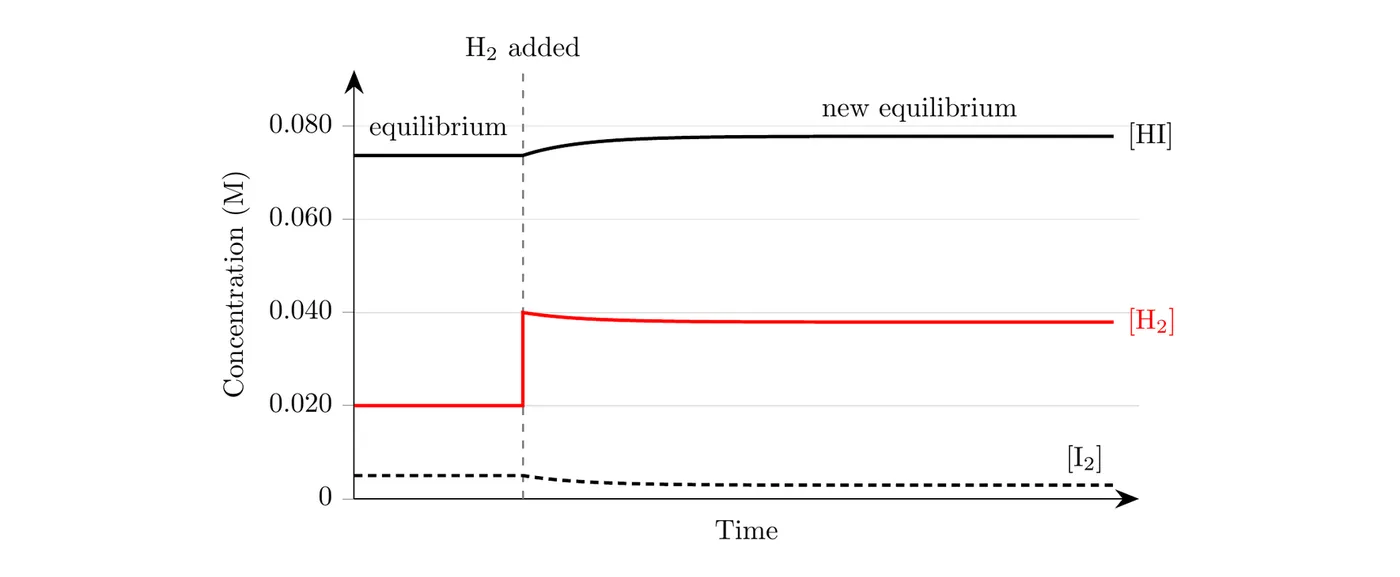
- The vertical jump is the stress. Only jumps, because only was added.
- Then the system shifts right. and fall while rises. They change in a 1 : 1 : 2 ratio, the coefficients of the equation: each time one and one react, two form.
- The new equilibrium has more and less than before. ends up lower than right after the addition (0.0379 M instead of 0.0400 M) but still higher than it started (0.0200 M). The system partly undoes the stress, not all of it.
Pure solids and liquids don't cause shifts
Adding or removing some of a pure solid or pure liquid causes no shift, because neither appears in Q or K (Topic 7.3). Adding to leaves the pressure the same.
Changing the temperature
To predict a temperature shift, write heat into the equation as a reactant or a product, using the sign of :
- Endothermic (): heat is a reactant. Reactants + heat products.
- Exothermic (): heat is a product. Reactants products + heat.
Raising the temperature adds heat, so the system shifts in the direction that absorbs heat: the endothermic direction. Lowering the temperature shifts it in the exothermic direction.
is brown and is colorless. The forward reaction is endothermic, so heating shifts this system right and the gas turns darker brown. Cooling shifts it left and the gas turns pale.
Temperature is the only one of the four stresses that changes the value of K. The others change concentrations but leave K alone. Topic 7.10 shows why that difference matters.
Changing the volume of a gas mixture
Squeezing a gas mixture into a smaller volume raises its pressure. The system responds by shifting toward the side with fewer moles of gas, which brings the pressure partway back down. Expanding the container shifts it toward the side with more moles of gas.
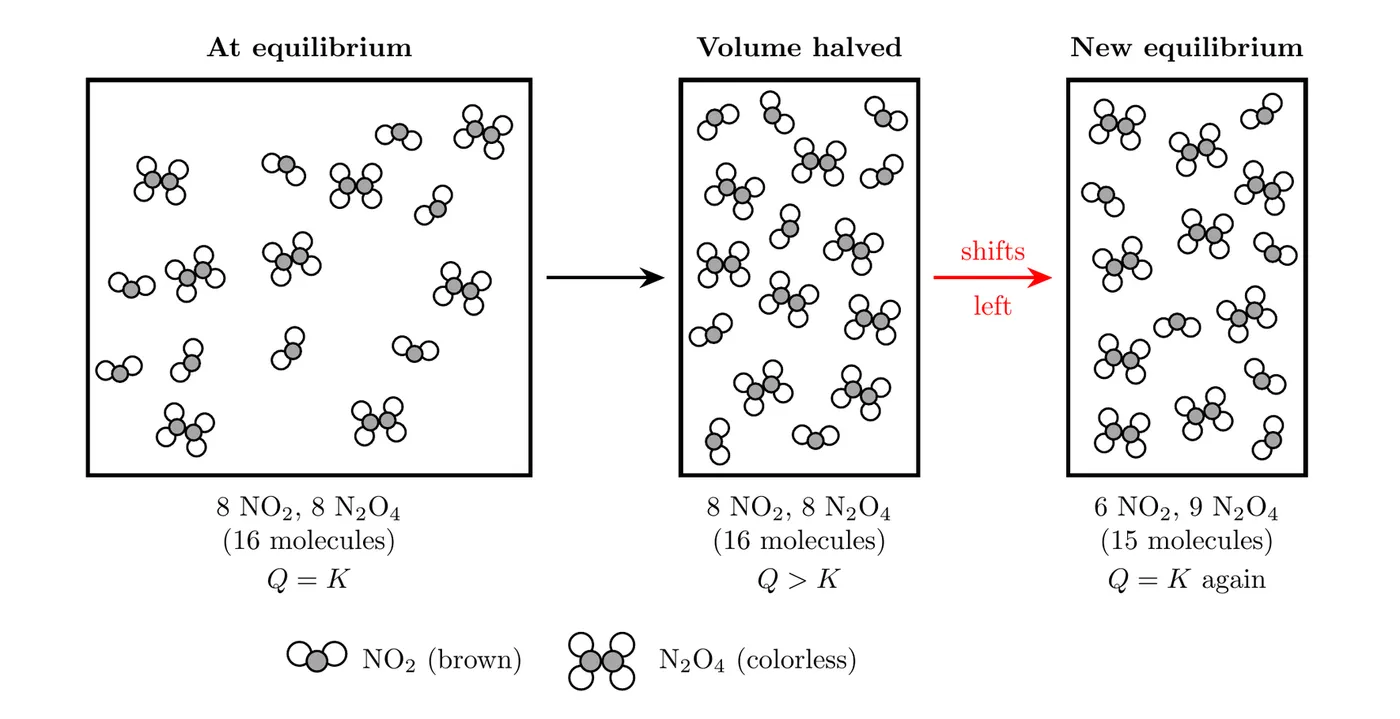
For , the left side has 1 mol of gas and the right side has 2. Halving the volume crowds the same 16 molecules into half the space. The system shifts left: pairs of combine into , and the count drops to 15 molecules. Fewer molecules hitting the walls means a lower pressure than right after the squeeze.
- Same moles of gas on both sides: for (2 mol of gas on each side), changing the volume causes no shift.
- Adding an unreactive gas, like argon, at constant volume: the total pressure rises, but the partial pressures and concentrations of the reacting gases don't change, so there's no shift.
Diluting a solution
Adding water to a solution at equilibrium is the solution version of expanding a gas. The system shifts toward the side with more dissolved particles.
The left side has 2 dissolved ions and the right side has 1, so dilution shifts this system left. The blood-red color of fades even more than dilution alone would cause, because some breaks apart. Water, the solvent, doesn't count as a particle.
Summary of stresses
Stress | Which way the system shifts | Does K change? |
Add a reactant or remove a product | Right | No |
Add a product or remove a reactant | Left | No |
Raise the temperature | In the endothermic direction | Yes |
Lower the temperature | In the exothermic direction | Yes |
Decrease the volume of a gas mixture | Toward fewer moles of gas | No |
Increase the volume of a gas mixture | Toward more moles of gas | No |
Dilute a solution | Toward more dissolved particles | No |
Add a pure solid or liquid, an unreactive gas at constant volume, or a catalyst | No shift | No |
A catalyst speeds up the forward and reverse reactions equally, so the system reaches equilibrium sooner, but the equilibrium amounts don't change.
Example 1: The Haber process
Ammonia is made from nitrogen and hydrogen:
Predict the shift for each change: (a) more is pumped in, (b) is removed as it forms, (c) the temperature is raised, (d) the volume is decreased, (e) argon is added at constant volume, (f) an iron catalyst is added.
- (a) Right. The system uses up some of the added .
- (b) Right. The system makes more to replace what was removed.
- (c) Left. The reaction is exothermic, so heat is a product. Adding heat shifts the system toward reactants, and there's less at the new equilibrium.
- (d) Right. The left side has 4 mol of gas (1 + 3) and the right side has 2. A smaller volume favors fewer moles of gas.
- (e) No shift. Argon doesn't change the partial pressures of , , or .
- (f) No shift. The catalyst only gets the mixture to equilibrium faster.
Seeing the shift in the lab: color, pH, and temperature
You can't watch molecules, so experiments track a property you can measure. Le Châtelier's principle predicts how that property changes:
- Color: if a shift makes more of a colored species, the color deepens. If it uses that species up, the color fades.
- pH: pH measures . More means a lower pH (Unit 8 has the details). A shift that produces (or uses up ) lowers the pH. A shift that uses up (or produces ) raises it. For example, in , a few drops of NaOH remove , so the system shifts left, and the color moves from orange toward yellow (more ).
- Temperature: in an insulated container, a shift in the exothermic direction releases heat, so the thermometer reading goes up. A shift in the endothermic direction absorbs heat, so the temperature goes down.
In the AP lab on Le Châtelier's principle (Investigation 13 in the AP Chemistry Lab Manual), you stress colored equilibrium systems and explain each change the same way: name the stress, predict the shift, and connect the shift to the species that causes the color.
Example 2: A sealed tube of (AP-style)
A sealed glass tube holds an equilibrium mixture of brown and colorless :
In an ice-water bath, the gas turns pale. In hot water, it turns dark brown. (a) Is the forward reaction endothermic or exothermic? Justify your answer with Le Châtelier's principle. (b) The same mixture is in a gas syringe at room temperature. A student quickly pushes the plunger in, halving the volume. The color first gets darker, then lightens a little, but ends up darker than it started. Explain all three observations.
(a) Heating makes the gas darker, so heating shifts the system right, toward . A system shifts in the endothermic direction when it's heated, so the forward reaction is endothermic. Cooling agrees: removing heat shifts the system left, toward colorless . (The measured value is .)
(b)
- Darker right away: halving the volume doubles the concentration of every gas, including . The color you see depends on the concentration of , and this happens before the system has time to shift.
- Then lighter: the left side has 1 mol of gas and the right side has 2, so the system shifts left, toward fewer moles of gas. Some combines into , and the color fades a little.
- Still darker than at the start: the shift only partly undoes the stress. at the new equilibrium is lower than right after the squeeze but higher than before it. Topic 7.10 checks this with numbers.
Common mistakes
- Thinking the system undoes the whole stress. It only partly undoes it. After is added, settles above its original value.
- Treating a temperature change like a concentration change. Only temperature changes K.
- Counting solids, liquids, or the solvent. For a volume change, count only moles of gas. For dilution, count only dissolved particles.
- Saying a catalyst shifts the equilibrium. It doesn't. It only gets the system to equilibrium faster.
- Putting heat on the wrong side. Check the sign of and write heat into the equation before you predict a temperature shift.