

7.3 - Reaction Quotient and Equilibrium Constant
Overview
To describe where a reaction stands, chemists use one number built from the concentrations: the reaction quotient, Q. When the reaction is at equilibrium, Q has a special value called the equilibrium constant, K. This topic shows how to write Q and K for any reaction, the difference between and , and which substances to leave out. Every equilibrium calculation in Units 7 and 8 starts with writing one of these expressions correctly.
The law of mass action
For a general reaction
the law of mass action says the equilibrium concentrations always fit this expression:
- Products go on top, reactants on the bottom.
- Each concentration is raised to the power of its coefficient in the balanced equation.
- The terms are multiplied, not added.
- Square brackets mean molarity (mol/L), and for they are the equilibrium values.
For example, for :
In Topics 7.1 and 7.2, the flasks settled at M and M , so at that temperature. K for a given reaction is constant at a given temperature. On the AP exam, K values are written without units.
The reaction quotient, Q
The reaction quotient has exactly the same form as K, but you can plug in the concentrations at any moment, not just at equilibrium:
- Q describes the mixture right now. It changes as the reaction proceeds. K is one fixed number for the reaction at that temperature.
- Q tends toward K. As a system approaches equilibrium, Q gets closer and closer to K. At equilibrium, .
- Two special cases. With only reactants present, . With only products present, Q has zero in the denominator, so it's undefined (think of it as huge).
The graph shows over time for the two flasks from Topic 7.2. Starting with only , starts at 0 and rises. Starting with only , starts off the top of the graph and falls. Both level off at .
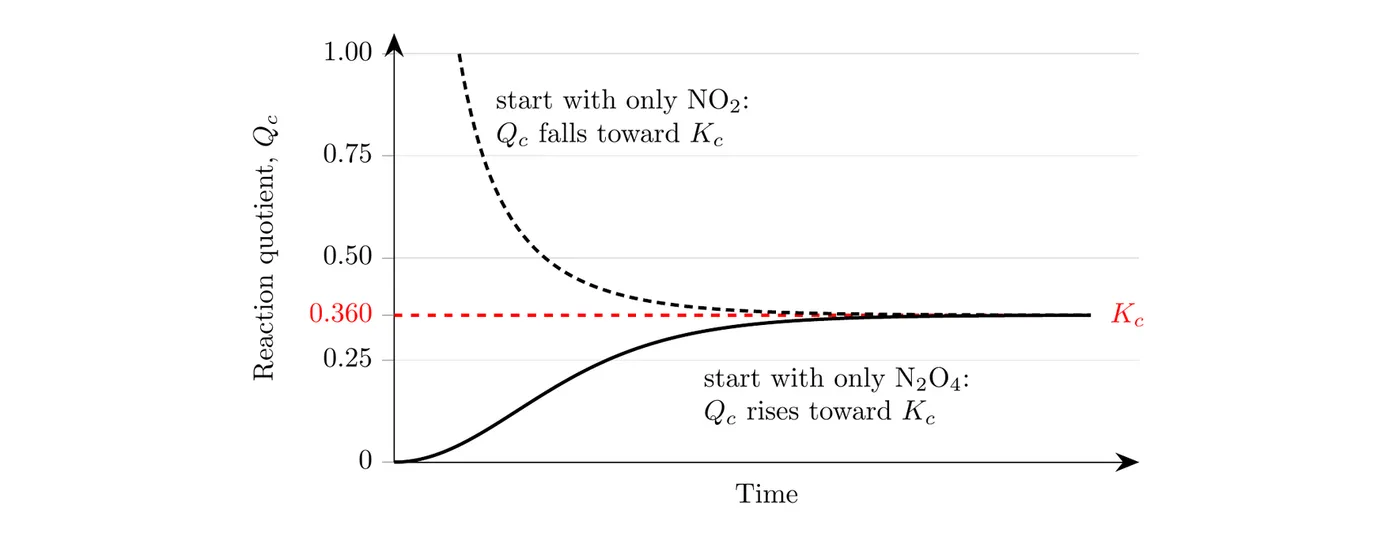
Comparing Q with K tells you which way a reaction will go to reach equilibrium. You'll use this in Topics 7.7 and 7.10.
Example 1: Calculating Q as a reaction proceeds (AP-style)
For , at a certain temperature. A flask that started with only is checked at two moments: at time A, M and M; at time B, M and M. (a) Calculate at each time. (b) Is the system at equilibrium at either time? (c) Describe how changes from time A onward. (d) A student calculates at time A. What mistake did the student make?
(a)
(b) No. Neither value equals .
(c) is below and rising: 0.0514, then 0.200. It keeps rising toward 0.360 and then stays there, like the solid curve in the graph above. A rising means is going up and is going down, so the net reaction is forward.
(d) The student used and forgot to square . The coefficient 2 in the balanced equation becomes an exponent.
Kc and Kp
For reactions involving gases, you can use partial pressures (in atm) instead of concentrations. This gives (and for any moment):
Both and are on the AP reference sheet.
(and ) | (and ) | |
What you plug in | Molar concentrations, [X], in M | Partial pressures, , in atm |
Which species appear | Gases and aqueous species | Gases only |
Typical use | Reactions in solution, or gas reactions | Gas reactions |
How they're related. For a gas, the ideal gas law rearranges to
So at constant temperature, a gas's partial pressure is proportional to its concentration. and describe the same equilibrium, but their numbers are usually different, because every concentration term picks up a factor of . They are equal only when both sides of the equation have the same total moles of gas, as in .
What the AP exam expects. You won't be asked to convert between and . You do need to notice which one a question gives you and use matching quantities: molarities with , partial pressures with , never a mix of the two.
The exam also won't ask for equilibrium calculations on a dissolved substance in equilibrium with its own gas, like in a sealed soda.
Example 2: Writing Kc and Kp for a gas reaction
Write and for the reaction
Everything is a gas (including the water), so every species appears, each raised to its coefficient:
There are 9 moles of gas on the left and 10 on the right, so and have different values for this reaction.
Leave out pure solids and pure liquids
Q and K do not include substances whose concentration doesn't depend on how much of them there is. That means pure solids and pure liquids.
Why: the "concentration" of a pure solid is the moles of solid divided by the volume of the solid itself. That equals its density divided by its molar mass, which is fixed. Doubling the amount of solid doubles both the moles and the volume, so the ratio doesn't change. The same goes for a pure liquid. Since these values never change, they're built into K instead of written in the expression.
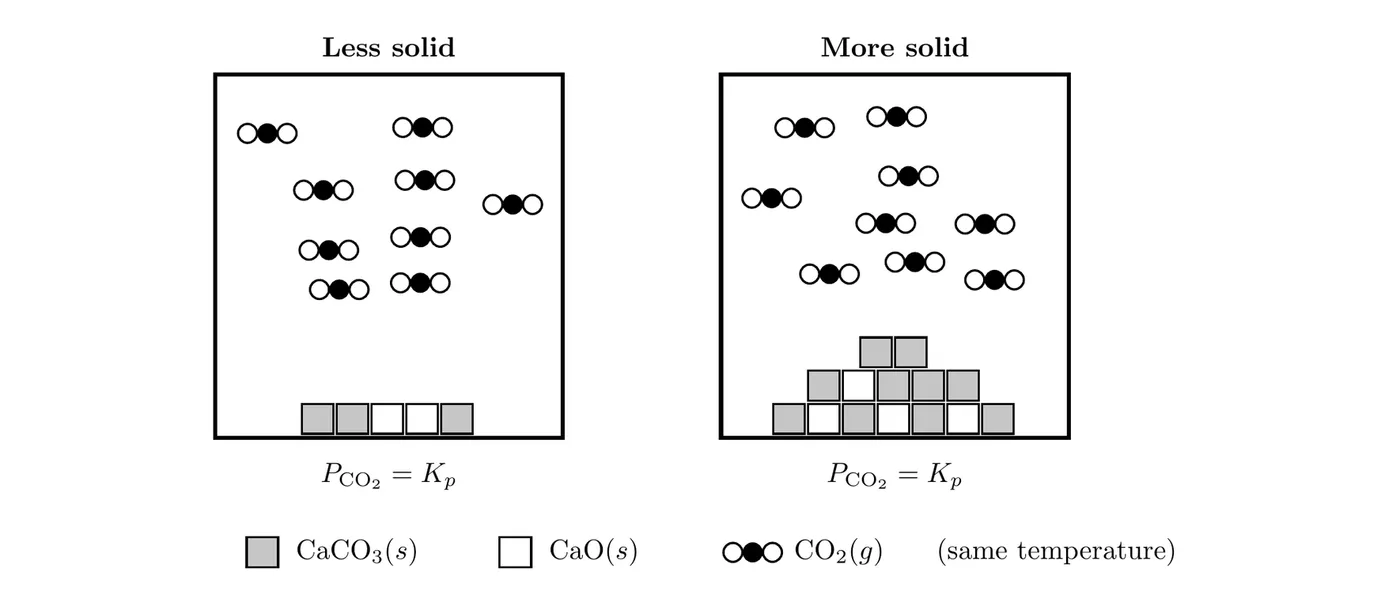
Calcium carbonate decomposing in a sealed container shows this:
At a given temperature, the pressure of at equilibrium is the same whether there's a little solid or a lot, as long as both solids are present.
Water. When water is the solvent, as in most aqueous reactions, is left out: it's nearly pure, and its concentration barely changes. But is a gas, so it is included. Dissolved species, (aq), are always included. Check every phase label before you write an expression.
Reaction | Expression | Why it looks that way |
Liquid left out; K is the vapor pressure from Topic 7.1 | ||
Solids left out; water is a gas here | ||
Water is the solvent, so it's left out | ||
Redox: only the ions appear | ||
No denominator left (Topic 7.11 calls this ) |
Example 3: Expressions with solids, liquids, and ions
Write the expression for each reaction.
(a)
Carbon is a solid, so it's left out. Water is a gas here, so it stays.
(b)
Liquid water is the solvent, so it's left out. (Unit 8 calls this .)
(c)
(d)
All three species are dissolved ions, so all three appear. Topic 7.4 measures this K in the lab.
Common mistakes
- Using coefficients as multipliers. is wrong; is right.
- Adding terms, or flipping the fraction. Multiply the terms, with products on top.
- Including solids, pure liquids, or solvent water. Leave them out, but keep and every (aq) species.
- Mixing pressures and concentrations in one expression. Use all molarities for or all partial pressures for .
- Plugging starting concentrations into K. Starting values give Q. K uses equilibrium values only.
- Assuming . That's only true when the total moles of gas are the same on both sides.