

7.5 - Magnitude of the Equilibrium Constant
Overview
Every equilibrium constant is a ratio, with products on top and reactants on the bottom. That makes the size of K a quick read on what the equilibrium mixture looks like. A huge K means the reaction runs essentially to completion, a tiny K means it barely gets started, and a K near 1 means you'll find plenty of both. On the AP exam, reading K this way tells you what to expect before you calculate anything, and which shortcut to use when you do.
What the size of K tells you
For the general reaction , the equilibrium expression from Topic 7.3 is
The numerator holds the products and the denominator holds the reactants, each measured at equilibrium. (For , use partial pressures instead. The reasoning is the same.)
- K much greater than 1: the numerator is much bigger than the denominator, so the equilibrium mixture is mostly products. The reaction is product-favored. When K is very large, the reaction goes essentially to completion: so little reactant is left that, for most purposes, you can treat it as zero.
- K much less than 1: the denominator wins, so the equilibrium mixture is mostly reactants. The reaction is reactant-favored. When K is very small, the reaction barely proceeds, and only a trace of product forms.
- K close to 1: neither side dominates, and the equilibrium mixture has significant amounts of both reactants and products.
There's no official cutoff for "very large" or "very small." A common rule of thumb: K above about means essentially complete, and K below about means the reaction barely proceeds.
Seeing it in a one-to-one reaction
The cleanest case is a reaction with one reactant particle and one product particle, , where . Here K is literally the ratio of product to reactant at equilibrium. If you start with pure A, the fraction that ends up as B is :
K | [B] : [A] at equilibrium | Percent of A converted to B |
1 : 1,000 | about 0.1% | |
1 : 10 | about 9% | |
1 | 1 : 1 | 50% |
10 | 10 : 1 | about 91% |
1,000 : 1 | about 99.9% |
Notice how lopsided it gets. At , only about 1 molecule in 1,000 is still A. At , it's 1 in 10 billion. The graphs show three such reactions, each starting with 1.00 M A and no B.
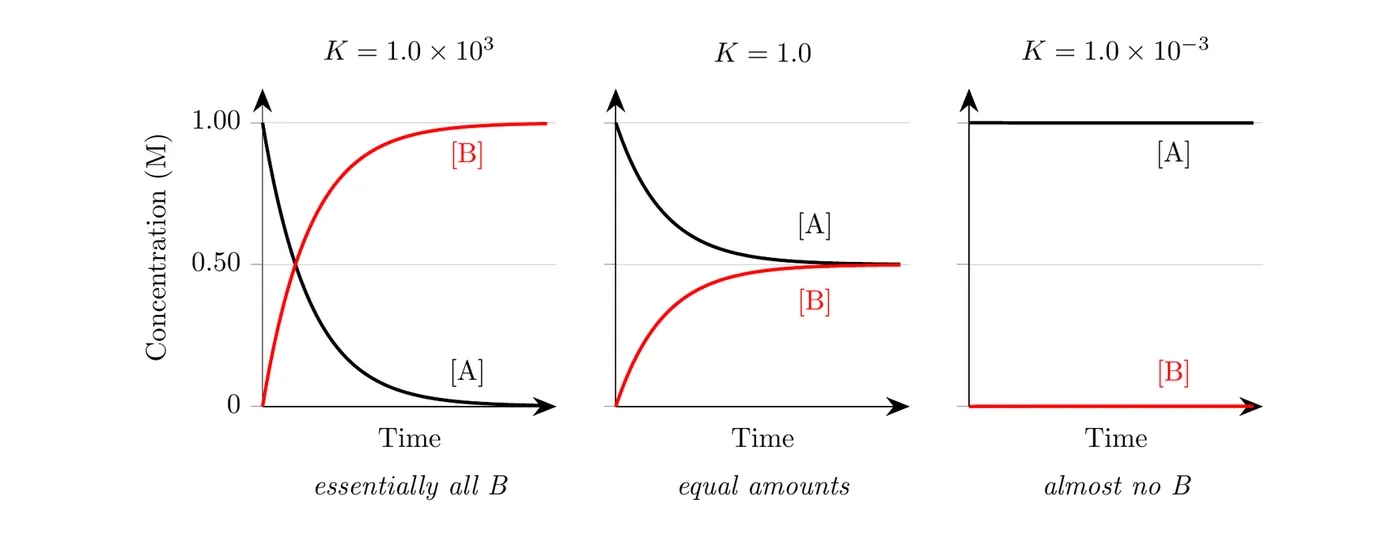
All three reactions reach equilibrium, and then their concentrations stop changing. What differs is where they stop: almost all the way to B, halfway, or barely past the start.
Example 1: Reading K values
Three different reactions, each of the form , reach equilibrium at the same temperature. Reaction 1 has , reaction 2 has , and reaction 3 has . Each flask starts with pure A.
(a) Which reaction goes essentially to completion, and which barely proceeds? Reaction 1 goes essentially to completion, because its K is far above . Reaction 3 barely proceeds, because its K is far below . Reaction 2 ends with significant amounts of both A and B.
(b) What is the ratio [B]/[A] at equilibrium in each? It's just K. Reaction 1 has 350,000 molecules of B for every molecule of A. Reaction 3 has 2 molecules of B for every million molecules of A.
(c) What percent of A is converted in reaction 2?
Real reactions span a huge range
Measured K values run from far below to far above . A few examples at 25 °C:
Reaction | K at 25 °C | What you find at equilibrium |
Essentially all water | ||
Essentially all HCl | ||
Neutralization goes to completion | ||
Both gases present | ||
Mostly un-ionized acetic acid | ||
Almost none of the solid dissolves | ||
Almost every water molecule intact | ||
Essentially no NO |
You'll meet in Topic 7.11 and and in Unit 8. They're all equilibrium constants, so everything on this page applies to them. The last row explains why the air around you, about 78% nitrogen and 21% oxygen, doesn't turn into nitrogen monoxide: K is so small that essentially none forms at room temperature.
Very large K: treat it like stoichiometry
When K is very large, assume the reaction goes to completion, just like a limiting-reactant problem from Topic 4.5. Then, if the question asks for it, use K to find the tiny amount of the limiting reactant that's still there. This is easy to miss: students often set up a long equilibrium calculation and get the product concentration wrong, when the large K is telling them the reaction is basically finished.
- Find the limiting reactant and let it react completely. This gives you the product concentrations and the leftover excess reactant.
- Let a small amount of product go back to reactants. Because K is huge, is tiny, so it doesn't change the large concentrations.
- Solve the K expression for , which is the concentration of the limiting reactant at equilibrium.
Example 2: A reaction that goes essentially to completion (AP-style)
Carbon monoxide and chlorine combine to form phosgene, :
At a certain temperature, . A 2.00 L flask is filled with 0.400 mol of CO and 0.300 mol of and held at that temperature until it reaches equilibrium.
(a) Starting concentrations.
(b) Explain why you can treat the reaction as complete. is very large (), so at equilibrium the ratio of product to reactants is enormous. Nearly all of the limiting reactant must end up as product. The reactants combine 1 : 1, so (0.150 M) runs out before CO (0.200 M): is the limiting reactant.
(c) Let it react completely, then back off by x.
(M) | (M) | (M) | |
Initial | 0.200 | 0.150 | 0 |
After reacting completely | 0.050 | 0 | 0.150 |
Change (back off) | |||
Equilibrium |
(d) Solve for the chlorine that's left.
At equilibrium: M, M, and M. The chlorine isn't literally zero, but it's less than a billionth of a mole per liter, so the reaction is complete for any practical purpose.
(e) Check. is far too small to change 0.050 or 0.150, so dropping it in those terms was fine. Substituting back: , which matches .
Very small K: almost nothing happens
When K is very small, the opposite shortcut works. So little reactant turns into product that the reactant concentrations barely change. Topic 7.7 turns this into the small-x approximation, along with a check that tells you whether it's allowed.
Example 3: How much does water ionize?
Water molecules transfer protons to each other:
Water is a pure liquid, so it's left out of the expression (Topic 7.3). In pure water, the two ions form in a 1 : 1 ratio, so call each concentration :
Compare that with the concentration of water itself. A liter of water has a mass of about g, and the molar mass of water is g/mol:
Only about 2 of every billion water molecules have handed off a proton at any moment. That's what a K of looks like: the reaction really does happen (pure water conducts electricity very slightly), but it barely proceeds.
K tells you how far, not how fast
K describes the equilibrium state, the place a reaction ends up. It says nothing about how long the reaction takes to get there. Speed is kinetics (Unit 5), and it depends on the activation energy, not on K.
A catalyst speeds up the forward and reverse reactions equally. It helps a system reach equilibrium sooner, but it doesn't change K or the equilibrium composition.
Example 4: Evaluating a claim (AP-style)
A student seals hydrogen and oxygen gas in a steel container at 25 °C. A week later, no water has formed. The student claims: "This reaction must have a small K, because almost no product formed." Evaluate the claim.
Answer: The claim is incorrect. For , , so at equilibrium the mixture would be almost entirely water. The container simply isn't at equilibrium: with almost no product, , far below K (Topic 7.7). The reaction is just extremely slow at 25 °C because its activation energy is high, so almost no collisions succeed. The observation is evidence about the rate, not about K. A spark or a platinum catalyst gets the reaction going (with a spark, explosively), and the system then heads to its equilibrium, which lies almost entirely on the product side.
K depends on the equation and the temperature
K also changes with temperature (Topic 7.10) and with the way the equation is written (Topic 7.6). Reversing an equation turns K into , so the breakdown of phosgene, the reverse of Example 2, has . A very large K one way is a very small K the other way.
Common mistakes
- Thinking a large K means a fast reaction. K tells you how far a reaction goes, not how fast.
- Thinking a small K means no product at all. Some product always forms; there's just very little of it.
- Setting up a full equilibrium calculation when K is huge. Let the reaction go to completion first, then use K to find the trace of leftover reactant.
- Assuming means equal concentrations of everything. That's only true for a one-to-one reaction like .
- Comparing K values of reactions with different forms as if they were percentages. Comparisons are safest between reactions of the same type, like the values of two acids.
- Forgetting that a K value belongs to one temperature and one way of writing the equation.