

7.11 - Introduction to Solubility Equilibria
Overview
When you stir an ionic solid into water, it doesn't simply dissolve or not dissolve. It dissolves until the solution is saturated, and from then on, dissolving and precipitating happen at the same rate. That's an equilibrium, and its equilibrium constant is the solubility-product constant, . In this topic you'll write expressions, calculate solubility from and from solubility, and use to compare salts.
Dissolving is a reversible process
Put excess lead(II) iodide in water. and ions leave the surface of the solid and spread through the water. As their concentrations build up, dissolved ions hit the solid and stick back onto it more and more often. Eventually the two rates are equal:
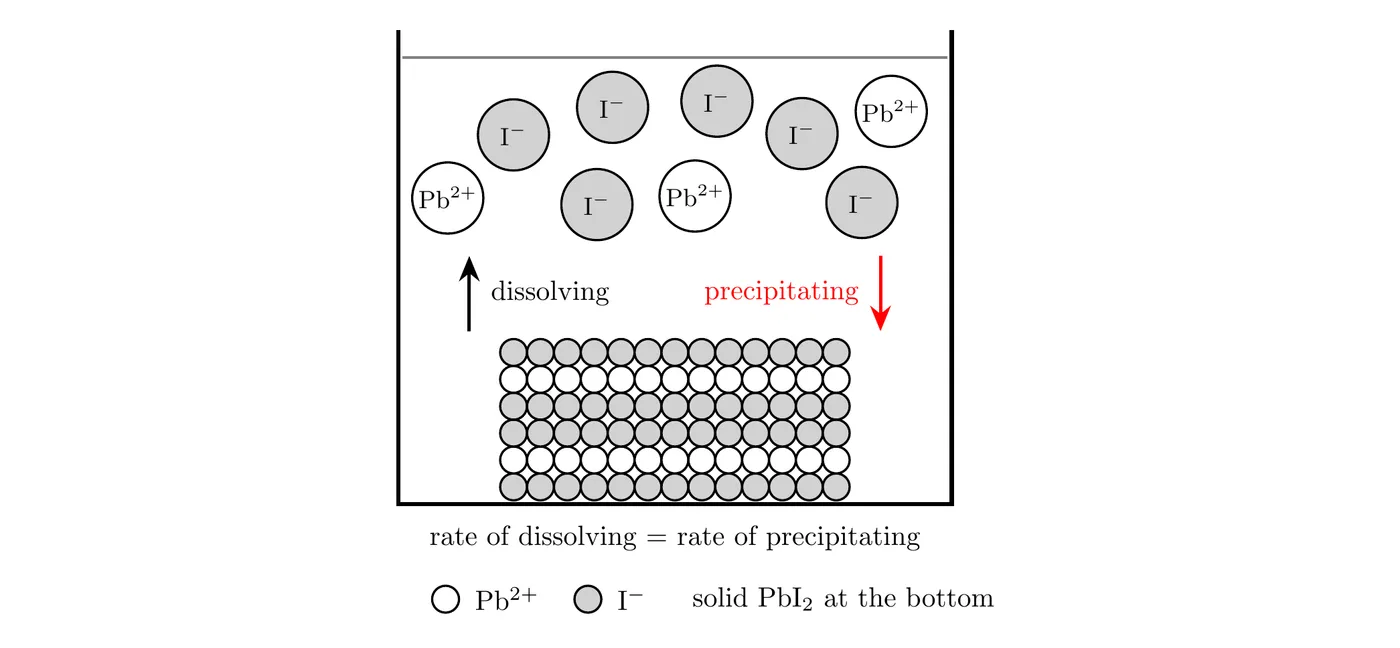
This is a saturated solution: it holds as much dissolved salt as it can at that temperature, with some solid left over. Ions keep dissolving and precipitating, but their concentrations stay constant. The dissolved ions are in a 1 : 2 ratio, the same ratio as in the formula .
The equilibrium constant for dissolving a salt is written like any other K. The solid is left out (pure solids never appear in Q or K), so only the ions remain, each raised to its coefficient:
describes the extent of dissolving: the larger is, the more of the salt dissolves before equilibrium is reached, as long as you compare salts with the same formula type (see below).
Salt | Dissolution equation | expression |
Polyatomic ions stay together when a salt dissolves: chromate stays and phosphate stays .
Molar solubility and
Molar solubility, , is the number of moles of a salt that dissolve per liter to make a saturated solution, in mol/L (M). Each mole that dissolves releases ions in the formula ratio, so every ion concentration can be written in terms of . For , = and = :
Formula type | Example | Ion concentrations | in terms of |
AB | and | ||
or | , | and | |
and | |||
and |
Don't memorize the last column. Write each ion concentration in terms of and substitute, every time. To get the solubility in grams per liter, multiply by the molar mass, .
The values in these notes are 25 °C values from the CRC Handbook of Chemistry and Physics. Tables in different books differ slightly, so on the exam, always use the value you're given.
Example 1: Silver bromide, a 1 : 1 salt
for is at 25 °C. Calculate its molar solubility and its solubility in grams per liter.
Step 1: Each formula unit gives one and one , so = = :
Step 2: Solve for :
Step 3: Convert to grams per liter with g/mol:
Answer: The molar solubility is M. Only about 0.14 mg of dissolves in a liter of water.
Example 2: Lead(II) iodide, a 1 : 2 salt
for is . Find its molar solubility and the concentration of each ion in a saturated solution.
Step 1: = and = :
Step 2: Divide by 4, then take the cube root:
Step 3: = = M and = = M. (Double the unrounded value, , then round.)
The 2 goes inside the parentheses because is , and then the whole thing is squared: , not .
Comparing the solubility of different salts
ranks salts by solubility directly only when they have the same formula type (the same number of ions per formula unit). , , and are all AB salts, and their values are , , and . So the solubility order is > > .
When the formula types differ, the expressions have different exponents, so calculate for each salt and compare those.
Example 3: versus
for is , and for is . Which salt has the greater molar solubility in water?
Answer: is about 5 times more soluble, even though its is more than 100 times smaller. Its is cubed in the expression, so a small still gives a fairly large .
and the solubility rules
Unit 4 had one solubility rule to know: all sodium, potassium, ammonium, and nitrate salts are soluble in water (Topic 4.7). puts numbers on the words "soluble" and "insoluble":
- > 1: soluble. The ion concentrations have to get large before the solution is saturated, so a lot of the salt dissolves. For , (calculated from thermodynamic data) is about 38.
- much less than 1: insoluble (more precisely, sparingly soluble). Only a tiny amount dissolves. 's molar solubility of M works out to about 1.9 mg per liter.
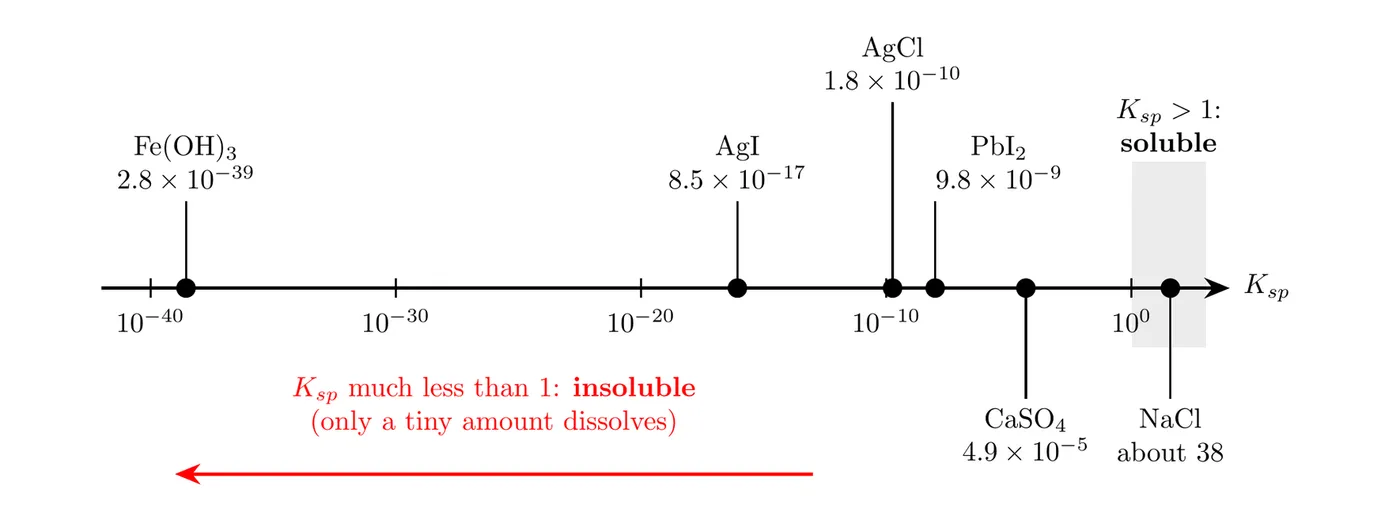
values span more than 40 powers of ten, so two "insoluble" salts can still differ enormously.
Finding from molar solubility
The reverse calculation is a common lab task: measure how much of a salt is dissolved in a saturated solution, then calculate . Convert the measurement to molar solubility, write each ion concentration in terms of , and substitute into the expression.
Example 4: of calcium fluoride from lab data (AP-style)
A student stirs excess in distilled water at 25 °C until no more dissolves, then filters the mixture. She evaporates 1.000 L of the clear filtrate to dryness and collects 0.0160 g of . (a) Calculate the molar solubility of . (b) Calculate . (c) Some fine particles passed through the filter paper. Is the calculated too high or too low? Explain.
(a) Use g/mol, and keep one extra digit until the end:
(b) = = M and = = M:
That matches the table value, , within rounding.
(c) Too high. The extra particles add mass to the residue, so the measured solubility is too high. Since , the error in gets cubed, so even a small error in the mass makes a bigger error in .
Will a precipitate form?
To predict whether mixing two solutions forms a precipitate, calculate Q for the dissolution, written just like but using the ion concentrations right after mixing, and compare it with :
- : more ions than a saturated solution can hold, so solid precipitates until .
- : unsaturated, so no precipitate forms.
- : exactly saturated.
Example 5: Silver nitrate in tap water
A student adds 1.00 mL of 0.0100 M to 99.0 mL of tap water that contains M . Does precipitate? ()
Step 1: Find each concentration in the mixed solution (total volume 100.0 mL):
Step 2: Calculate Q and compare:
Answer: , so precipitates and the solution turns cloudy. That's why silver nitrate solutions are always made with distilled water.
Common mistakes
- Including the solid in . The expression has only the ions.
- Forgetting the coefficient inside the parentheses. For , = , so the term is .
- Comparing values across different formula types. Compare directly only for salts with the same number of ions. Otherwise, calculate .
- Mixing up and an ion concentration. In saturated , = , but = .
- Forgetting dilution when two solutions are mixed. Find the new concentrations in the total volume before you calculate Q.