

1.1 - What Is African American Studies?
What Makes African American Studies Distinct
African American Studies isn't just history class with a different name. It blends multiple disciplines together (history, literature, sociology, political science, the arts, and more) with real scholarly rigor to study the history, culture, and contributions of people of African descent, both in the United States and across the wider African diaspora.
Here's the thing though: the field didn't start in a classroom. It grew out of Black artistic, intellectual, and political work that was happening long before anyone formalized it into a college subject. That's why the discipline gives you a useful lens for understanding Black freedom struggles both inside and outside of academia, because the ideas came from real movements first and got institutionalized later.
You can see this in the decades before the first Black Studies departments. In 1915, historian Carter G. Woodson co-founded the Association for the Study of Negro Life and History to research and publish Black history, and in 1926 he launched Negro History Week, which later grew into Black History Month (Topic 3.15). Black writers, artists, and activists were doing this kind of work outside universities too. So when Black Studies departments appeared in the late 1960s, they built on a long tradition instead of starting from zero.
The field also digs into how ideas about Africa's history have developed over time, and how the continent continues to connect to Black communities around the world today.
How African American Studies Got Into Colleges
The 1960s and 70s were a turning point. As the Civil Rights Movement was winding down and the Black Power Movement was picking up steam, Black students started enrolling at predominantly white colleges and universities in numbers America had never seen before.
Part of the reason was civil rights victories that opened doors that had been closed, and part was that many colleges started recruiting Black students and offering more financial aid in the mid to late 1960s. Before this, most Black college students attended historically Black colleges and universities (HBCUs).
Once they were on campus, a lot of these students noticed something missing: their own history and culture were barely represented in what they were being taught. That frustration fueled the Black Campus Movement, which ran roughly from 1965 to 1972. During this stretch, hundreds of thousands of Black students, joined by Latino, Asian, and white supporters, organized protests at more than 1,000 colleges across the country. Their demands were pretty consistent: more opportunities to actually study Black history and experience, and more support for Black students, faculty, and administrators on campus.
That's the direct line from protest to program. The photo of the San Francisco State strike is basically a snapshot of this exact moment in action.
How African American Studies Reframes Early Africa
One of the field's biggest contributions is correcting the record on early Africa. Africa is where humanity began, and it's the ancestral home of African Americans. African American Studies looks closely at early African societies and their achievements across art, architecture, technology, politics, religion, and music. That long history of innovation still shapes how African Americans understand their identity and experience today.
This matters because there's a persistent myth that early Africa is somehow undocumented or unknowable, basically a blank spot in history. Interdisciplinary research in this field pushes back hard against that idea. It shows early Africa as a diverse continent full of complex, sophisticated societies that made real, lasting contributions to the world, and these societies were already globally connected well before the transatlantic slave trade ever began.
Big Picture
African American Studies exists because people demanded it exist. It came out of Black intellectual and political traditions long before it had a name, got pushed into universities through organized student activism in the 60s and 70s, and eventually formalized into its own academic discipline complete with departments, courses, and conferences. At its core, the field does two things at once: it uses rigorous, interdisciplinary methods to study the Black experience in America and across the diaspora, and it corrects the historical record on Africa itself, replacing myths of an unknowable past with evidence of complex, globally connected societies.
Required Sources
This topic comes with three required sources, and each one gives you a window into how African American Studies actually came to exist as a college subject.
Photo of the Black Student Union Strike for Black Studies at San Francisco State College, 1968
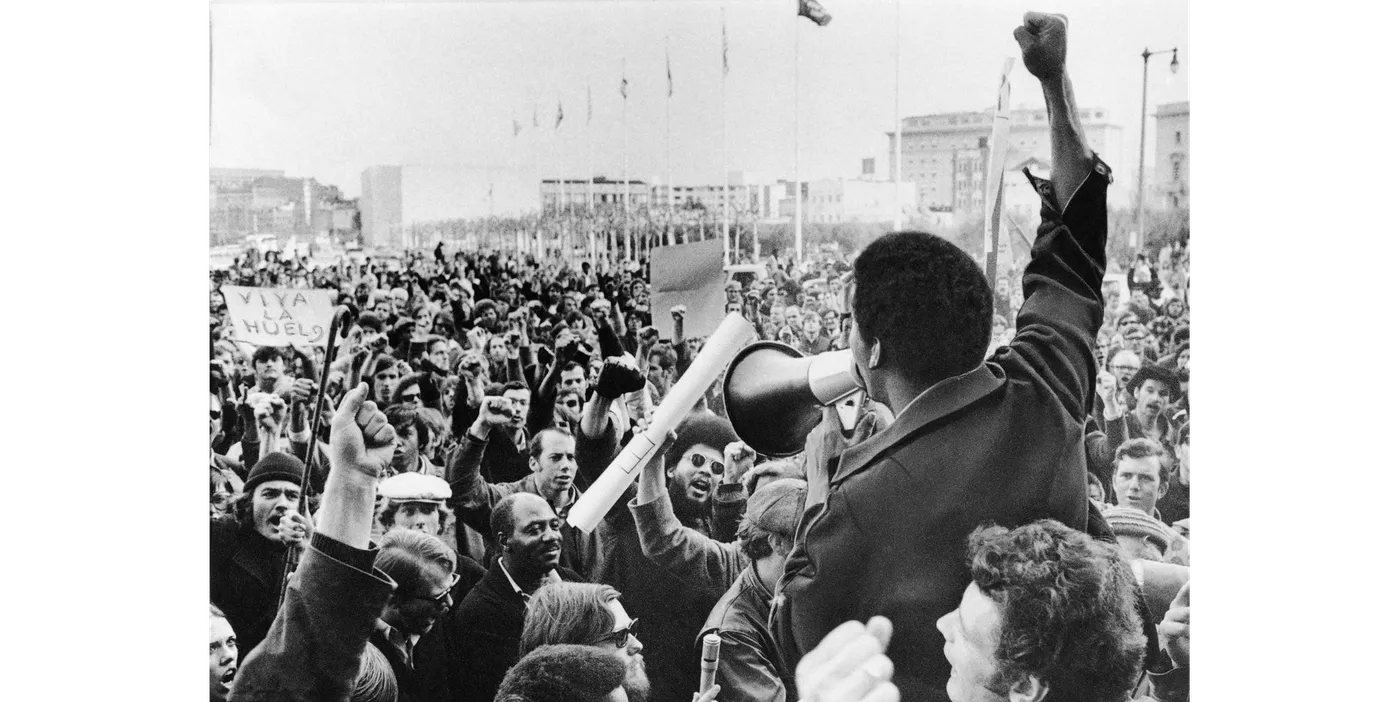
This photo, from the Associated Press, shows a rally during the San Francisco State strike. A Black speaker talks through a bullhorn with his fist raised, and the crowd in front of him is racially mixed, with one sign reading "Viva la Huelga" (Spanish for "Long live the strike"). The strike began on November 6, 1968, led by the Black Student Union and the Third World Liberation Front, a coalition of student groups of color that included Latino and Asian American students. It lasted until March 1969, one of the longest student strikes in U.S. history, and it ended with the college agreeing to create a College of Ethnic Studies. San Francisco State also became home to the first Black Studies department at a four-year college. The photo captures the Black Campus Movement (1965 to 1972) in a single picture: Black students demanding the chance to study Black history and real support on campus, with Latino, Asian, and white allies standing with them.
Schedule of Courses for Black and Puerto Rican Studies, Hunter College, 1972
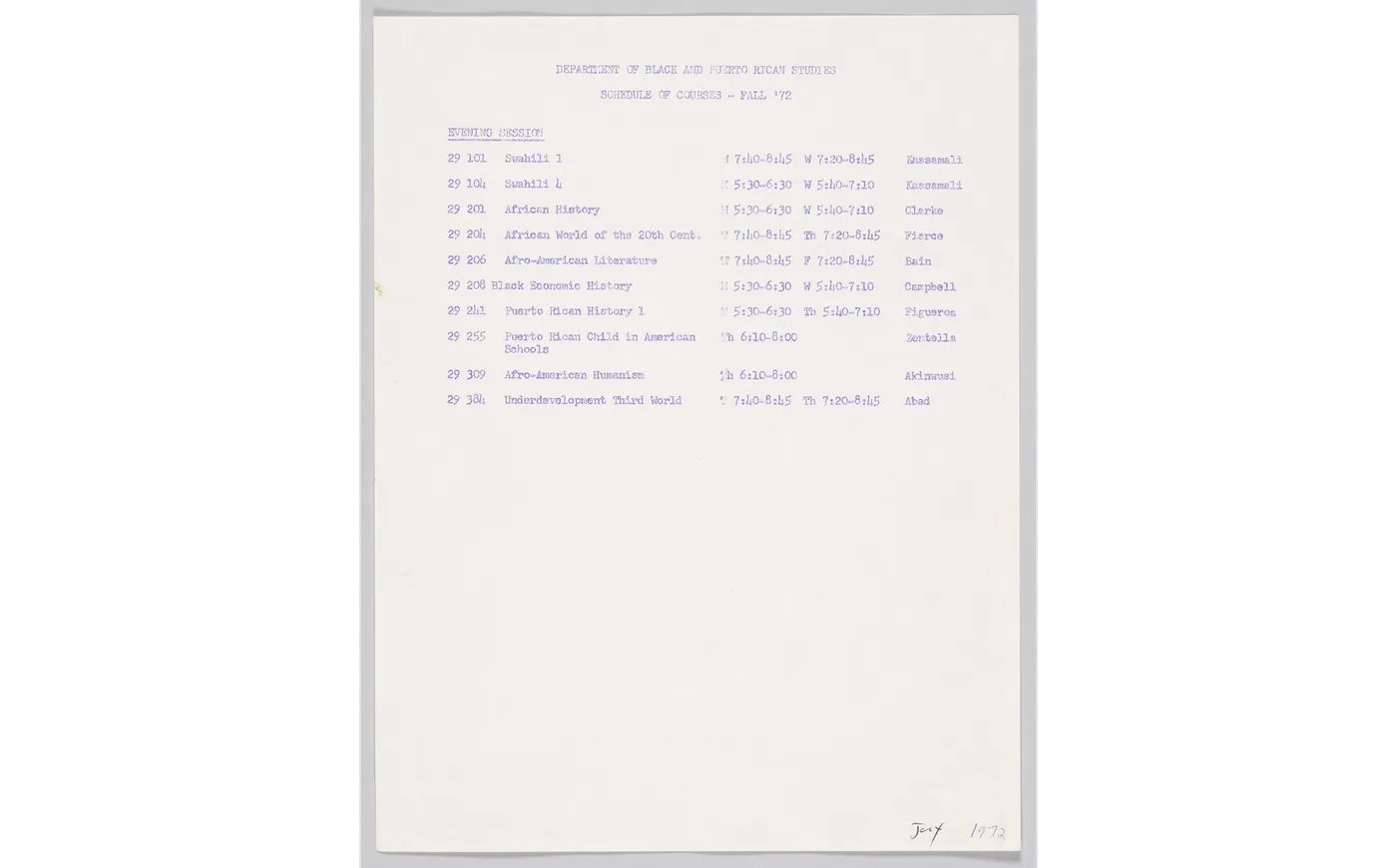
This course schedule shows what it looked like once student activism actually turned into something concrete: real classes, with real names and real credit hours, built around Black and Puerto Rican history and culture. It's proof that the protests worked. Demands turned into departments, and departments turned into course catalogs.
Look at what's actually on this list for the fall 1972 evening session: Swahili, African History, African World of the 20th Century, Afro-American Literature, Black Economic History, Puerto Rican History, Puerto Rican Child in American Schools, and Underdevelopment Third World. That's the interdisciplinary approach in action, with language, history, literature, economics, and education in one department. Several courses focus on Africa itself, which shows the field studying Black communities in the U.S. alongside Africa and the wider diaspora. Hunter is a public college in New York City, where Black and Puerto Rican students pushed for these fields together, which is why the department combined them. Offering classes at night also made them available to students who worked during the day.
Program for the First National Council for Black Studies Annual Conference, 1975
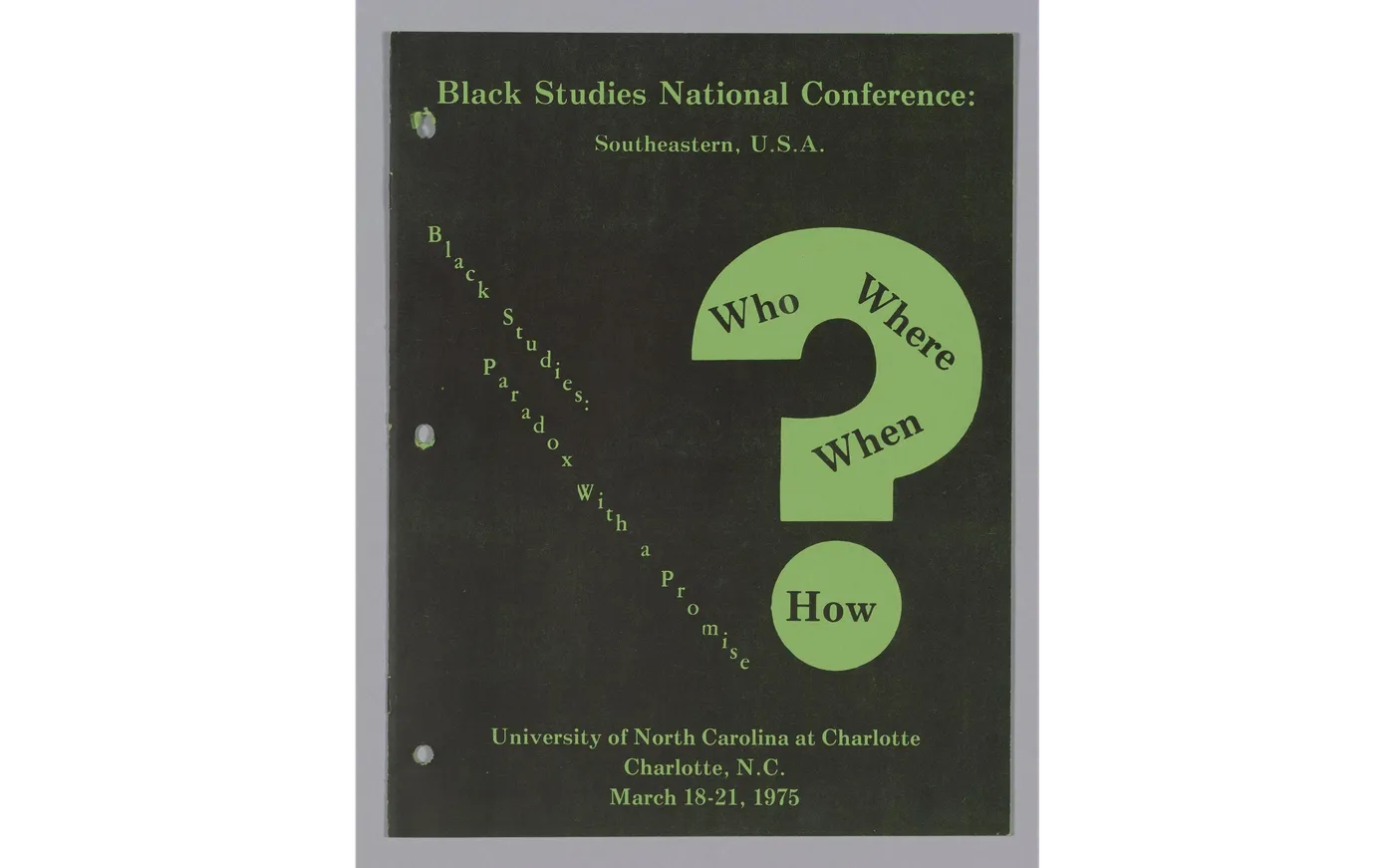
By 1975, Black Studies wasn't just scattered course offerings anymore, it had become an organized academic field with its own national conference. This program represents the formalization stage: scholars and educators coming together to treat the discipline seriously, set standards, and build it into something lasting.
The program's cover reads "Black Studies National Conference: Southeastern, U.S.A." with the theme "Black Studies: Paradox with a Promise." The meeting took place at the University of North Carolina at Charlotte on March 18 to 21, 1975, and it was where scholars began organizing the National Council for Black Studies (NCBS), which became the field's main professional organization. The program was donated to the Smithsonian by Dr. Bertha Maxwell Roddey, the founding director of UNC Charlotte's Black Studies program and a co-founder of NCBS. The giant question mark on the cover, with the words Who, Where, When, and How, sums up the moment: the field existed, but scholars were still working out what it should look like and how to make it last.