

1.7 - Indigenous Cosmologies and Religious Syncretism
How Syncretism Developed in Africa
When leaders in some African societies adopted outside religions, like Islam in Mali and Songhai, or Christianity in Kongo, it didn't mean their communities abandoned their own spiritual traditions overnight. Instead, people often blended these newly introduced faiths with their existing Indigenous beliefs and cosmologies. This blending of traditions is called religious syncretism, and it became a defining feature of religious life in these regions.
Cosmology means a people's understanding of how the universe is organized and how the human world connects to the spiritual world. In Yoruba cosmology, for example, there's a supreme creator, Olodumare, and many orishas, deities who each govern parts of life and act as go-betweens for people (Shango, for instance, rules thunder and lightning). Ancestors also stay involved in the lives of the living. A system like this already had room for many spiritual beings, so people could add a new faith's saints or practices without throwing the old beliefs out. In Kongo, Christian crucifixes were made in local styles (see the Triple Crucifix in Topic 1.9), and in Mali, Muslim rulers kept many older court customs alongside Islam.
How Syncretism Traveled to the Americas
This blending of faiths didn't stay in Africa, it crossed the Atlantic along with enslaved Africans. In fact, roughly one-quarter of the enslaved Africans brought to North America came from societies that were already Christian, and another quarter came from societies that were already Muslim. So a huge portion of enslaved Africans arrived already practicing some version of a syncretic faith, one that combined Indigenous African spirituality with an introduced world religion.
Once in the Americas, specific spiritual practices rooted in West and West Central Africa survived and adapted, including things like ancestor veneration, divination, healing rituals, and collective singing and dancing. These practices didn't disappear under slavery, they persisted and evolved into African diasporic religions, Louisiana Voodoo being one clear example.
Louisiana Voodoo is a good example. It grew in and around New Orleans from the spiritual practices of enslaved people brought from West Africa (including the region of today's Benin and Togo, where vodun means "spirit") and West Central Africa, blended with the Catholicism of French and Spanish Louisiana. Practitioners honored African spirits and Catholic saints side by side and used healing, divination, and protective charms. In the 1800s, Marie Laveau of New Orleans became its most famous priestess.
These syncretic faiths weren't just about personal belief either, they served a practical, even political purpose. Enslaved Africans and their descendants often performed spiritual ceremonies tied to these faiths specifically to strengthen and prepare themselves before leading revolts against slavery. Religion, in this context, was tied directly to resistance.
A famous example is the Vodou ceremony at Bois Caïman in Saint-Domingue (today's Haiti) in August 1791. According to early accounts and Haitian tradition, enslaved people gathered there for a ceremony just days before launching the uprising that began the Haitian Revolution (Topic 2.12).
Required Sources
"Osain del Monte" by Grupo Abbilona (video, 4 minutes, 36:00 to 40:00)

This performance comes from Osain del Monte, an Afro-Cuban group from Havana whose shows draw on the sacred music and dance of Afro-Cuban religions. Those religions blend Yoruba, Kongo, and other African traditions with Catholicism. The name comes from Osain (Osanyin in Yoruba), the orisha of herbs, plants, and healing. In the clip, notice how drumming, singing, and dancing work together, just as they do in religious ceremonies, the same collective singing and dancing that survived from West and West Central Africa. It's a present-day example of the blended faiths described above: these traditions didn't survive unchanged, they survived by adapting and mixing in the Americas.
Yoruba Oshe Shango Ceremonial Wand, Mid-Twentieth Century
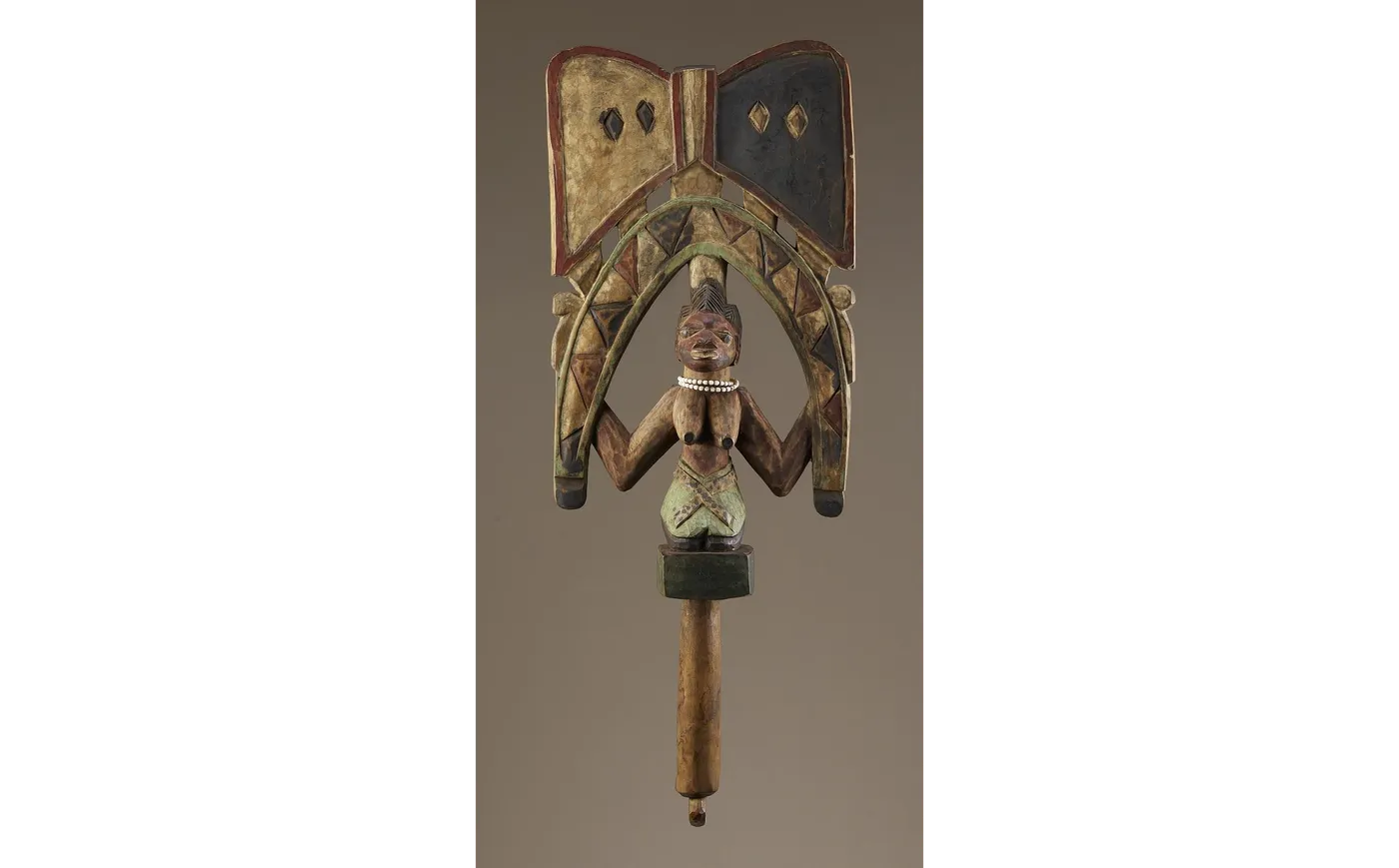
This wand comes from the Yoruba people of Nigeria and is used in dances honoring the orisha (deity) Shango, who represents thunder, fire, and lightning, and who is also remembered as a deified ancestor and former monarch of the Oyo kingdom. The wand itself follows a consistent design: a handle, two stone axes representing Shango's lightning bolts, and a female figure typically shown carrying those axes on her head. This object is a good example of how spiritual belief, ancestor veneration, and artistic craftsmanship all come together in a single ceremonial item, exactly the kind of Indigenous cosmology that carried over and blended with introduced faiths.
This staff was carved by a Yoruba artist in Nigeria in the mid-1900s and is now in the Smithsonian's National Museum of African Art. Here the figure is a kneeling woman holding up an arch, with the double-axe shape above her head, a pose of devotion to Shango. Shango's worship also crossed the Atlantic: in Cuba, followers of Regla de Ocha (once called Santería) honor him as Changó and link him with the Catholic Saint Barbara, a clear example of the syncretism this topic is about.
Oya's Betrayal by Harmonia Rosales, 2020
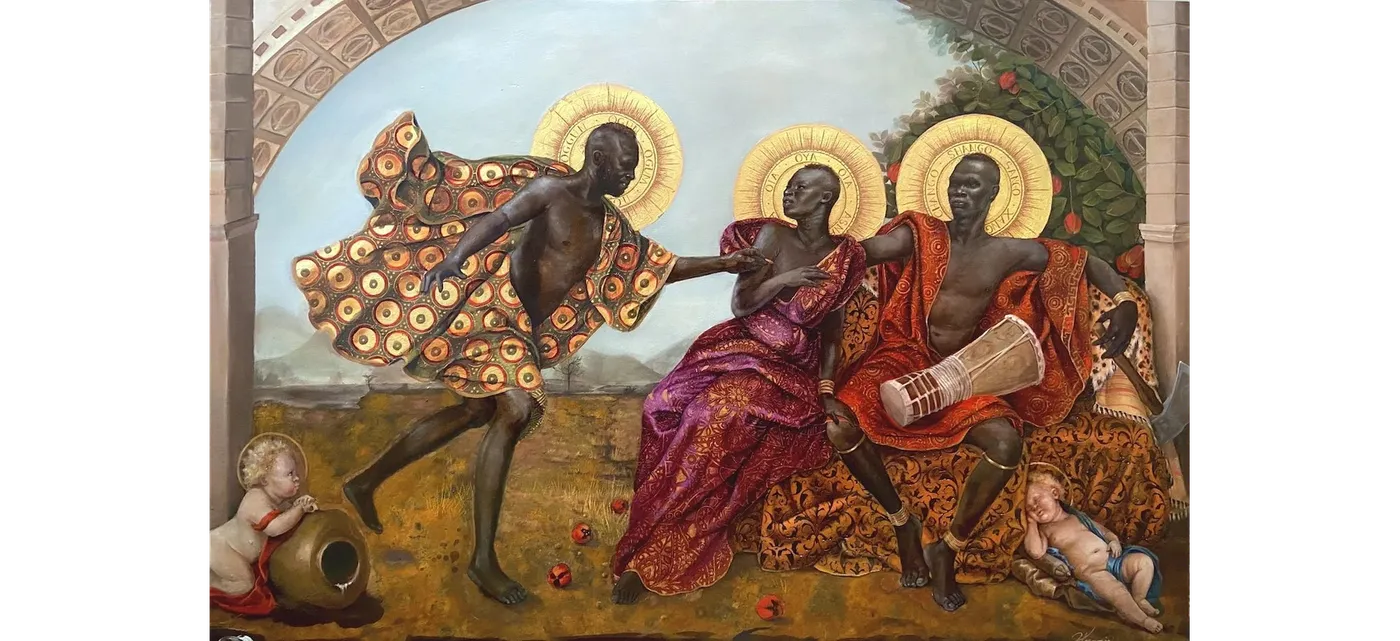
This painting depicts a conflict among three orishas, Oya, Ogun, and Shango, and it does so by visually blending Yoruba oral tradition with the style of European Renaissance painting. That combination is itself a form of syncretism, just expressed through visual art rather than religious practice. It's a modern artistic reminder that these African spiritual traditions are still very much alive, and still being reinterpreted through new mediums today.
Harmonia Rosales is an Afro-Cuban American artist who paints orisha stories in the style of European Renaissance art. In her telling, Oya has been married to Ogun, but Shango wins her love; Ogun rushes in from the left and catches them together, which sets off a war among the orishas. Look for the Renaissance features: golden halos with each orisha's name (like the halos of Christian saints), a stone arch, and two babies, the Ibeji twins (Shango's children in her telling), painted like Renaissance cherubs. She painted it in oil with real gold leaf on a wood panel, and the reddish ground is made with iron oxide to suggest the red soil of Africa.