

1.9 - West Central Africa: The Kingdom of Kongo
Christianity's Effect on Kongo's Economy and Religion
In 1491, King Nzinga a Nkuwu, who took the Christian name João I, along with his son Nzinga Mbemba, who became known as Afonso I, made a voluntary decision to convert the powerful West Central African Kingdom of Kongo to Roman Catholicism. This wasn't forced on them, it was a choice made from a position of strength.
Nzinga Mbemba ruled as Afonso I for more than thirty years, starting in the early 1500s, and was a devoted Catholic. He learned to read and write Portuguese and sent young nobles, including his son Henrique, to study in Portugal. In 1518 Henrique became the first bishop from sub-Saharan Africa.
That conversion paid off economically. Kongo's new religious ties to Portugal strengthened their trade relationship, and the kingdom grew wealthier as a result, primarily through trading ivory, salt, copper, and textiles.
Because the conversion started at the top, with the nobility choosing Christianity voluntarily rather than having it forced on them through colonial occupation, the religion was able to spread and gain real, widespread acceptance throughout Kongo society. Over time, this produced a distinct form of African Catholicism, one that wove together Christian belief with local Kongolese aesthetic and cultural traditions rather than replacing them outright.
In practice, Kongo Catholicism used Kikongo words for Christian ideas, was spread by Kongo nobles and local teachers as well as European priests, and produced Christian art in Kongo styles, like the Triple Crucifix below.
Kongo, Portugal, and the Transatlantic Slave Trade
Kongo's growing political relationship with Portugal came with a serious cost. As the two kingdoms grew closer through Christianity and trade, Portugal began demanding access to the trade of enslaved people in exchange for continued military support.
Kongo wanted things only Portugal could provide, like priests, teachers, and soldiers and guns to fight rivals and rebels. Portugal used that need as leverage, and Portuguese merchants based on the nearby island of São Tomé pushed to buy more and more captives.
Kongo's nobles did take part in the transatlantic slave trade, but importantly, they weren't able to control or limit how many captives ended up being sold to European traders. What started as a diplomatic and religious partnership gradually turned into something Kongo's own leadership couldn't fully contain. Over time, Kongo and the wider West Central African region became the single largest source of enslaved people in the entire history of the transatlantic slave trade to the Americas.
Kongo's Christian Legacy in African American Communities
Roughly one-quarter of enslaved Africans transported directly to what became the United States came from West Central Africa, and a significant number of them were already Christian by the time they arrived in the Americas. This matters a lot for understanding early African American religious life, Christianity wasn't only introduced through slavery in America, many people brought it with them already.
There's also a striking cultural detail tied to naming practices. In Kongo, it was common even before the transatlantic slave trade to name children after saints, or based on the day of the week they were born, sometimes called "day names." Because of this, many Christian names found among early African Americans, names like Juan, João, and John, actually carry African origins, not just European ones. It's a clear example of how ideas around kinship, lineage, and identity survived the Middle Passage and carried forward into new generations.
Required Sources
Excerpt of Letter from Nzinga Mbemba to Portuguese King João III, 1526
Sir, Your Highness should know how our Kingdom is being lost in so many ways that it is convenient to provide for the necessary remedy, since this is caused by the excessive freedom given by your agents and officials to the men and merchants who are allowed to come to this Kingdom to set up shops with goods and many things which have been prohibited by us, and which they spread throughout our Kingdoms and Domains in such an abundance that many of our vassals, whom we had in obedience, do not comply because they have the things in greater abundance than we ourselves; and it was with these things that we had them content and subjected under our vassalage and jurisdiction, so it is doing a great harm not only to the service of God, but the security and peace of our Kingdoms and State as well ... Moreover, Sir, in our Kingdoms there is another great inconvenience which is of little service to God, and this is that many of our people, keenly desirous as they are of the wares and things of your Kingdoms, which are brought here by your people, and in order to satisfy their voracious appetite, seize many of our people, freed and exempt men, and very often it happens that they kidnap even noblemen and the sons of noblemen, and our relatives, and take them to be sold to the white men who are in our Kingdoms; and for this purpose they have concealed them; and others are brought during the night so that they might not be recognized ... And we cannot reckon how great the damage is, since the mentioned merchants are taking every day our natives, sons of the land and the sons of our noblemen and vassals and our relatives, because the thieves and men of bad conscience grab them wishing to have the things and wares of this Kingdom which they are ambitious of; they grab them and get them to be sold; and so great, Sir, is the corruption and licentiousness that our country is being completely depopulated, and Your Highness should not agree with this nor accept it as in your service. And to avoid it we need from those (your) Kingdoms no more than some priests and a few people to teach in schools, and no other goods except wine and flour for the holy sacrament ... That is why we beg of Your Highness to help and assist us in this matter, commanding your factors that they should not send here either merchants or wares, because it is our will that in these Kingdoms there should not be any trade of slaves nor outlet for them. Concerning what is referred [to] above, again we beg of Your Highness to agree with it, since otherwise we cannot remedy such an obvious damage. Pray Our Lord in His mercy to have Your Highness under His guard and let you do forever the things of His service. Letter from King Afonso I (Nzinga Mbemba) of Kongo to King João III of Portugal, 1526. English translation in Basil Davidson, The African Past (Boston: Little, Brown, 1964)
This letter is a firsthand account, written by a Kongolese king himself, addressing the Portuguese crown directly about the state of their relationship. It offers a rare, direct window into how Kongo's leadership viewed and tried to manage its increasingly complicated ties to Portugal, especially as those ties became entangled with the demand for enslaved people. Reading a source like this, in the ruler's own words, makes the political pressure Kongo was under feel far more concrete than a general historical summary could.
In the excerpt, Afonso makes three complaints and one request:
- Goods are weakening his power: Portuguese merchants are flooding Kongo with goods, so his vassals now have more of these things than the king does, and he can no longer keep them loyal by handing such goods out.
- Free people are being kidnapped: People eager for Portuguese goods are seizing free Kongolese, even nobles and the king's own relatives, and selling them to the Portuguese, often hiding them or moving them at night.
- The kingdom is being emptied: So many people are being taken that he says the country is being depopulated.
- His request: He asks King João III to send only priests, teachers, and wine and flour for Mass, to stop sending merchants, and he says he wants no slave trade at all in his kingdoms.
Think about his perspective and audience. Afonso was a Catholic king writing to another Catholic king, so he frames the problem as harm to God's service as well as to his kingdom's peace. He also wasn't against all slavery: Kongo, like many states in the region, held and traded war captives. What he wanted was control, and he later set up officials to check that people being sold had been legally enslaved. The letter shows the problem in this topic clearly: Kongo's nobles took part in the slave trade but couldn't limit how many people were captured and sold.
Image of Triple Crucifix, Sixteenth to Nineteenth Century
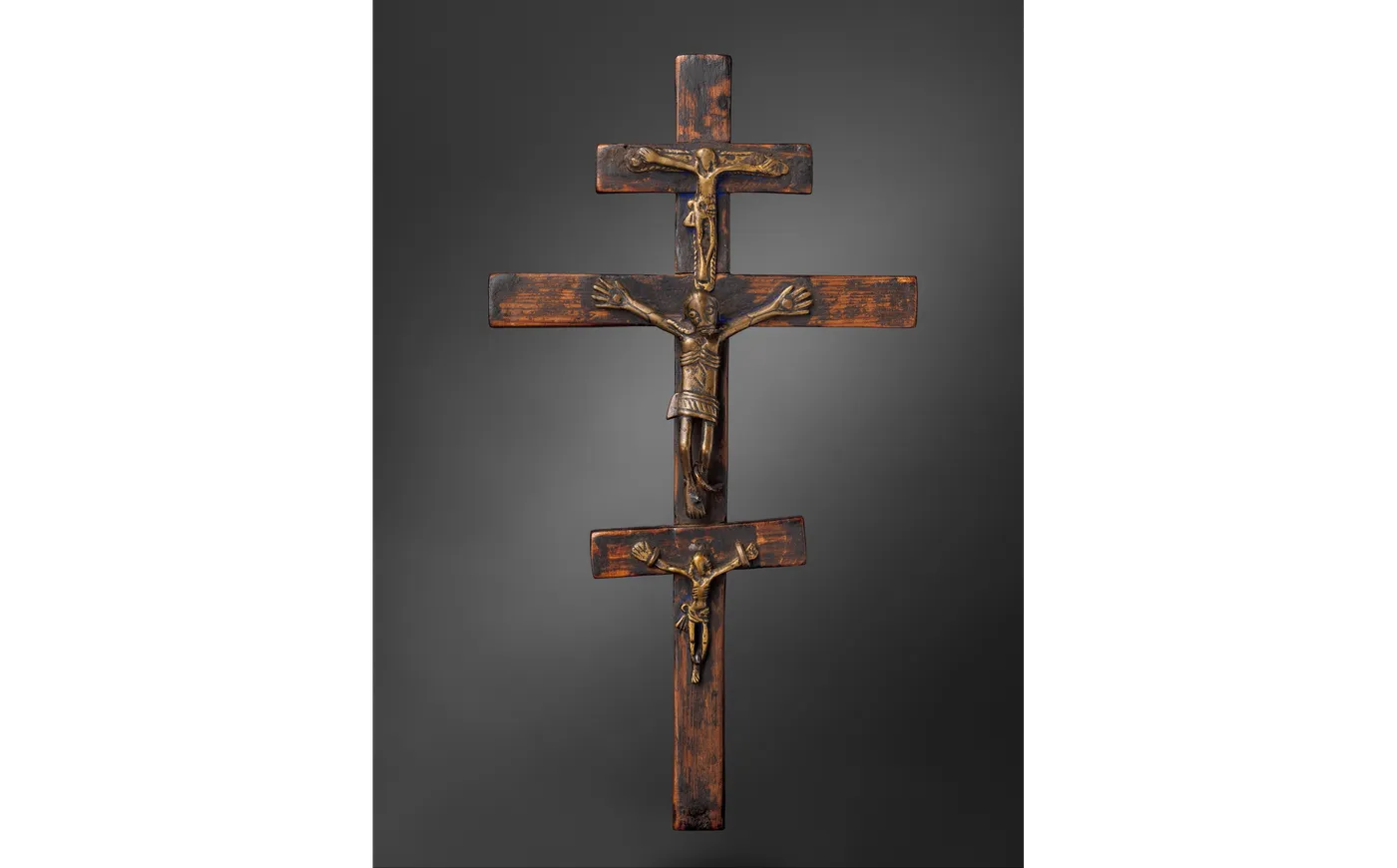
This crucifix is a physical example of the African Catholicism described above, a Christian religious object made by Kongo artists using their own artistic traditions and craftsmanship. It has three cast metal figures of Christ attached to a wooden cross with three crossbars, and the Metropolitan Museum of Art suggests the three figures may stand for the Trinity. Its long date range comes from its parts: the larger central figure was made in the sixteenth or seventeenth century, and the smaller top and bottom figures date to the eighteenth or nineteenth century. In other words, Kongo Christians were still making and using crucifixes like this centuries after the conversion, which shows how deeply and durably Christianity took root in Kongo. This wasn't a passing trend, it was a lasting cultural and religious fusion.