

1.11 - Global Africans
Why Africans Went to Europe and Europeans Went to Africa
Well before the transatlantic slave trade reached its height, there was already a steady flow of people and goods moving between Africa and Europe. In the late fifteenth century, trade between West African kingdoms and Portugal grew steadily, covering gold, other goods, and enslaved people, and increasingly bypassing the older trans-Saharan trade routes. It's worth noting that slave trading itself wasn't new or introduced by Europeans, it was already a common feature of hierarchical West African societies, and African kingdoms used it, alongside other trade, to build their own wealth and power.
The Portuguese did this by sailing down Africa's Atlantic coast instead of crossing the Sahara. In 1482 they built a fort, São Jorge da Mina (Elmina), on the Gold Coast (in today's Ghana) to buy gold directly from African traders. Gold that used to travel north by camel through the Sudanic empires could now leave by ship, which is part of why Songhai lost wealth (Topic 1.5).
As this Portuguese-West African trade expanded, it changed the populations on both sides of the exchange. More Europeans began showing up in West Africa, while at the same time, the population of sub-Saharan Africans grew in Iberian port cities like Lisbon and Seville.
Not everyone who made this journey was enslaved, either. African elites, including ambassadors and the children of rulers, traveled to Mediterranean port cities for diplomatic, educational, and religious reasons. Once there, free and enslaved Africans alike took on a wide variety of roles, working as domestic laborers, boatmen, guards, entertainers, vendors, and even knights. This is an important detail: African presence in European cities during this period wasn't limited to enslaved labor, it included real social and professional standing in some cases.
Kongo is a good example. King Afonso I sent young nobles to study in Portugal, including his son Henrique, who was made a bishop in 1518 (Topic 1.9). Ethiopian Christians traveled too: Ethiopian monks attended a church council in Florence, Italy, in 1441.
How Early Portuguese Slave Labor Shaped the Americas
The roots of slave-based plantation economies actually trace back to islands off the African coast, not the Americas themselves. In the second half of the fifteenth century, the Portuguese colonized the Atlantic islands of Cabo Verde (from the 1460s) and São Tomé (from the 1480s and 1490s), and set up cotton, indigo, and sugar plantations there using enslaved African labor.
By the year 1500, around 50,000 enslaved Africans had already been removed from the continent to work either on these Portuguese-colonized islands or in Europe itself. These early plantations weren't just a preview of what was coming, they directly became the model that later slave labor-based economies in the Americas would follow.
Here's what that model looked like. São Tomé became one of the world's leading sugar producers in the 1500s. Its plantations were large estates growing one main crop for export, worked by enslaved Africans brought from the mainland, with the sugar shipped to Europe. The island was also a stopping point for slave ships headed to the Americas. Portuguese planters later used the same system in Brazil, and other Europeans spread it through the Caribbean.
Required Sources
Chafariz d'El-Rey (The King's Fountain), 1570 to 1580
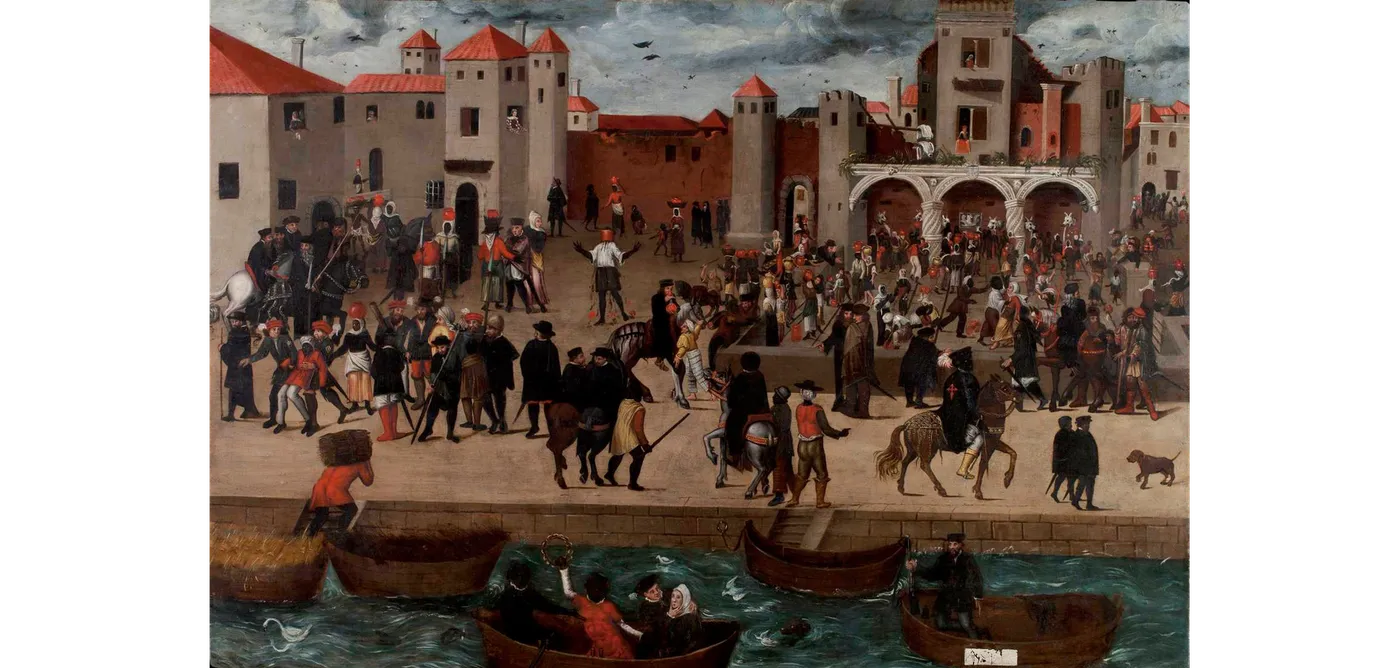
This painting is one of the richest visual records available of African life in a European city during this period. It depicts a busy scene in Lisbon, a city where, by the sixteenth century, Africans made up a large share of the population (the AP course puts it at about 20 percent; many historians estimate closer to 10 percent). Among the figures shown is João de Sá Panasco, an African Portuguese knight of the Order of Saint James, riding on horseback, along with two African noblemen dressed in European attire and carrying swords in the corner of the scene. Elsewhere in the painting, you can also see an African court guard and Muslim African traders. Taken together, this single painting captures the full range of roles and social standing Africans held in Lisbon at the time, from nobility and knighthood to trade and guard duty, and it does so well before the transatlantic slave trade reached its peak. It's a powerful visual counterpoint to the assumption that African presence in Europe during this era was defined only by enslavement.
The painting was made around 1570 to 1580 by an unknown artist, probably from the Netherlands, and shows the Chafariz d'El-Rey, a public fountain on Lisbon's waterfront. Around the fountain, many people, a large share of them Black men and women, fill water jugs and carry them on their heads, which was everyday work in the city. João de Sá Panasco is the rider in the black cloak marked with the red cross of the Order of Saint James. Because the artist was simply recording a busy street scene, the painting is strong evidence of how ordinary African presence in Lisbon had become.