

1.6 - Learning Traditions
Centers of Learning in West Africa
West African empires weren't just centers of trade and military power, they were also home to real institutions of learning, often built right into their trading cities. The best known example is Timbuktu, in Mali, where a book trade, a university, and a broader learning community all flourished together. Timbuktu became a magnet for astronomers, mathematicians, architects, and legal scholars (jurists), people traveled there specifically to study and exchange ideas.
Timbuktu's "university" wasn't one campus like a modern college. It was a network of scholars who taught students in mosques, such as the Sankore Mosque, and in their own homes. Students studied the Quran and Islamic law along with subjects like astronomy, mathematics, and medicine, and scholars copied, bought, and sold handwritten books. Thousands of these Timbuktu manuscripts still survive today, many of them kept for centuries in family libraries.
This matters because it pushes back on the idea that education in early West Africa was informal or unstructured. Timbuktu functioned as a genuine intellectual hub, on par with learning centers anywhere else in the world at the time.
The Griot Tradition
Alongside formal institutions like Timbuktu, West African societies also preserved knowledge through a completely different, community-based model: the griot tradition. Griots were highly respected historians, storytellers, and musicians whose job was to maintain and pass down a community's history, traditions, and cultural practices, mostly through oral performance rather than written text.
Being a griot (called a jeli in Mande languages) usually ran in families. Children born into griot families learned the genealogies, stories, songs, and instruments from older relatives over many years. That's what makes the griot tradition a community-based model of education: knowledge passed from one generation to the next through memory and performance, not in a school building. Griots also served as advisers to kings. In the Epic of Sundiata, the griot Balla Fasséké stays at Sundiata's side as his counselor and spokesman.
Gender was an important part of this tradition too. Griots weren't exclusively men, both women and men served as griots, and together they preserved detailed knowledge of a community's births, deaths, and marriages through the stories they told and passed down.
One of the most famous examples of this oral tradition is the Epic of Sundiata, sometimes called the story of the "lion prince." Mande griots have kept this epic alive for centuries, and it's still celebrated today in Mali. The epic tells the story of Sundiata Keita, the founder of the Mali Empire and, in most accounts, Mansa Musa's great-uncle, and in doing so, it preserves the early history of the Mande people in a way no written record could replace.
Required Sources
"The Sunjata Story, Glimpse of a Mande Epic," a Griot Performance of the Epic of Sundiata (video, 20:00)

This performance is a direct, living example of the griot tradition in action. Watching it helps make sense of why griots held such a respected role in West African societies: this isn't casual storytelling, it's a skilled, structured performance meant to preserve real historical memory, in this case the origin story of the Mali Empire itself.
The storyteller here is Malian singer Hawa Kassé Mady Diabaté, joined by Fodé Lassana Diabaté on the balafon (a wooden xylophone), with Professor Chérif Keita giving an English translation. Notice that the voice carrying the story is a woman's, which ties directly to the role of gender in the griot tradition. The performance is also unusual because it covers the whole story in about 20 minutes, while griots usually perform just one or two episodes of Sundiata's life at a time.
Image of Griot Basimana with Guitar, Mali
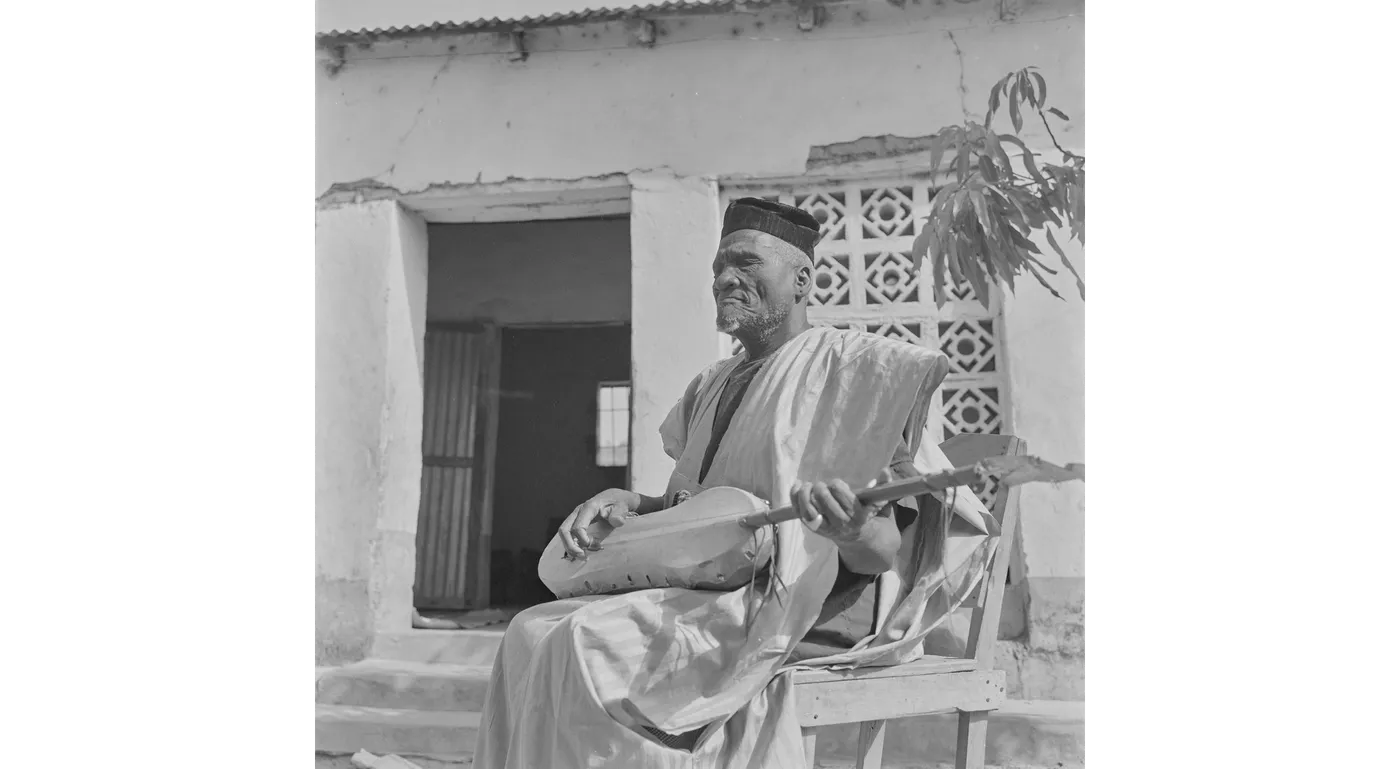
This photograph shows a griot with a stringed instrument, which reflects how deeply music was woven into the griot's role as historian and storyteller. The image is a reminder that griots weren't just speakers, they were performers, using music alongside oral narrative to carry a community's history forward. Even though this photo was taken in 1970, it reflects a tradition that stretches back centuries and continues into the present day.
The photo was taken by Marli Shamir in 1970 and is now in the Smithsonian's Eliot Elisofon Photographic Archives. The archive calls the instrument a guitar, but it's a West African lute with a long neck and a skin-covered body, similar to the ngoni that many Mande griots play.