

1.10 - Kinship and Political Leadership
Kinship and Women's Roles in Early African Societies
A lot of early West and Central African societies were organized around extended family networks, kinship ties, and these bonds often did more than hold families together. They frequently formed the basis for political alliances between groups.
In practice, a person's lineage (the family line they descended from) often decided who could inherit land, hold office, or become ruler. Many Central African societies, including Kongo, traced descent through the mother's side of the family. Rulers built alliances by marrying into other powerful families, so one marriage could tie two lineages, or even two states, together.
Women in these societies held a wide range of important roles. They served as spiritual leaders, political advisors, market traders, educators, and agriculturalists. In other words, women's influence wasn't limited to the household, it extended into the economy, spirituality, and politics of their societies.
For example, in many Yoruba and other West African towns, women ran much of the market trade, and priestesses led the worship of orishas. Royal women could hold real political and military power too, as the two queens below show.
Two Powerful Queens: Idia and Njinga
Two women in particular stand out as examples of real political and military leadership: Queen Idia of Benin and Queen Njinga of Ndongo-Matamba.
Queen Idia became the first iyoba, or queen mother, in the Kingdom of Benin (in present-day Nigeria) in the early 1500s (the AP framework says the late 1400s). Her role wasn't ceremonial, she served as a genuine political advisor to her son, the king (called the oba), Esigie.
Queen Njinga rose to power a bit later, becoming queen of the kingdoms of Ndongo and Matamba (in present-day Angola) in the early seventeenth century. Her reign began around the same time that people from Ndongo became the first large group of enslaved Africans to arrive in the American colonies, a striking historical overlap.
That first group arrived at Point Comfort, Virginia, in 1619: about 20 Africans who had been captured during Portuguese wars against Ndongo and were taken from a Portuguese slave ship by English privateers (Unit 2).
Both queens didn't just rule from a throne, they personally led armies into battle. Queen Idia relied on spiritual power and medicinal knowledge to help secure victories for Benin, blending religious authority with military leadership. Queen Njinga took a different, more prolonged path: she led roughly 30 years of guerrilla warfare against the Portuguese in order to protect her kingdom's sovereignty. Interestingly, she also participated in the slave trade herself, using it to build her own wealth and political influence, while at the same time offering sanctuary to people who had escaped Portuguese enslavement, growing her military by welcoming them into her forces.
Idia's best-known moment came in the early 1500s. Her son Esigie had to fight his brother for the throne and then a war against the Igala kingdom to the north (around 1515 to 1516). Benin traditions credit Idia's advice, spiritual power, and medicinal knowledge with his victories. To reward her, Esigie created the title of iyoba for her, with her own palace, and later kings kept giving the title to their mothers.
Njinga was a skilled diplomat as well as a fighter. In 1622, before she became queen, she went to the Portuguese colony of Luanda to negotiate peace for her brother, the king of Ndongo, and was baptized a Christian there, taking the name Ana de Sousa. When the peace broke down, she fought back, conquered the neighboring kingdom of Matamba as a new base, and in the 1640s allied with the Dutch, who had taken Luanda from Portugal. She ruled until her death in 1663.
Comparing the two queens:
- Similarities: Both were women who held real power in kingdoms usually led by men, both are remembered as military leaders, and both lived during growing contact with the Portuguese.
- Differences: Idia's power came through her son. She led as queen mother and advisor, and her strength came from counsel, spiritual power, and medicine. Njinga ruled in her own name as queen, and her strength came from diplomacy, shifting alliances, decades of guerrilla war, and her role in the slave trade.
Their Lasting Legacy
Both queens left legacies that reached far beyond their own reigns. In 1977, Queen Idia became a widely recognized symbol of Black women's leadership across the entire African diaspora, after an ivory mask of her face was adopted as the official symbol of FESTAC, the Second World Black Festival of Arts and Culture.
FESTAC '77 was held in Lagos, Nigeria, and brought together artists, musicians, and writers from Africa and the African diaspora. Nigeria asked the British Museum to lend its version of the Idia mask, which British soldiers had taken from Benin City in 1897. The museum refused, so the festival's emblem was based on the mask instead.
Queen Njinga's legacy took a different but equally powerful form. Her example as a skilled political and military leader was so influential that it paved the way for nearly 100 more years of women rulers in Matamba after her reign ended.
Today Njinga is honored as a national hero in Angola, where a large statue of her stands in the capital, Luanda.
Required Sources
Illustration of Queen Njinga, Seventeenth Century
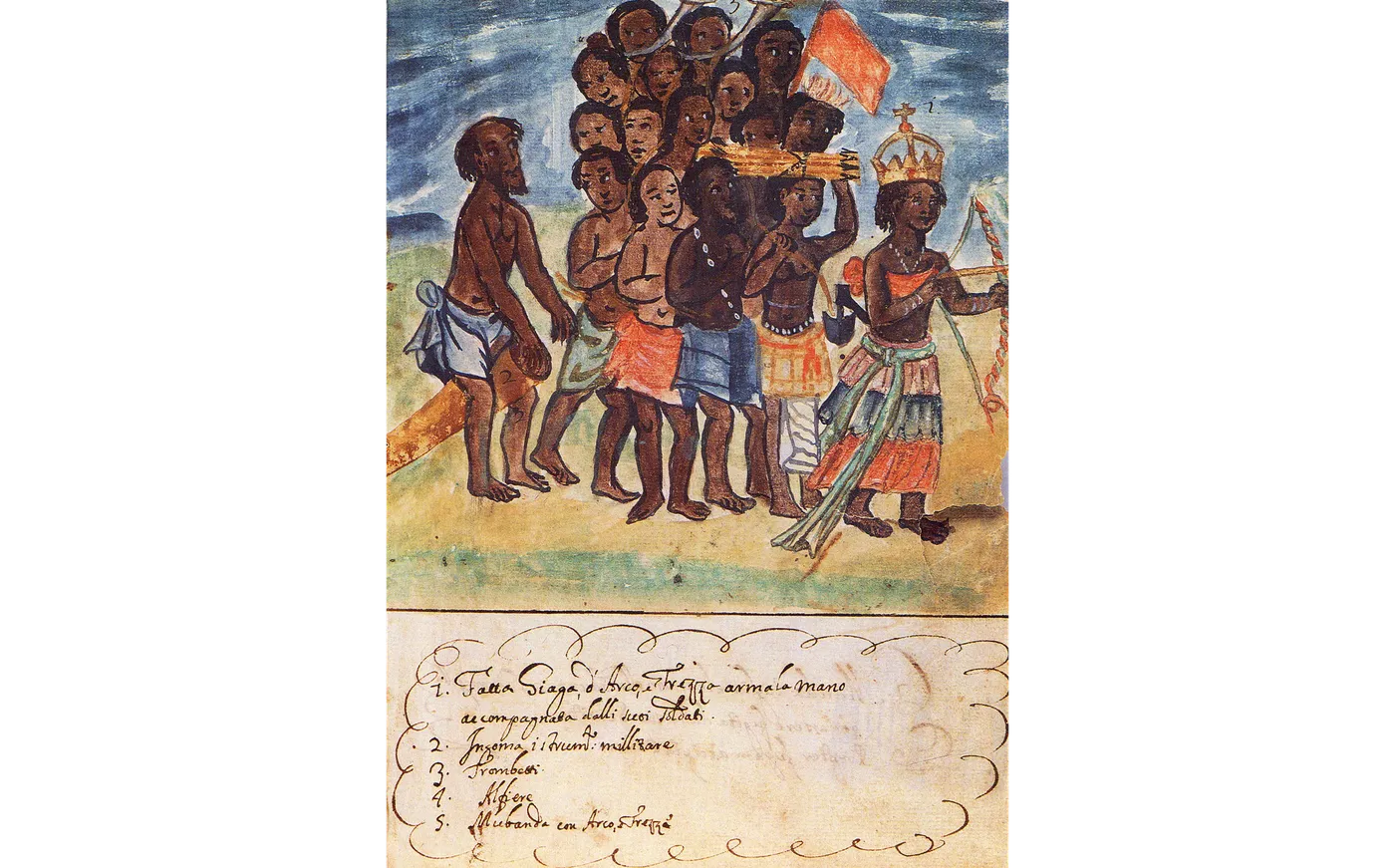
This illustration is a contemporary depiction of Queen Njinga from her own era, giving a visual sense of how she was represented at the height of her power. Given everything covered above, her decades-long resistance against the Portuguese and her skill at building alliances and military strength, this image helps put a face to a leader whose influence shaped Matamba's political future for a century after she was gone.
This watercolor was painted in the 1660s by Giovanni Antonio Cavazzi, an Italian Capuchin missionary who lived at Njinga's court in Matamba near the end of her life. He shows her as a war leader: she holds a bow and arrows and wears a crown topped with a cross, a sign of her Christian faith, while soldiers, trumpeters, and a flag bearer follow her. The handwritten key under the picture labels each figure in Italian. Keep the source's perspective in mind: Cavazzi was a European missionary, so he presents Njinga through a Catholic, European lens.
Image of Queen Mother Pendant Mask: Iyoba, Sixteenth Century
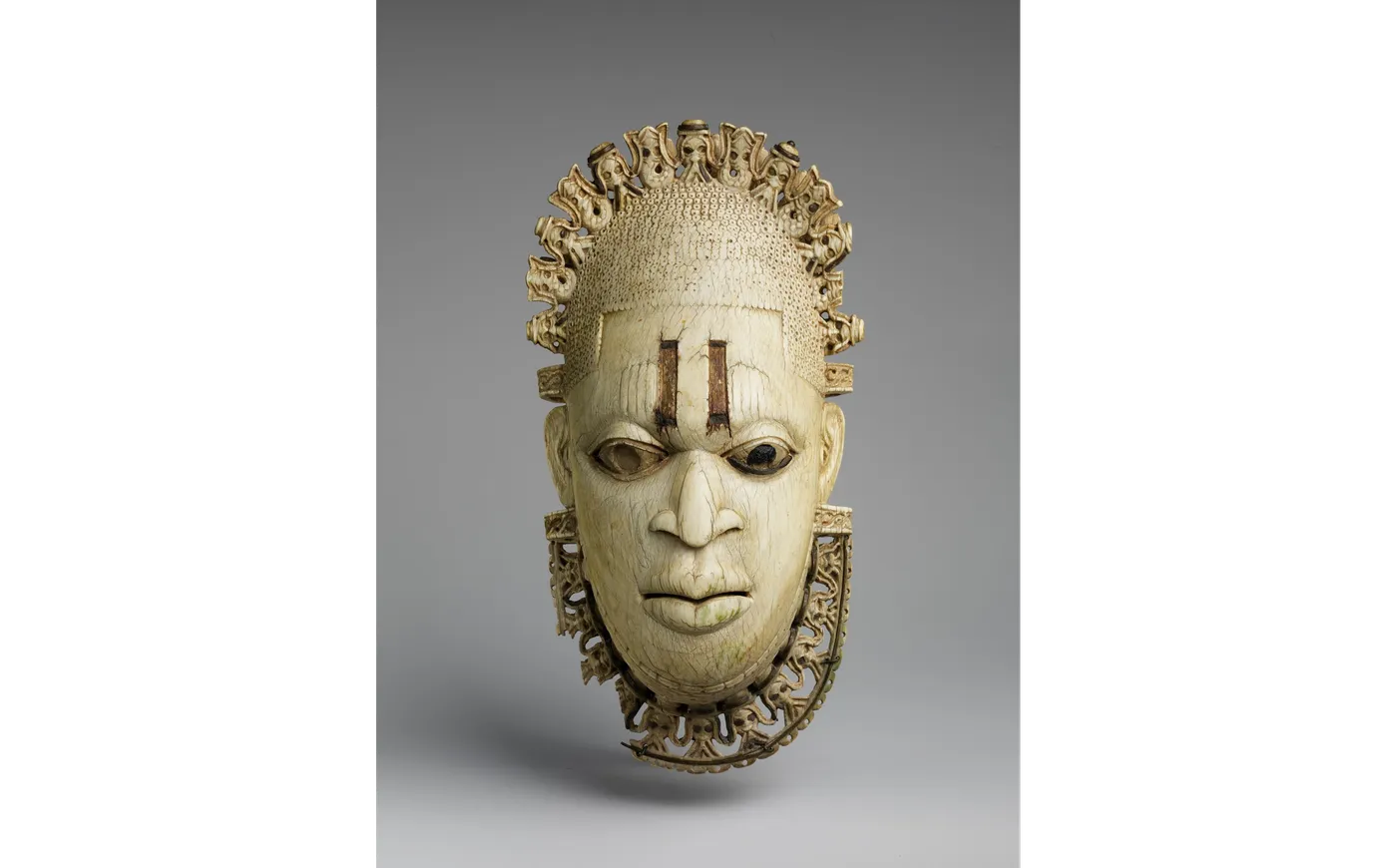
This mask is packed with meaning once you know what to look for. It was originally designed as a pendant meant to be worn to inspire Benin's warriors before battle, so it wasn't just art, it was a functional symbol of leadership. The small faces carved along the top of Queen Idia's head represent her skill in diplomacy and trade with the Portuguese. The scarification marks on her forehead, made using iron, identify her specifically as a warrior. And the beaded pattern above her face is meant to represent Afro-textured hair, celebrating her natural features rather than hiding them. Every element of this mask reinforces the same message: Queen Idia was a diplomat, a warrior, and a source of pride in her own identity, all at once. It's easy to see why this same image was chosen decades later, in 1977, to represent Black women's leadership across the entire diaspora.
The mask was carved from ivory in the 1500s by artists of Benin's royal guild of ivory carvers, most likely for Oba Esigie to honor his mother, and the scarification marks on the forehead are inlaid iron. Ivory was a royal material in Benin, closely controlled by the oba, which adds to the mask's message of power and prestige.