

1.3 - Population Growth and Ethnolinguistic Diversity
What Caused the Bantu Expansion
Population growth among West and Central African peoples didn't happen randomly, it was driven by real innovation. Technological advances, like the development of new tools, combined with agricultural breakthroughs like cultivating bananas, yams, and grains, allowed communities to grow larger and more stable over time.
Iron was a big part of this. Over the course of the expansion, many Bantu-speaking communities learned to smelt iron, and iron hoes and axes made it much easier to clear forest and farm new land. More food meant larger families and villages, and when a village got too crowded, some families moved on to start a new one.
As populations grew, people needed more space and resources, which triggered a long wave of migrations across the continent. This is known as the Bantu expansion, and it happened gradually over a huge stretch of time, roughly from 1500 BCE to 500 CE. The people driving this migration spoke Bantu languages, and as they moved, their language and culture moved with them.
Keep in mind this wasn't one big march. It happened slowly, over many generations, as small groups moved a little at a time. Along the way, Bantu speakers often mixed with or absorbed the hunter-gatherer and herding peoples who already lived in those areas.
The Linguistic and Genetic Legacy of the Bantu Expansion
Because the Bantu expansion played out over such a long period and across so much territory, its linguistic effects were massive. Today, the Bantu language family includes hundreds of distinct languages spoken across West, Central, and Southern Africa, including languages like Xhosa, Swahili, Kikongo, and Zulu. All of these trace back to that same root migration.
Two terms help here. The name Bantu comes from the word for "people" in many of these languages, and the Bantu languages are one branch of a much larger family called Niger-Congo. Ethnolinguistic means having to do with both ethnic groups and languages, because a group's identity is often tied to the language it speaks.
It's worth remembering that Africa as a whole is home to thousands of ethnic groups and languages, the Bantu family is just one branch of a much larger linguistic landscape. But that branch matters a lot for African American history specifically. A large share of African Americans' genetic ancestry traces back to communities in West and Central Africa that spoke Bantu languages. So this migration isn't just an ancient historical event, it's directly tied to the ancestry of people living today.
Required Sources
Map Showing the Movement of Bantu Peoples, Languages, and Technologies
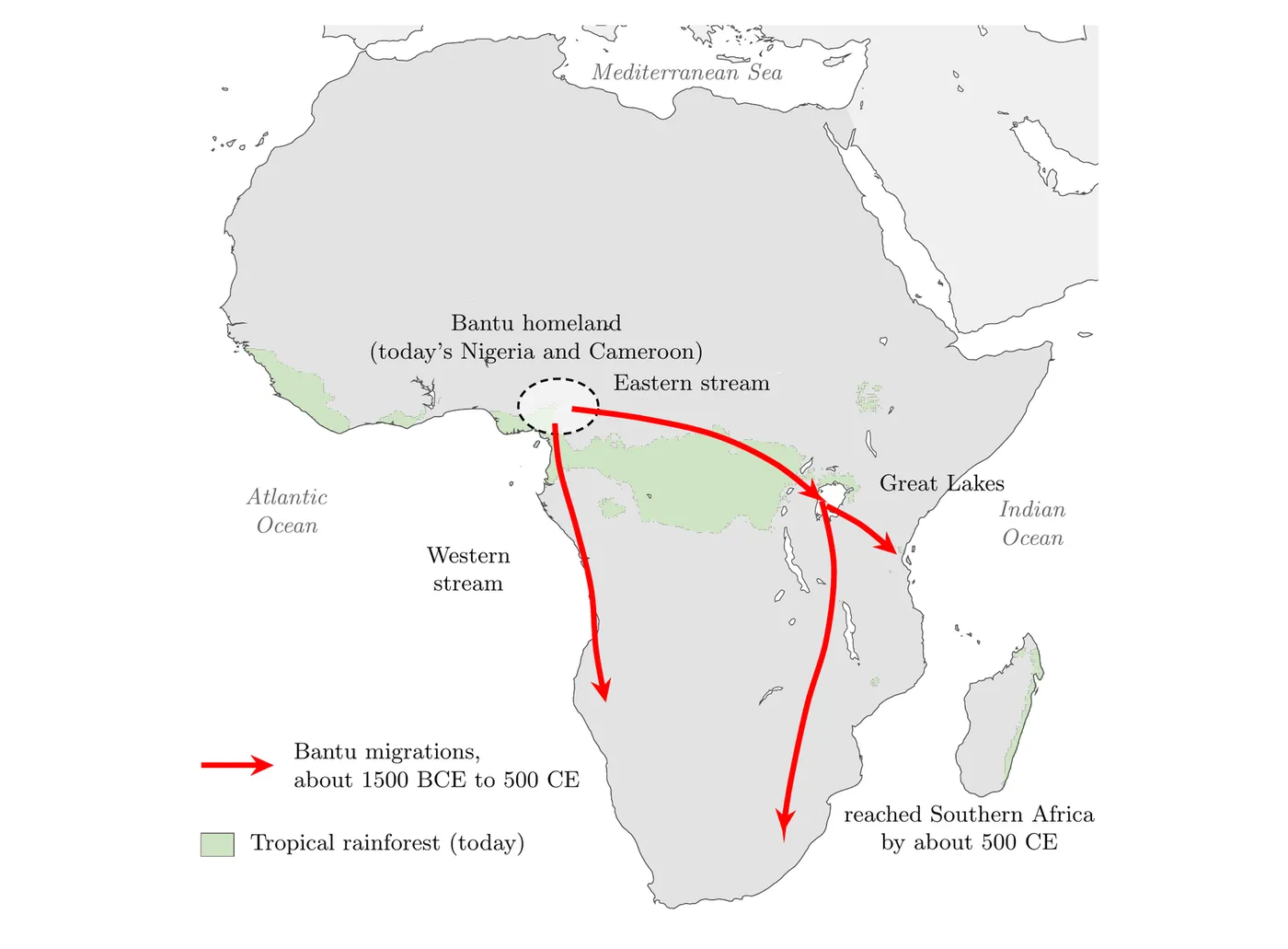
This map traces the actual physical routes of the Bantu expansion over time, showing how migration spread outward from an origin point in West Africa across the rest of the continent over centuries. It's a good visual complement to the topic because it turns an abstract timeline (1500 BCE to 500 CE) into something you can actually see happening across geography. The branching arrows on the map mirror the branching of the Bantu language family itself: as people spread into new regions, their language spread and diversified along with them, eventually producing the hundreds of related languages spoken today.
Reading the map: the expansion starts in a homeland near the border of today's Nigeria and Cameroon. A western stream moves south along the Atlantic side of the continent, toward the region that later became the Kingdom of Kongo, where Kikongo is spoken. An eastern stream moves east to the Great Lakes, then out toward the Indian Ocean coast, where Swahili later developed, and south into Southern Africa, where Zulu and Xhosa are spoken, reaching it by about 500 CE. So the four example languages above line up with the routes on the map.