

1.5 - The Sudanic Empires: Ghana, Mali, and Songhai
Gold, Trade, and the Rise of the Sudanic Empires
Ghana, Mali, and Songhai are often grouped together as the Sudanic empires, sometimes called the Sahelian empires, and together they dominated West Africa from around the seventh century all the way through the sixteenth century. They didn't all rise at once though, each one had its own era of dominance, and each one basically rose out of the decline of the one before it:
- Ghana flourished from the seventh to the thirteenth century
- Mali flourished from the thirteenth to the seventeenth century
- Songhai flourished from the fifteenth to the sixteenth century
It's worth clearing up a common mix-up here: ancient Ghana was actually located in what's now Mauritania and Mali, not in the modern country of Ghana. The modern nation just adopted that name later, when it gained independence from colonial rule in 1957, as a way of honoring the legacy of the ancient empire.
What made all three empires so powerful was the same basic formula: gold and location. Each one controlled major gold mines and sat right at the crossroads of trade routes linking the Sahara (and from there, Europe) to sub-Saharan Africa. That trans-Saharan trade didn't just move gold and goods though, it also brought North African traders, scholars, and administrators into the region, and they're the ones who introduced Islam and helped it spread across West Africa.
Here's how that trade worked. Camel caravans crossed the Sahara carrying salt (mined in the desert at places like Taghaza), cloth, copper, and other goods south, and gold from mines in the lands to the south went north. The empires sat in between, controlled the trading towns, and taxed the goods that passed through, which made their rulers rich.
Islam spread first among rulers and merchants. Converting tied them to the Muslim traders of North Africa and gave them advisers who could read and write Arabic, which helped with records, letters, and trade. In ancient Ghana, for example, the king kept Muslim officials at court while still following his own religion. Most farmers and villagers kept their local beliefs for a long time, often blending them with Islam (Topic 1.7).
Songhai was the last of these empires, and also the largest. But its dominance didn't last, once Portuguese explorers started making their way down the western coast of Africa, trade started shifting away from trans-Saharan routes toward Atlantic trade instead. That shift cut into Songhai's wealth and, eventually, its power.
Songhai was based at Gao, on the Niger River, and grew under strong rulers like Sunni Ali and Askia Muhammad in the late 1400s and early 1500s. After trade shifted toward the coast, a Moroccan army armed with guns defeated Songhai at the Battle of Tondibi in 1591, and the empire broke apart.
Mali's Golden Age Under Mansa Musa
Mali's story really centers on one figure: Mansa Musa, who ruled in the fourteenth century. (Quick note: "Mansa" isn't a name, it's a title, meaning ruler or king among Mande speakers.) Under his leadership, Mali became a genuine center for trade, learning, and cultural exchange, not just a wealthy empire, but an influential one.
That wealth translated directly into military power too. Mali's access to trans-Saharan trade let its leaders crossbreed strong North African horses and buy steel weapons, both of which helped the empire extend control over neighboring groups.
Mansa Musa's wealth became famous well outside of Africa too, largely because of his hajj, his pilgrimage to Mecca, in 1324. Word of his riches spread all the way to merchants and mapmakers across the eastern Mediterranean and into southern Europe, and it actually got people planning to trade manufactured goods for Malian gold. Mali, at this point, encompassed parts of present-day Mali, Mauritania, and Senegal, and its wealth had turned it into a name recognized across continents.
Arab writers reported that Mansa Musa spent and gave away so much gold in Cairo on his way to Mecca that the value of gold there stayed low for years. He came home with Muslim scholars and an architect from Granada, al-Sahili, and built mosques such as the Djinguereber Mosque in Timbuktu, which helped turn the city into a center of learning (Topic 1.6).
Connection to African Americans
Geographically, the Sudanic empires stretched from Senegambia all the way to present-day Côte d'Ivoire, and included parts of what's now Nigeria. This matters a lot for African American history specifically, because the majority of enslaved Africans brought directly to North America descended from societies in exactly two regions: West Africa and West Central Africa. In other words, the Sudanic empires sit right in the ancestral homeland of a huge portion of the African American population today.
Required Sources
Map of Africa's Kingdoms and Empires
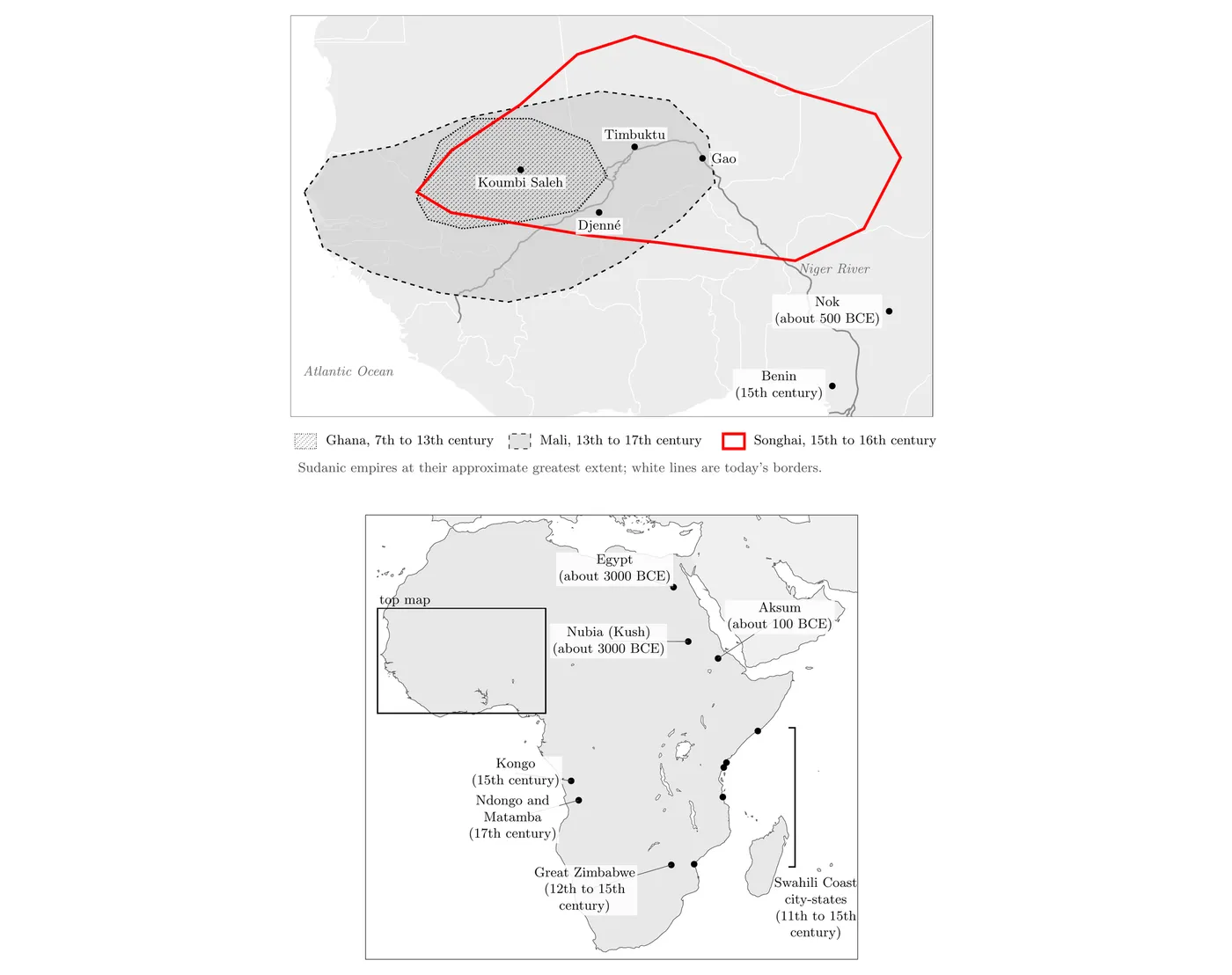
This map gives you the spatial layout for everything covered in this topic. Seeing Ghana, Mali, and Songhai positioned geographically helps make sense of why they rose in that particular order, each one expanding into and eventually eclipsing the territory of the one before, and why their location made them such a natural hub for trans-Saharan trade.
Catalan Atlas by Abraham Cresques, 1375
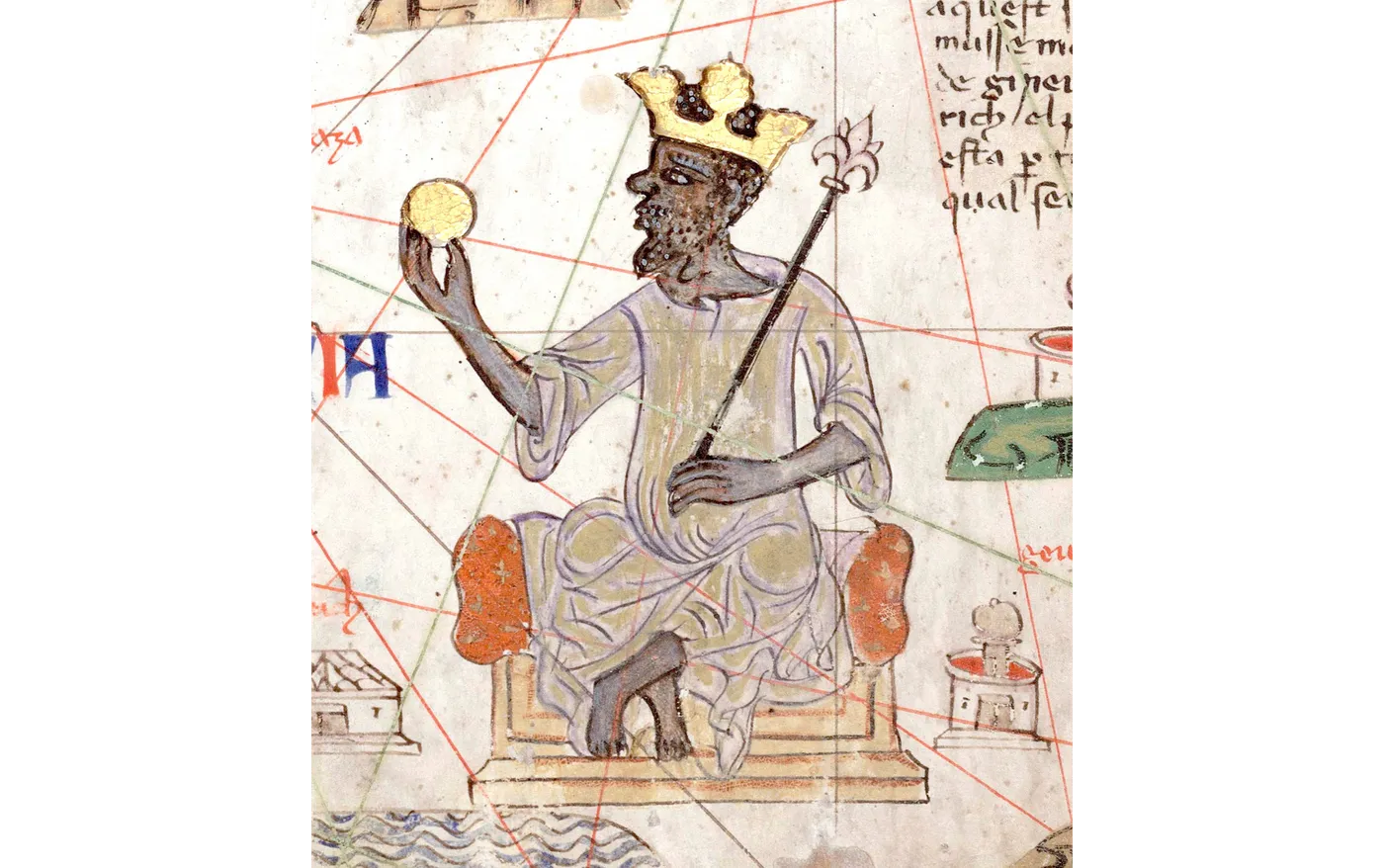
This atlas is a valuable historical source because it shows how Europeans saw Mansa Musa and the Mali Empire. It was made in 1375 and is credited to Abraham Cresques, a Jewish mapmaker on the island of Majorca (part of present-day Spain), about fifty years after Mansa Musa's famous hajj. In it, Mansa Musa is shown wearing a gold crown and holding a gold orb, visual shorthand for the kind of riches that had already made him legendary across the Mediterranean world. The Catalan text beside him calls him the richest and noblest ruler in the region because of all the gold in his lands. Beyond just showing off Mali's wealth, the atlas also reflects the spread of Islam through West Africa and confirms Mali's role as a real center of trade and cultural exchange. Keep its perspective in mind: Cresques never traveled to Mali, so he drew Mansa Musa from his reputation and from what traders reported, through the eyes of an outsider.
Image of Mali Equestrian Figure, Thirteenth to Fifteenth Century
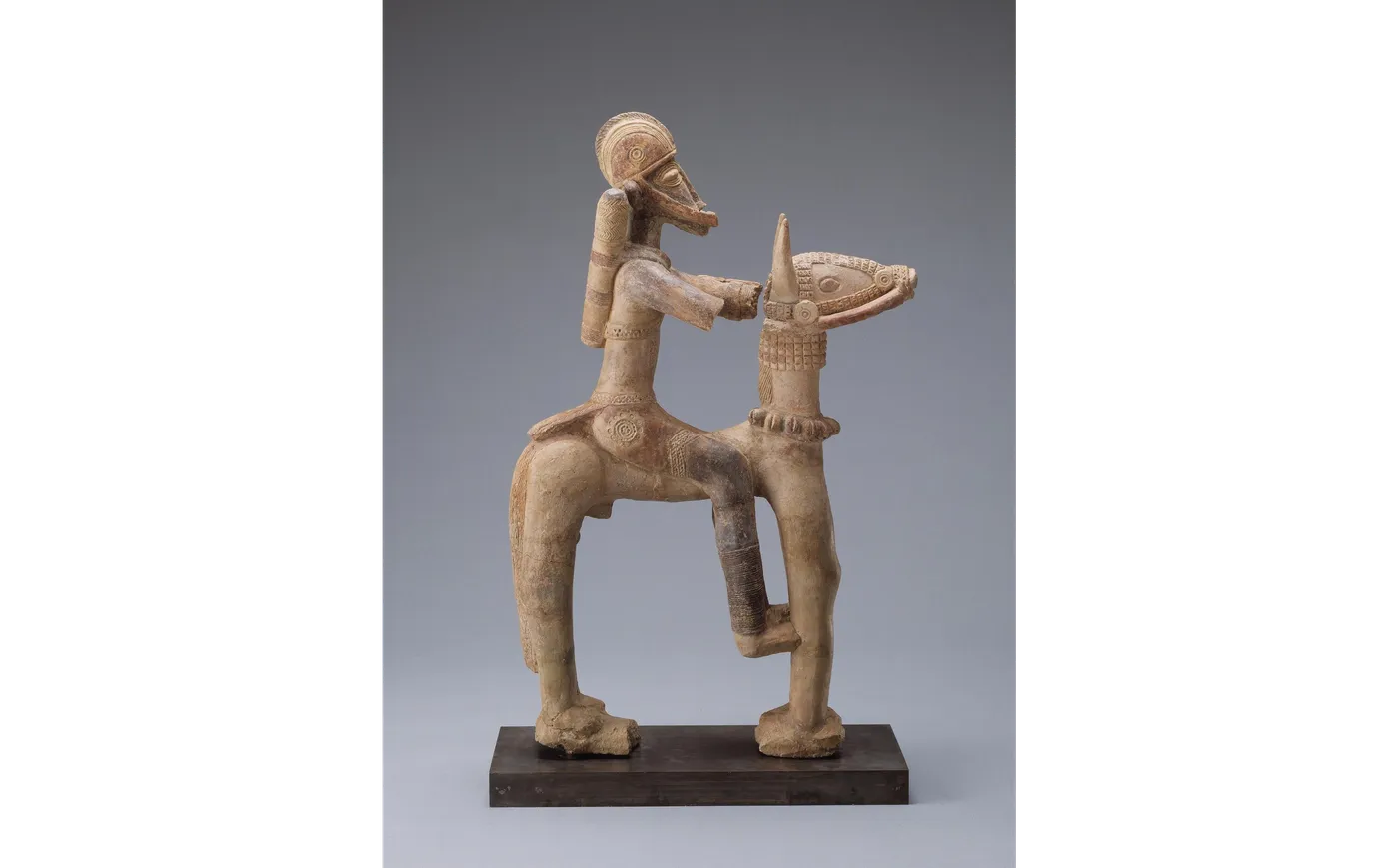
This sculpture depicts a mounted rider, and it connects directly to the point about Mali's military strength. Remember that Mali's wealth allowed its rulers to crossbreed powerful North African horses and equip fighters with steel weapons. A sculpture like this one reflects how central horseback warriors were to Malian identity and power, cavalry wasn't just a battlefield tool, it was significant enough to be memorialized in the empire's art.
The figure is terracotta (fired clay) from the Inland Niger Delta, the region around the city of Djenné in today's Mali, made sometime between the 1200s and 1400s. Look at the detail on the rider's helmet, jewelry, and gear, and on the horse's decorated bridle and harness. The best horses came across the Sahara from North Africa and were expensive to keep, so a mounted rider like this one stood for wealth, high rank, and military power.