

1.4 - Africa’s Ancient Societies
Early Complex Societies in East and West Africa
Some of the world's earliest large-scale, complex societies actually started in Africa, not just in the places history classes usually focus on.
Egypt and Nubia both emerged along the Nile River around 3000 BCE. Nubia (also known as Kush or Cush) formed in what's now Egypt and Sudan, and it developed its own writing system through its city of Meroë. Nubia was actually the source of Egypt's gold and other luxury trade goods, and that economic relationship eventually created tension between the two societies. Around 750 BCE, that tension boiled over: Nubia defeated Egypt and established the twenty-fifth dynasty, known as the dynasty of the Black Pharaohs, who ruled Egypt for about a century.
Further east, the Aksumite Empire (covering what's now Eritrea and Ethiopia) rose up around 100 BCE. Its location next to the Red Sea was huge for its success, since that gave it direct access to major maritime trade routes connecting the Mediterranean world and the Roman Empire all the way to India. Aksum wasn't just a trading hub either, it developed its own currency and its own script, called Ge'ez.
Aksum's main port, Adulis, on the Red Sea, shipped out ivory and other goods from the African interior and brought in goods from the Mediterranean and India. Aksum was also one of the few states of its time to mint its own gold coins, and it put Greek writing on them so traders across the Red Sea and Mediterranean world could read them.
Over in West Africa, the Nok society (in present-day Nigeria) emerged around 500 BCE and was one of the earliest ironworking societies in the region. They're best known today for their pottery and their naturalistic terracotta sculptures of people and animals, often shown with detailed hairstyles and jewelry. These artifacts matter a lot historically, they're the oldest surviving evidence we have of a complex, settled society in sub-Saharan Africa.
Along with the sculptures, archaeologists have found Nok pottery, stone tools such as grinding stones, and furnaces where the Nok smelted iron.
Why These Ancient Societies Matter to Black Communities
These civilizations aren't just interesting ancient history, they carry real cultural and political weight for Black communities, both historically and today.
Aksum in particular was the first African society to adopt Christianity on its own, under King Ezana's leadership. That's an important distinction: this wasn't Christianity imposed through colonialism or the transatlantic slave trade, it was a choice Aksum made independently, on its own terms. Its script, Ge'ez, is still used today as the main liturgical language of the Ethiopian Orthodox Church, so this history isn't just preserved in books, it's still actively practiced.
This happened in the mid-300s CE. A Christian from Tyre (in today's Lebanon) named Frumentius, who had been brought to Aksum as a young captive and later became its first bishop, helped bring Christianity to the royal court. Ezana's coins show the change: his earlier coins carry a crescent and disc, symbols of Aksum's older religion, and his later coins carry a cross.
Starting in the late 1700s, African American writers began pointing to ancient Africa in both their religious and secular writing. They used examples like Egypt, Nubia, and Aksum to directly push back against racist stereotypes claiming African societies had no real government or culture. This body of writing became part of the early foundation of African American Studies as a field.
Two examples show how this worked. In sacred writing, Black churches and writers often quoted Psalm 68:31 from the Bible, "Princes shall come out of Egypt; Ethiopia shall soon stretch out her hands unto God," as a promise that Africa and its people would rise. In secular writing, David Walker's Appeal to the Coloured Citizens of the World (1829) pointed to ancient Egypt to argue that Africans had built one of the world's first great civilizations.
Then in the mid-twentieth century, this same history took on political weight again. Research into the complexity and achievements of Africa's ancient societies helped support African political movements demanding self-rule and independence from European colonial powers. In other words, the argument was: if these societies were this advanced and organized thousands of years ago, the case for colonial rule falls apart.
You can see this in the independence era. In the 1950s, Senegalese scholar Cheikh Anta Diop argued that ancient Egypt was a Black African civilization, an argument that influenced African and African American scholars for decades. New nations also took their names from Africa's great states of the past: the Gold Coast became Ghana at independence in 1957, naming itself after the old West African empire (Topic 1.5), and Mali (1960) and Zimbabwe (1980) did the same (Topic 1.8).
Required Sources
Image of Aksumite Coin Showing King Ezana, Circa 340 to 400
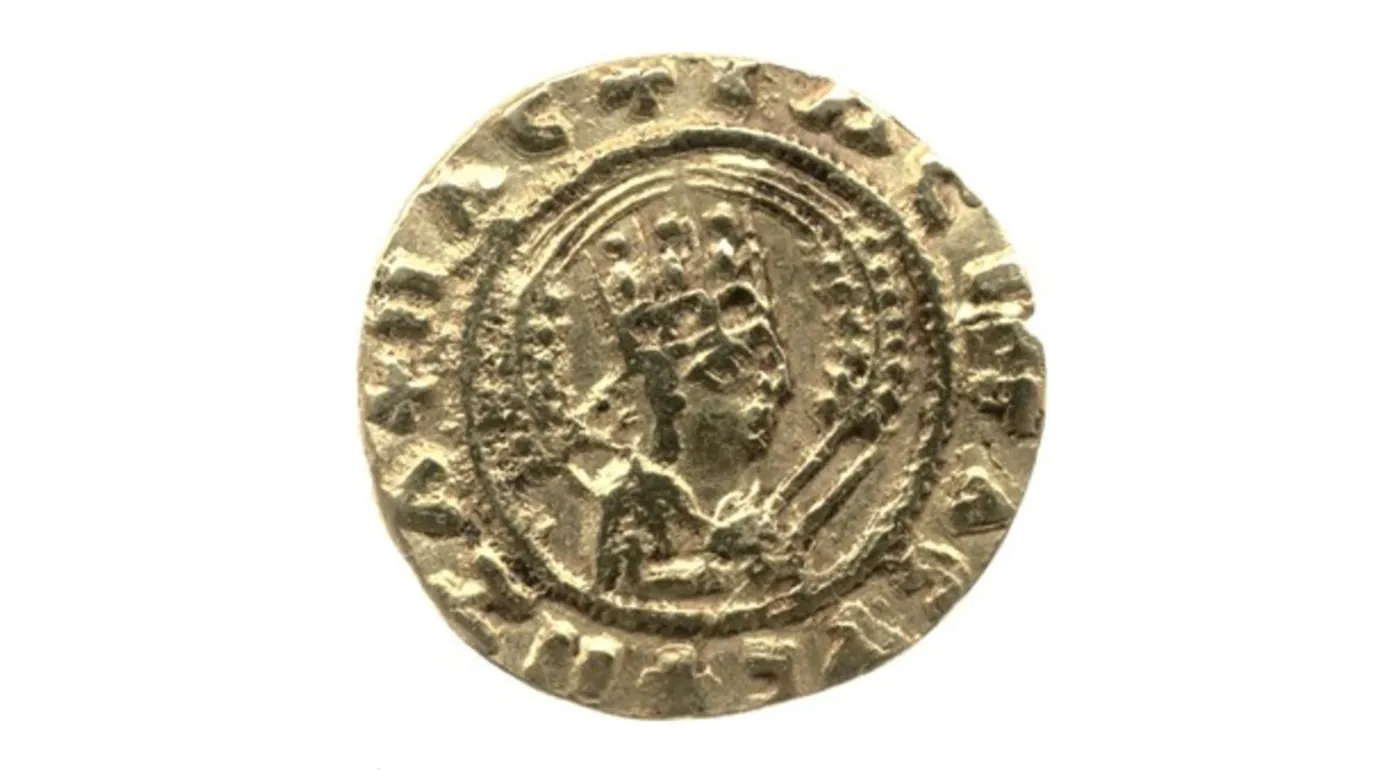
This coin is physical proof of everything covered above about Aksum's independence and sophistication. The fact that Aksum minted its own currency at all shows it operated as a legitimate, self-sufficient economic power, not a dependent or peripheral society. And because it features King Ezana specifically, the ruler credited with bringing Christianity to Aksum, it directly connects to the point that African societies could and did adopt world religions entirely on their own initiative.
On the coin you can see King Ezana's crowned head and a small cross at the top of the lettering around the edge. The inscription is in Greek, the language of trade around the Red Sea and Mediterranean, which shows who Aksum expected to use its coins: merchants far beyond Africa. Coins like this one are among the earliest coins anywhere to carry a Christian symbol.
Image of Nok Sculpture, Circa 900 BCE to 200 CE
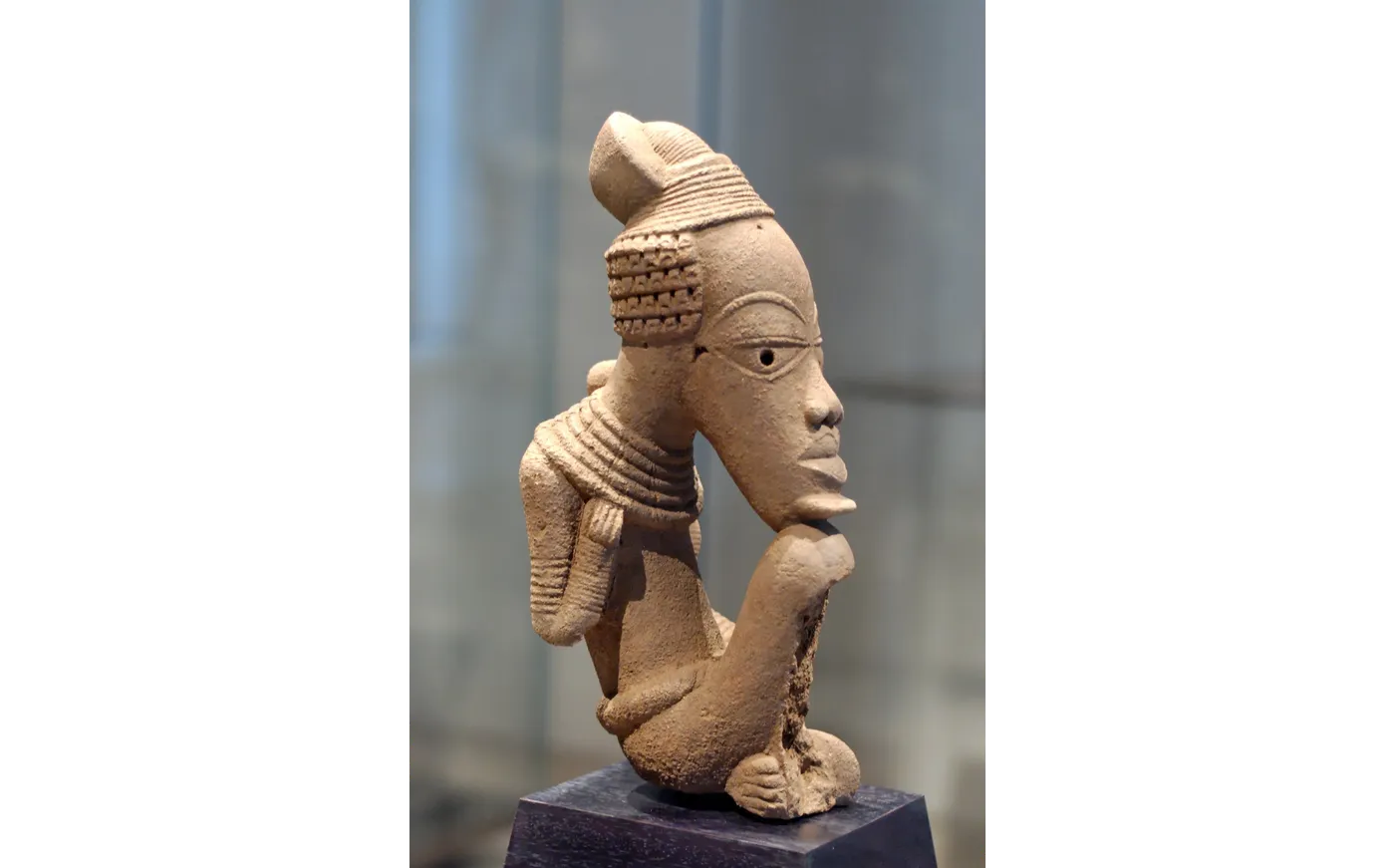
This sculpture is the kind of artifact that anchors the Nok society's whole legacy. It's worth knowing that archaeological research in the 1940s is what first brought Nok history to light. What makes these sculptures especially significant is their strong resemblance to later terracotta work from the Ife Yoruba and Benin cultures, which suggests the Nok may actually be an early ancestor of those better-known traditions. So this single sculpture isn't just standalone art, it's a thread connecting West African artistic and cultural lineage across thousands of years.
This figure sits with its chin resting on its knee. Look for the features that make Nok sculpture easy to recognize: an elaborate hairstyle, stacked necklaces, and large carved eyes with pierced pupils. Because Nok artists put so much care into hair and jewelry, sculptures like this one may also show how Nok people styled their hair and decorated themselves.