

3.16 - The Great Migration
What Caused the Great Migration
The Great Migration stands as one of the largest internal migrations in United States history. Between the 1910s and the 1970s, roughly six million African Americans relocated in successive waves from the South to the North, Midwest, and western United States, reshaping the demographic map of the entire country.
Several forces converged to drive this movement. Labor shortages in the North during both the First and Second World Wars opened up real job opportunities in northern industrial cities, drawing African Americans who were seeking genuine economic advancement they couldn't find in the South.
Environmental hardship played its own role too. Floods, boll weevil infestations, and spoiled crops left many Black Southerners economically devastated, pushing them to look elsewhere for stability.
Perhaps most urgently, many African Americans left simply in search of safety. The constant threat of unchecked lynching and racial violence under Jim Crow made staying in the South a genuine danger for Black families, and leaving became, for many, a matter of survival rather than just opportunity.
None of this migration would have been logistically possible without two key developments: the expanding railway system, which gave people an actual physical means of traveling north, and the Black press, which provided encouragement and practical instructions for African Americans planning to leave the South, functioning as an essential information network for people making an enormous, often risky decision.
The Chicago Defender, founded in 1905 by Robert S. Abbott, was the most influential paper in this effort. It printed job ads and train schedules, ran stories about life in the North, and in 1917 called for a "Great Northern Drive." Black Pullman porters and other railroad workers carried copies into the South, where some white officials tried to ban the paper. The Illinois Central Railroad, which ran from New Orleans through Mississippi straight up to Chicago, became one of the main migration routes.
The Impact of the Great Migration
The Great Migration didn't just relocate people, it fundamentally transformed American cities, Black communities, and the trajectory of Black cultural movements as a whole. As millions of Black Southerners moved into cities like New York, Chicago, Pittsburgh, and Los Angeles, they brought Black Southern culture with them, helping forge a more unified, shared African American culture that stretched across the entire country rather than staying regionally isolated.
This migration also shifted the basic character of African American life itself, transforming a population that had been primarily rural into one that was now primarily urban. Black Southerners built entirely new relationships with their northern environments, for instance, engaging with nature as a source of leisure rather than as the site of agricultural labor they'd known in the South.
This mass departure didn't go unopposed either. As underpaid and disempowered Black laborers began leaving Southern jobs behind, racial tensions actually increased. Southern employers, unhappy about losing their labor force, often resisted this exodus directly, in some cases having Black workers unjustly arrested to try to prevent them from leaving.
Organizations sprang up specifically to help migrants navigate this massive transition. The National Urban League, founded in New York City in 1910 as an interracial organization, played a direct role in assisting African Americans arriving from the rural South, helping them acclimate to unfamiliar urban life and secure housing and employment. The League's work didn't stop with the Great Migration either, it went on to support A. Philip Randolph's 1941 March on Washington and later worked directly alongside the Southern Christian Leadership Conference during the Civil Rights Movement, showing how the infrastructure built to support migration fed directly into the next generation of civil rights organizing.
The 1941 march never actually took place: Randolph called it off after President Franklin D. Roosevelt issued Executive Order 8802, which banned racial discrimination in defense industries.
Required Sources
Anonymous Letter Beckoning African Americans to Leave the South, Published in The Messenger, March 1920, in Call and Response, 258
The AP framework calls this an anonymous letter, but it was printed as an unsigned editorial titled "Negroes, Leave the South!" in the March 1920 issue of The Messenger, a radical, socialist monthly magazine started in New York in 1917 by A. Philip Randolph and Chandler Owen. It speaks directly to Black Southerners, urging them to go North, East, or West, anywhere, for better schools, higher wages, the vote, better housing, and more liberty. It also makes an economic argument: every worker who leaves makes labor scarcer in the South, which forces employers there to pay the people who stay more. Coming less than a year after the Red Summer, it shows how the Black press treated migration as both an escape and a form of protest.
NEGROES, LEAVE THE SOUTH!
Fellow Negroes of the South, leave there. Go North, East, and West, anywhere, to get out of that hell hole. There are better schools here for your children, higher wages for yourselves, votes if you are twenty-one, better housing and more liberty. All is not rosy here, by any means, but it is Paradise compared with Georgia, Arkansas, Texas, Mississippi and Alabama. Besides, you make it better for those you leave behind. Labor becomes scarce, so that the Bourbons of Dixie are compelled to pay your brothers back home more wages. They will give them more schools and privileges, too, to try to get them to come back, and, secondly, to try to keep you from leaving.
Stop buying property in the South, to be burned down and run away from over night. Sell out your stuff quietly, saying nothing to the Negro lackeys, and leave! Come into the land of at least incipient civilization!
Anonymous (unsigned), "Negroes, Leave the South!" (1920). Source: The Messenger, March 1920, p. 2, HathiTrust scan of the University of California copy, hosted by the Marxists Internet Archive
The Migration Series by Jacob Lawrence, 1940 to 1941 (various panels, in particular Panel No. 1)
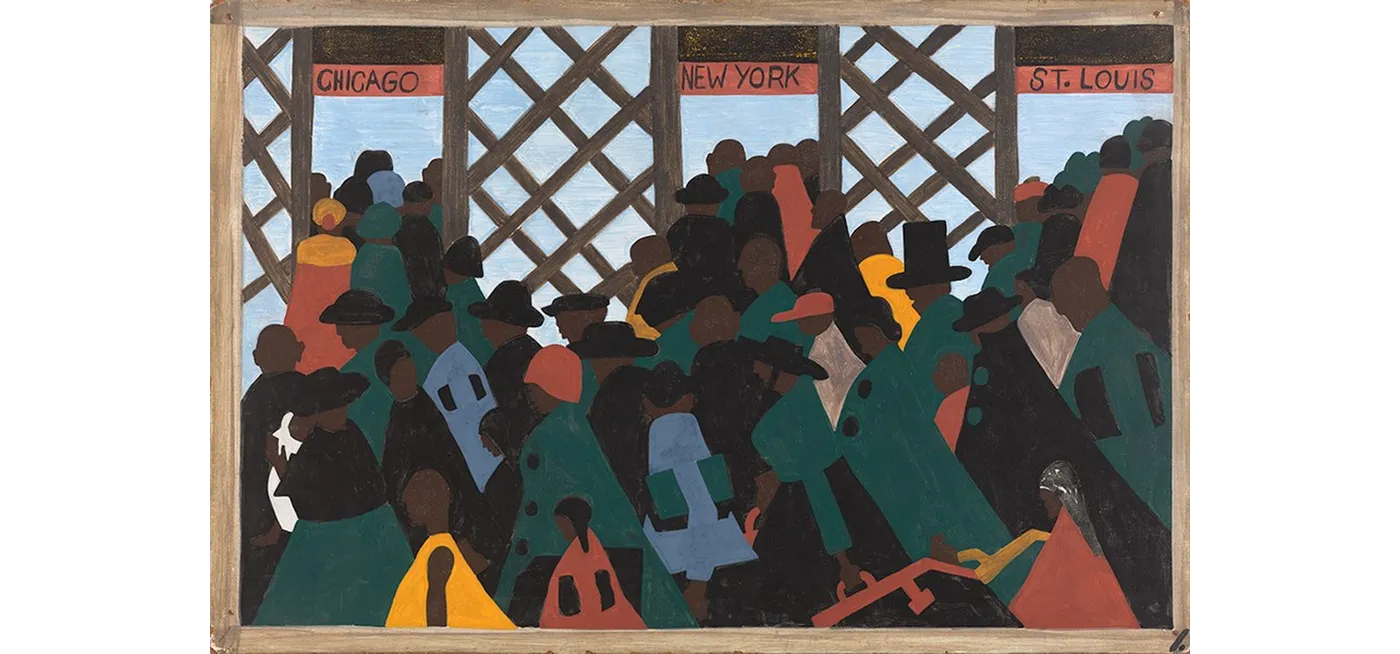
In this series, Jacob Lawrence chronicles the hopes and hardships African Americans experienced throughout the Great Migration. His work is especially known for its social realism, using visual art to depict the migration's human dimension in a way that pure statistics or written accounts can't fully capture. Starting with Panel No. 1 gives a sense of how Lawrence structured the entire series as a visual narrative, following the migration's arc from its causes to its consequences across dozens of connected images.
Lawrence, whose own parents had moved north during the Great Migration, painted the series' 60 small panels in 1940 and 1941, finishing when he was only 23. Each panel has a short caption. Panel No. 1 shows crowds of travelers pushing through a train station toward gates marked Chicago, New York, and St. Louis. In 1942 the series was split between the Phillips Collection in Washington, D.C. (the odd-numbered panels) and the Museum of Modern Art in New York (the even-numbered panels).
Map of the Great Migration
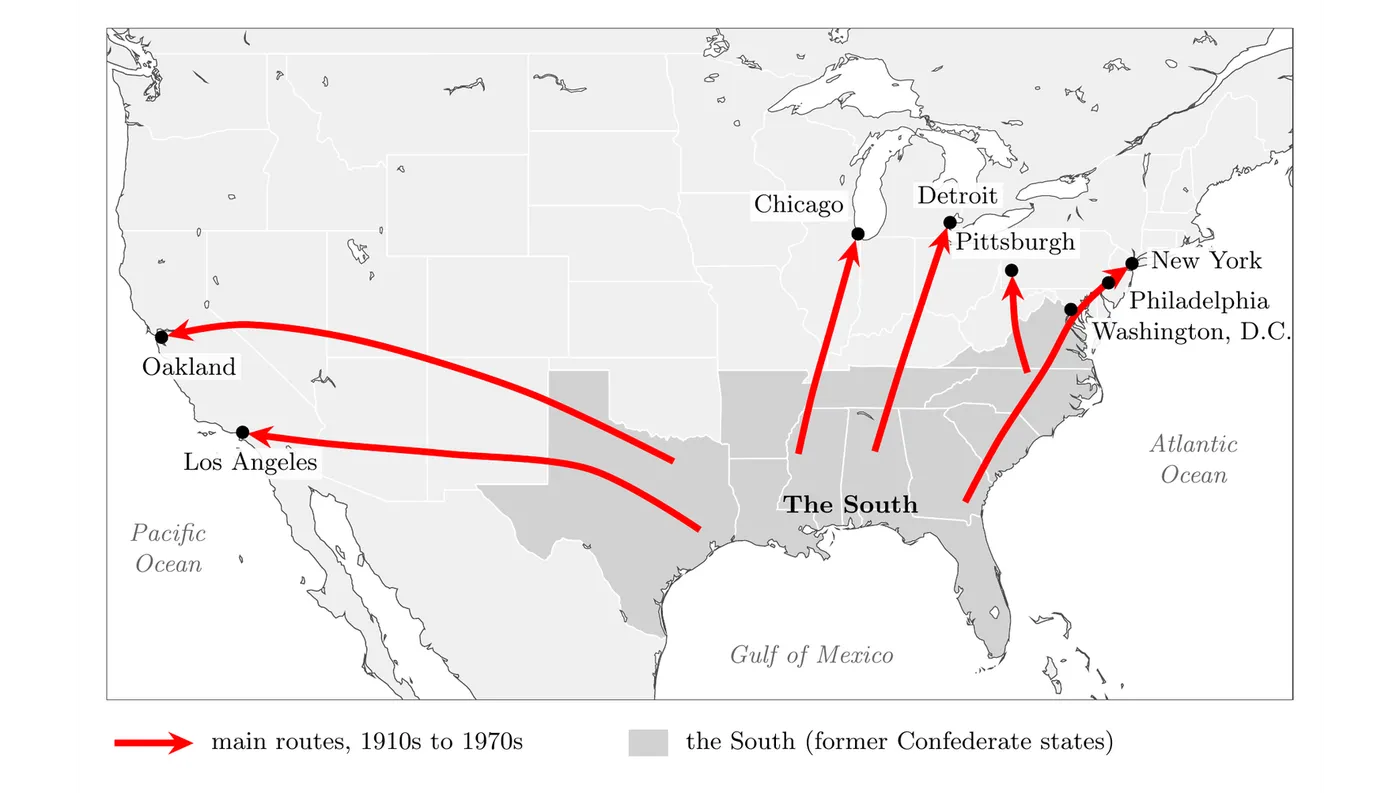
This map turns the scale of the Great Migration into something visible and immediate, showing exactly how population flowed from Southern states toward cities like New York, Chicago, Pittsburgh, and Los Angeles. Seeing these routes mapped out helps clarify why certain cities became such significant centers of Black culture and political organizing in the decades that followed, they were quite literally where the migration was heading.