

3.1 - The Reconstruction Amendments
Redefining Citizenship After the Civil War
During Reconstruction, which ran from 1865 to 1877, the federal government took on the enormous task of reintegrating the former Confederate states while also trying to establish and protect real rights for free and formerly enslaved African Americans. This included granting citizenship, equal rights, and political representation within American government, a genuinely transformative shift on paper, even if the reality proved far messier in practice.
Three constitutional amendments did the heavy lifting here, and each one tackled a different piece of the puzzle.
The Thirteenth Amendment, ratified in 1865, officially abolished slavery and involuntary servitude, with one significant exception: as punishment for a crime, a carve-out that would go on to have serious consequences in later eras.
The Fourteenth Amendment, ratified in 1868, established the principle of birthright citizenship in the United States and guaranteed equal protection under the law to all people. This amendment directly overturned the Dred Scott v. Sandford decision from 1857, which had denied African Americans citizenship entirely, and it also undercut various state-level Black codes that had been used to restrict Black rights after emancipation.
The Fifteenth Amendment, ratified in 1870, prohibited both the federal government and individual states from denying or restricting a citizen's right to vote based on "race, color, or previous condition of servitude." In practice, this amendment extended voting rights to Black men for the first time at a constitutional level.
The Impact of Black Political Participation
The Fifteenth Amendment didn't just exist on paper, it opened the door to real, formal political participation for Black men across the country. The sheer scale of African American involvement in Southern politics during Reconstruction, with thousands of newly enfranchised voters, many of them formerly enslaved, became one of the defining features of the entire era.
During Reconstruction, nearly 2,000 African Americans went on to serve in public office, ranging from local positions all the way up to the United States Senate, a remarkable and rapid political transformation for a population that had been enslaved just years earlier. Unfortunately, much of this progress didn't last. Many of the rights African Americans gained during Reconstruction were systematically rolled back during the Jim Crow era that followed, and African Americans would later have to fight in the 1960s to reclaim rights that had actually already been secured, and then lost, back in the 1870s.
Required Sources
The Thirteenth, Fourteenth, and Fifteenth Amendments to the United States Constitution, 1865, 1868, and 1870
The required reading covers specific sections: Sections 1 and 2 of the Thirteenth Amendment, Sections 1, 3, and 4 of the Fourteenth, and Sections 1 and 2 of the Fifteenth. Congress passed each amendment and sent it to the states, which ratified them in 1865, 1868, and 1870. Here's what each section says, in plain terms:
- Thirteenth, Section 1: Neither slavery nor involuntary servitude can exist in the United States, "except as a punishment for crime whereof the party shall have been duly convicted." That exception is the loophole Southern states later used to build the convict leasing system.
- Thirteenth, Section 2: Congress has the power to enforce the amendment "by appropriate legislation."
- Fourteenth, Section 1: Everyone born or naturalized in the United States (and subject to its jurisdiction) is a citizen of the nation and of the state where they live. No state can take away the privileges or immunities of citizens, deprive any person of "life, liberty, or property, without due process of law," or deny any person "the equal protection of the laws." Due process means the government has to follow fair legal procedures before punishing someone or taking their property, and equal protection means a state's laws have to apply equally to everyone.
- Fourteenth, Section 3: Anyone who had sworn an oath to support the Constitution as a federal or state official and then took part in insurrection or rebellion (in practice, Confederate leaders) is barred from Congress, from serving as a presidential elector, and from any federal or state office, unless two-thirds of each house of Congress votes to remove that ban.
- Fourteenth, Section 4: The federal government's own debts, including those from putting down the rebellion, can't be questioned. But no government may pay the Confederacy's debts or pay anyone for "the loss or emancipation of any slave," so former enslavers got no compensation for the people they had held in bondage.
- Fifteenth, Section 1: The right of citizens to vote can't be "denied or abridged by the United States or by any State on account of race, color, or previous condition of servitude."
- Fifteenth, Section 2: Congress can enforce the amendment "by appropriate legislation." Congress used this power in the Enforcement Acts of 1870 and 1871, which made it a federal crime to use force, threats, or bribery to keep Black men from voting and targeted the Ku Klux Klan.
Read together, these sections show how Congress defined citizenship after slavery: freedom (Thirteenth), citizenship and equal treatment under the law (Fourteenth), and voting rights for Black men (Fifteenth), with Congress given the power to enforce each one. They also show the limits written into the text. The crime exception in the Thirteenth Amendment was later exploited, and because the Fifteenth Amendment only banned denying the vote "on account of race," Southern states got around it with poll taxes, literacy tests, and grandfather clauses that never mentioned race. The Fifteenth also said nothing about sex, so women of every race had no constitutional right to vote until the Nineteenth Amendment (1920).
Amendment XIII Section 1. Neither slavery nor involuntary servitude, except as a punishment for crime whereof the party shall have been duly convicted, shall exist within the United States, or any place subject to their jurisdiction. Section 2. Congress shall have power to enforce this article by appropriate legislation.
Amendment XIV Section 1. All persons born or naturalized in the United States, and subject to the jurisdiction thereof, are citizens of the United States and of the State wherein they reside. No State shall make or enforce any law which shall abridge the privileges or immunities of citizens of the United States; nor shall any State deprive any person of life, liberty, or property, without due process of law; nor deny to any person within its jurisdiction the equal protection of the laws. Section 3. No person shall be a Senator or Representative in Congress, or elector of President and Vice-President, or hold any office, civil or military, under the United States, or under any State, who, having previously taken an oath, as a member of Congress, or as an officer of the United States, or as a member of any State legislature, or as an executive or judicial officer of any State, to support the Constitution of the United States, shall have engaged in insurrection or rebellion against the same, or given aid or comfort to the enemies thereof. But Congress may by a vote of two-thirds of each House, remove such disability. Section 4. The validity of the public debt of the United States, authorized by law, including debts incurred for payment of pensions and bounties for services in suppressing insurrection or rebellion, shall not be questioned. But neither the United States nor any State shall assume or pay any debt or obligation incurred in aid of insurrection or rebellion against the United States, or any claim for the loss or emancipation of any slave; but all such debts, obligations and claims shall be held illegal and void.
Amendment XV Section 1. The right of citizens of the United States to vote shall not be denied or abridged by the United States or by any State on account of race, color, or previous condition of servitude. Section 2. The Congress shall have power to enforce this article by appropriate legislation.
U.S. Congress, Thirteenth Amendment (sections 1 and 2), Fourteenth Amendment (sections 1, 3, and 4), and Fifteenth Amendment (sections 1 and 2) to the U.S. Constitution (1865, 1868, 1870). Source: National Archives, "The Constitution: Amendments 11 to 27"
Engraved Portrait of Five African American Legislators from Reconstruction Congresses, Early 1880s
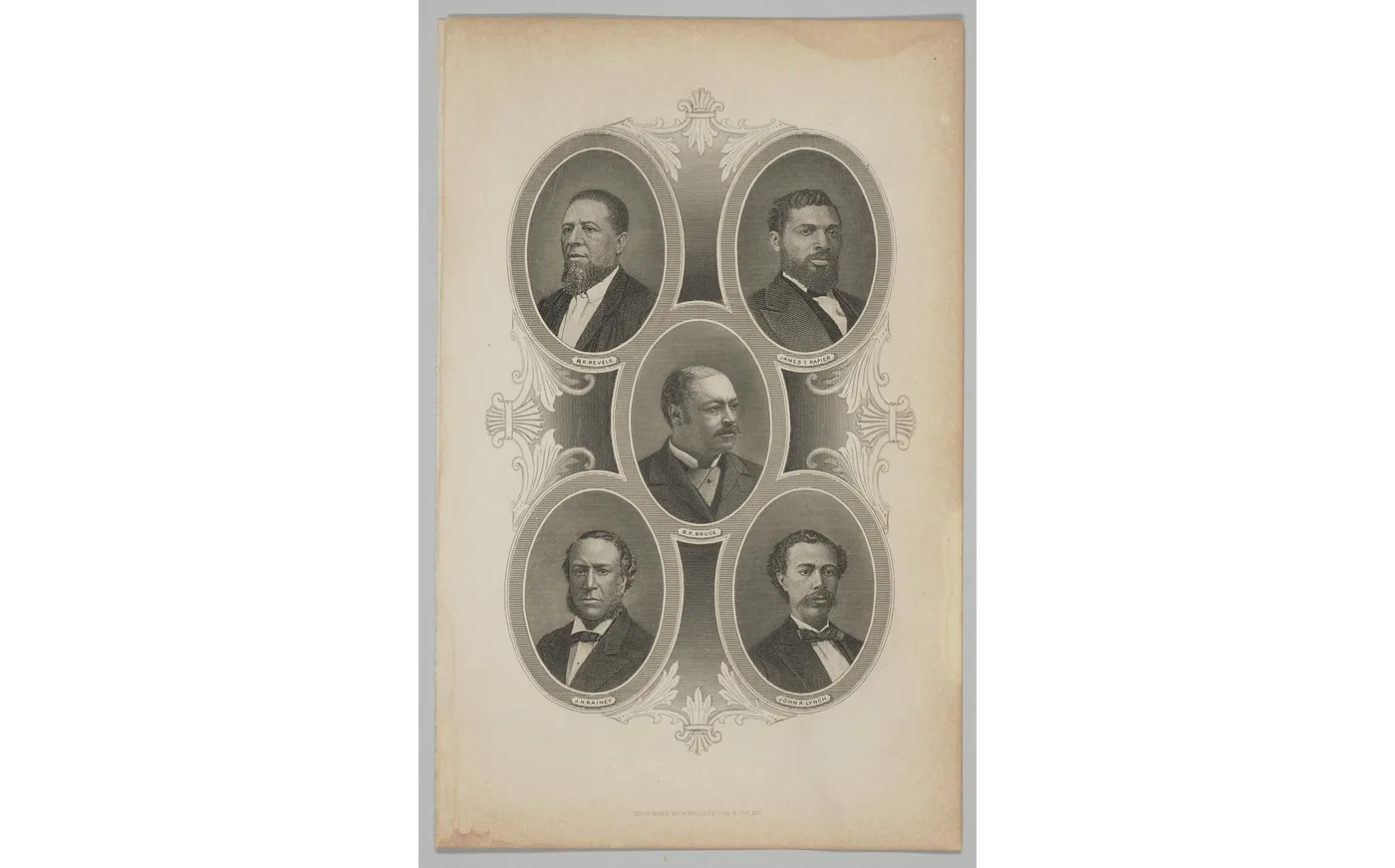
This portrait puts real faces to the political transformation described above, depicting five men who each broke significant ground during Reconstruction. Hiram Revels, of both African and Indigenous ancestry, became the first African American to serve in either house of Congress. Blanche Bruce, born enslaved, became the first African American elected to serve a full term in the U.S. Senate. John Lynch, also born enslaved, became the first African American Speaker of the Mississippi House of Representatives, and remarkably remained the only African American to represent Mississippi in the U.S. House for the following hundred years, a sobering reminder of just how thoroughly Reconstruction-era gains were rolled back. Joseph Rainey, born enslaved, became the first African American to serve in the House of Representatives and to preside over a House debate, and he held the distinction of being the longest-serving Black lawmaker in Congress throughout Reconstruction. James Rapier became Alabama's second Black Representative and went on to found the state's first Black-owned newspaper. Together, these five men's stories capture both the genuine achievement and the historical fragility of Black political power during this era.