

3.6 - White Supremacist Violence and the Red Summer
The Roots of Heightened Racial Violence
Between 1917 and 1921, the United States saw a sharp rise in racial violence driven by white supremacists. The most intense period of this violence, in 1919, became known as the "Red Summer," a term actually coined by African American writer and activist James Weldon Johnson.
That summer's violence didn't emerge out of nowhere, it was fueled by a combination of factors converging all at once: a global flu pandemic, fierce competition for jobs, and open racial discrimination against Black veterans who had just returned from serving in the First World War. Together, these tensions sparked more than 30 separate urban race riots across the country in a single summer.
Two examples show how this played out. In Chicago in July 1919, a Black teenager named Eugene Williams drowned in Lake Michigan after a white man threw rocks at him for drifting toward a beach that whites claimed as theirs. When police refused to arrest the man, fighting spread across the city for about a week, leaving 38 people dead (23 Black and 15 white) and more than 500 injured. Tensions had been building for months as Black migrants and white workers competed for jobs and housing. In Elaine, Arkansas, that fall, Black sharecroppers met to organize a union and demand fair prices for their cotton. White mobs, later joined by federal troops, killed somewhere between about 100 and more than 200 Black people, and afterward it was Black farmers, not their attackers, who were put on trial.
Two years later, in 1921, this same undercurrent of white supremacist violence exploded into one of the most devastating attacks on a Black community in American history. A mob of white residents, joined by city officials, incited the Tulsa race massacre in Tulsa, Oklahoma. The massacre destroyed more than 1,250 homes and businesses in Greenwood, a neighborhood so prosperous it was known as "Black Wall Street," one of the most affluent African American communities anywhere in the United States at the time.
The consequences of this violence reached far beyond the immediate destruction. Racial violence throughout the twentieth century, events like Tulsa chief among them, prevented countless African American families from passing down wealth and property to future generations, erasing decades of accumulated economic progress in a matter of hours.
How African Americans Responded
Faced with this level of coordinated violence, African Americans didn't simply absorb the blow. They resisted through political activism, published firsthand accounts of the violence, and in some cases, armed self-defense, refusing to let these attacks go undocumented or unanswered.
Each kind of resistance had clear examples. For political activism, the NAACP organized the Silent Protest Parade in New York in July 1917, where about 10,000 African Americans marched without a word down Fifth Avenue to protest the East St. Louis massacre and lynching, and it pushed Congress for a federal anti-lynching law (the Dyer Bill passed the House in 1922 but died in the Senate). For published accounts, Black newspapers and writers documented violence that the white press ignored or blamed on Black people; Ida B. Wells-Barnett, for example, investigated and wrote about the Elaine massacre. For armed self-defense, Black residents, many of them World War I veterans, fought back during the 1919 riots in Chicago and Washington, D.C. In Tulsa in 1921, armed Black men went to the courthouse to stop a white mob from lynching Dick Rowland, a young Black man accused of assaulting a white woman, and that confrontation set off the massacre.
This same climate of racial violence, combined with a lack of economic opportunity across the South, also helped set in motion the beginnings of the Great Migration, as African Americans began looking north and west for a chance at safety and opportunity that the South increasingly refused to provide.
This form of violence persisted for a long time in American life. The U.S. Senate didn't pass a bill making lynching a federal hate crime until 2018, and lynching didn't become a federal hate crime by law until March 2022, when the Emmett Till Antilynching Act was signed. The brutal 1955 murder of 14-year-old Emmett Till stands as a stark reminder of just how long lynching continued to be used as a tool of white supremacist terror, decades after the Red Summer and the Tulsa massacre.
Required Sources
"If We Must Die" by Claude McKay, 1919
This poem was written by Claude McKay, a Jamaican poet and a key figure of the Harlem Renaissance, in direct response to the violence of the Red Summer. Rather than portraying Black communities as passive victims, McKay's poem urges African Americans to preserve their dignity and actively fight back against anti-Black violence and discrimination, capturing the spirit of resistance described above in a single, defiant piece of writing.
McKay published the poem, a sonnet, in the magazine The Liberator in July 1919, as the Red Summer violence was building. It never mentions race directly. Instead, the speaker refuses to die "like hogs" and calls on the persecuted to face the mob with courage, "dying, but fighting back." Black readers took it up as a rallying cry, and it became one of the best-known early works of the Harlem Renaissance. It's a clear example of a published response to white supremacist violence.
If we must die, let it not be like hogs Hunted and penned in an inglorious spot, While round us bark the mad and hungry dogs, Making their mock at our accursèd lot. If we must die, O let us nobly die, So that our precious blood may not be shed In vain; then even the monsters we defy Shall be constrained to honor us though dead! O kinsmen! we must meet the common foe! Though far outnumbered let us show us brave, And for their thousand blows deal one death-blow! What though before us lies the open grave? Like men we'll face the murderous, cowardly pack, Pressed to the wall, dying, but fighting back!
Claude McKay, "If We Must Die" (1919), as printed in McKay's Harlem Shadows (1922). Source: Project Gutenberg
Photograph of the Greenwood District Burning During the Tulsa Race Massacre, 1921
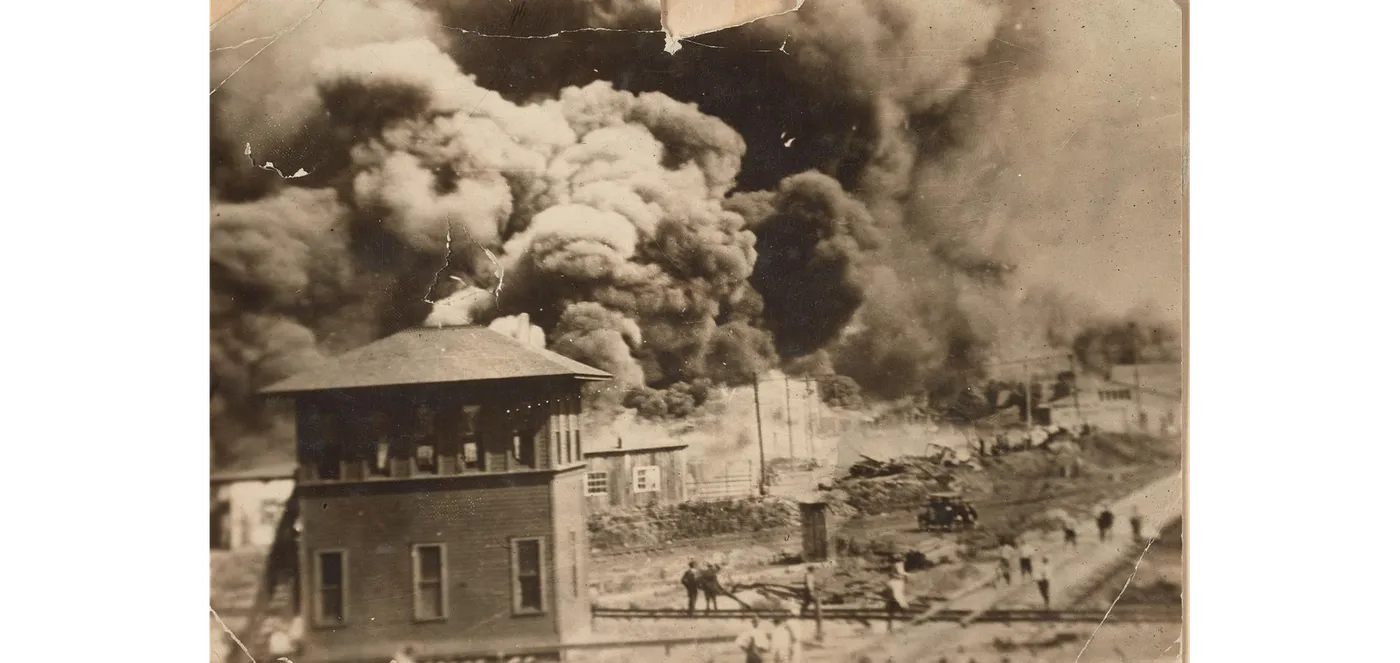
This photograph captures the destruction of Greenwood as it was actually happening, giving a visceral sense of the scale of violence unleashed on what had been one of the wealthiest Black communities in the country. Seeing the fire in progress helps convey just how quickly generations of accumulated Black wealth could be, and was, destroyed.
Photograph of Black Men with Hands Raised During the Tulsa Race Massacre, 1921
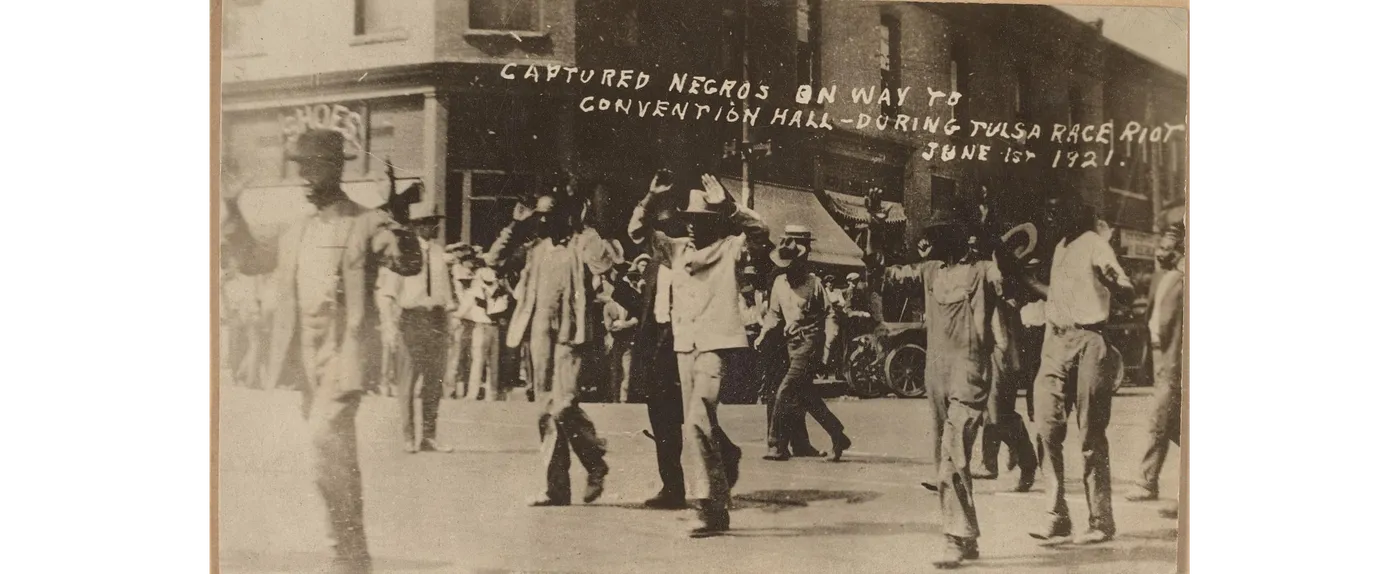
This image shows Black men being forcibly detained during the massacre, hands raised in surrender. It's a stark visual reminder that the violence in Tulsa wasn't limited to property destruction, it involved direct physical intimidation and control over Black residents themselves, often with the backing or participation of local authorities.
Photograph of Destruction in Greenwood After the Tulsa Race Massacre, 1921
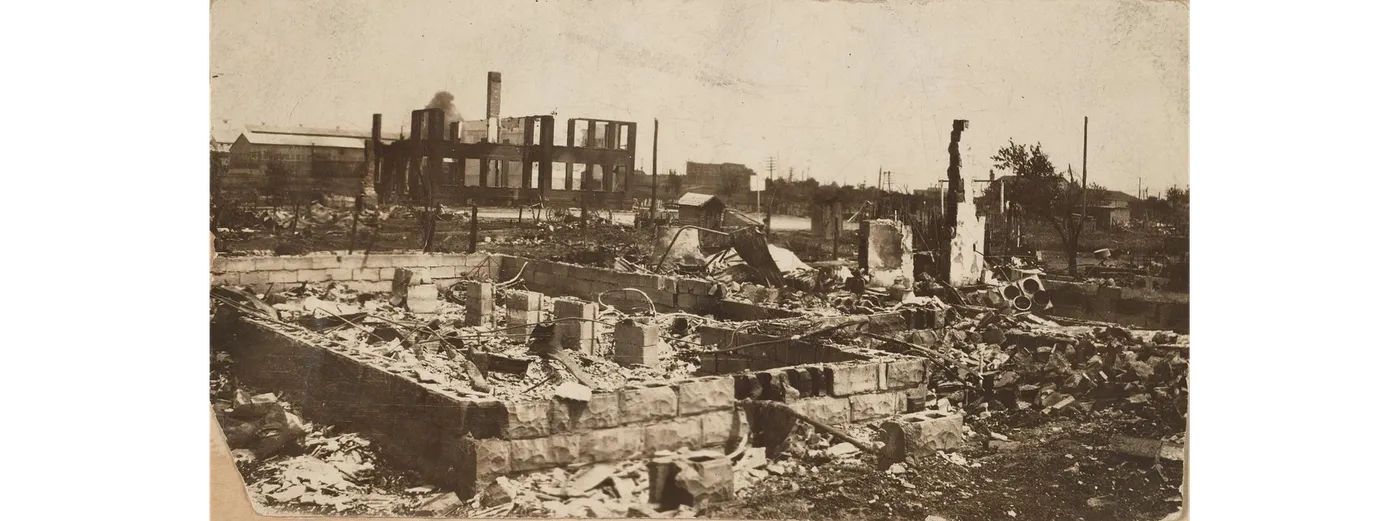
This photograph shows the aftermath, the wreckage left behind once the violence had ended. Seeing Greenwood reduced to rubble drives home the essential knowledge point above: this destruction wasn't just a tragic event in the moment, it permanently disrupted the ability of Black families in Greenwood to build and pass down generational wealth.