

3.5 - Disenfranchisement and Jim Crow Laws
The Rise of Jim Crow Laws
The term "Jim Crow" actually originated in the 1830s, decades before the laws it would later name even existed. It came from a white stage performer named Thomas Dartmouth "T.D." Rice, who performed in blackface as part of an act called "Jump, Jim Crow," caricaturing African Americans through exaggerated speech and dance. The popularity of Rice's demeaning performance is what turned "Jim Crow" into a common derogatory term for Black people in the first place, a term that would later be attached to an entire legal system of racial oppression.
Jim Crow laws themselves were local and state-level statutes, passed primarily, though not exclusively, in the South, and they operated under the legal protection of the Supreme Court's 1896 decision in Plessy v. Ferguson, which upheld racial segregation under the doctrine of "separate but equal." These laws restricted Black men's right to vote and enforced racial segregation across nearly every aspect of public life, hospitals, transportation, schools, and even cemeteries were all segregated by race. This system of legal segregation wouldn't be dismantled until the Civil Rights Movement of the 1950s and 1960s, meaning it shaped American life for well over half a century.
The Nadir: Resistance During America's Lowest Point
African American Studies scholars refer to the period between the end of Reconstruction and the start of the Second World War as "the nadir," meaning the lowest point in American race relations. This term was coined by Rayford W. Logan, a Pan-Africanist and historian who studied the post-Reconstruction period closely. It's a fitting name, since this era included some of the most openly, brutally racist public acts in American history, including widespread lynching and mob violence against Black communities.
African American journalists and writers of this period took direct aim at the racist logic underlying Southern lynch laws, laws that were used to try to justify the rampant, unjust killing of Black people. Rather than staying silent, African American activists responded with organized resistance strategies, including trolley boycotts, and they relied heavily on sympathetic journalists in the press to expose and publicize the mistreatment and murder happening in Black communities across the country.
Trolley boycotts were one of the most common forms of protest. When Southern cities and states began requiring segregated streetcars (trolleys) around 1900, African Americans in more than 25 Southern cities organized boycotts between 1900 and 1906, walking instead of riding and, in a few cities, starting their own Black-owned transportation lines. In Montgomery, Alabama, a boycott that began in 1900 pushed the streetcar company to stop enforcing segregation for a few years. Most of the boycotts couldn't overturn the laws, but they showed that Black communities could use their power as customers, a strategy activists would use again in the Montgomery bus boycott of 1955 to 1956.
One of the most significant voices of this era was Ida B. Wells-Barnett. Born into slavery, she became a journalist, civil rights advocate, and feminist active across the late nineteenth and early twentieth centuries. Her writing exposed lynching for what it actually was: a deliberate tool of terror meant to intimidate African Americans out of pursuing any real economic, political, or social advancement. In response to the surge in anti-Black violence following Reconstruction, Wells went so far as to suggest that every African American household own a Winchester rifle for self-protection, a striking, practical response to a system that offered Black communities no legal protection of their own.
Wells's activism started with her own act of resistance. In 1884 she refused to give up her seat in the first-class ladies' car of a Tennessee train and was dragged off. She sued the railroad and won in a local court, but the Tennessee Supreme Court reversed the decision in 1887. Then in 1892, after a white mob in Memphis lynched three Black men who ran a successful grocery store (Thomas Moss, Calvin McDowell, and Will Stewart), Wells used her newspaper, the Free Speech, to urge Black residents to leave Memphis and to stop riding the city's streetcars, and thousands left. While she was traveling in the North, a mob destroyed her newspaper's office, so she carried on her anti-lynching campaign from the North, publishing Southern Horrors (1892) and A Red Record (1895).
Required Sources
Excerpt from Chapter 1 of A Red Record by Ida B. Wells-Barnett, 1895
A Red Record (1895) is Wells-Barnett's pamphlet documenting lynchings in the United States, mostly in the South, in 1892, 1893, and 1894. In Chapter 1, "The Case Stated," she explains how white Southerners' excuses for lynching kept changing: first they claimed they were putting down planned Black "race riots," then that they were preventing "Negro domination" at the polls, and finally that they were protecting white women from assault. She showed that these excuses didn't match the facts, and to make her evidence hard to dismiss, she relied on statistics gathered by white newspapers, especially the Chicago Tribune. Her argument ties directly to this topic: lynching wasn't about punishing crime, it was a tool of terror meant to keep African Americans from voting, prospering, or asserting their rights during the nadir.
Not all nor nearly all of the murders done by white men, during the past thirty years in the South, have come to light, but the statistics as gathered and preserved by white men, and which have not been questioned, show that during these years more than ten thousand Negroes have been killed in cold blood, without the formality of judicial trial and legal execution. And yet, as evidence of the absolute impunity with which the white man dares to kill a Negro, the same record shows that during all these years, and for all these murders only three white men have been tried, convicted, and executed. As no white man has been lynched for the murder of colored people, these three executions are the only instances of the death penalty being visited upon white men for murdering Negroes.
Naturally enough the commission of these crimes began to tell upon the public conscience, and the Southern white man, as a tribute to the nineteenth-century civilization, was in a manner compelled to give excuses for his barbarism. His excuses have adapted themselves to the emergency, and are aptly outlined by that greatest of all Negroes, Frederick Douglass, in an article of recent date, in which he shows that there have been three distinct eras of Southern barbarism, to account for which three distinct excuses have been made.
The first excuse given to the civilized world for the murder of unoffending Negroes was the necessity of the white man to repress and stamp out alleged "race riots." For years immediately succeeding the war there was an appalling slaughter of colored people, and the wires usually conveyed to northern people and the world the intelligence, first, that an insurrection was being planned by Negroes, which, a few hours later, would prove to have been vigorously resisted by white men, and controlled with a resulting loss of several killed and wounded. It was always a remarkable feature in these insurrections and riots that only Negroes were killed during the rioting, and that all the white men escaped unharmed.
[...]
Then came the second excuse, which had its birth during the turbulent times of reconstruction. By an amendment to the Constitution the Negro was given the right of franchise, and, theoretically at least, his ballot became his invaluable emblem of citizenship. In a government "of the people, for the people, and by the people," the Negro's vote became an important factor in all matters of state and national politics. But this did not last long. The southern white man would not consider that the Negro had any right which a white man was bound to respect, and the idea of a republican form of government in the southern states grew into general contempt. It was maintained that "This is a white man's government," and regardless of numbers the white man should rule. "No Negro domination" became the new legend on the sanguinary banner of the sunny South, and under it rode the Ku Klux Klan, the Regulators, and the lawless mobs, which for any cause chose to murder one man or a dozen as suited their purpose best. It was a long, gory campaign; the blood chills and the heart almost loses faith in Christianity when one thinks of Yazoo, Hamburg, Edgefield, Copiah, and the countless massacres of defenseless Negroes, whose only crime was the attempt to exercise their right to vote.
[...]
Brutality still continued; Negroes were whipped, scourged, exiled, shot and hung whenever and wherever it pleased the white man so to treat them, and as the civilized world with increasing persistency held the white people of the South to account for its outlawry, the murderers invented the third excuse: that Negroes had to be killed to avenge their assaults upon women. There could be framed no possible excuse more harmful to the Negro and more unanswerable if true in its sufficiency for the white man.
[...]
The purpose of the pages which follow shall be to give the record which has been made, not by colored men, but that which is the result of compilations made by white men, of reports sent over the civilized world by white men in the South. Out of their own mouths shall the murderers be condemned. For a number of years the Chicago Tribune, admittedly one of the leading journals of America, has made a specialty of the compilation of statistics touching upon lynching. The data compiled by that journal and published to the world January 1, 1894, up to the present time has not been disputed. In order to be safe from the charge of exaggeration, the incidents hereinafter reported have been confined to those vouched for by the Tribune.
Ida B. Wells-Barnett, A Red Record, Chapter 1, "The Case Stated" (1895). Source: Project Gutenberg
Segregated Water Fountains (date unknown)
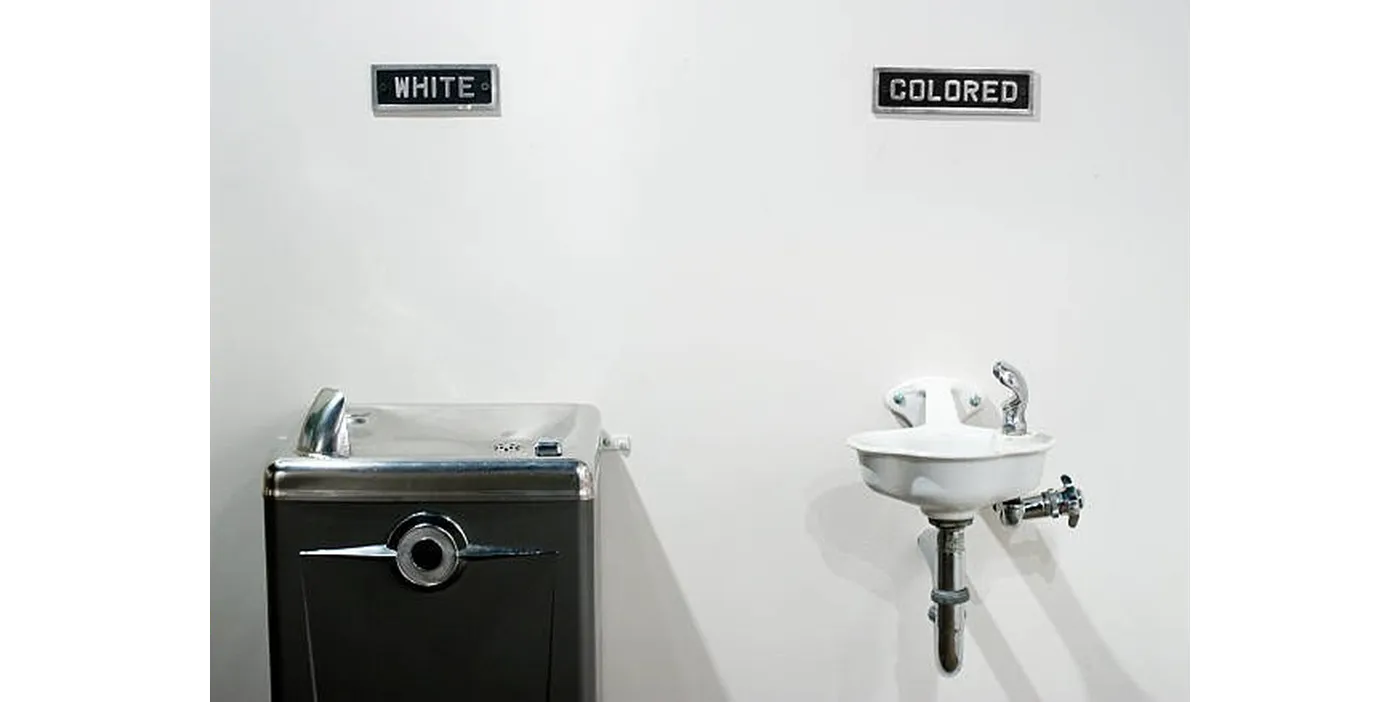
This image captures one of the most iconic and immediately recognizable symbols of Jim Crow segregation. Something as basic and universal as drinking water was made into a tool of racial division, a small but telling example of just how thoroughly Jim Crow laws touched every aspect of daily life, not just major institutions like schools or courts.
Segregated Restrooms, Circa 1960
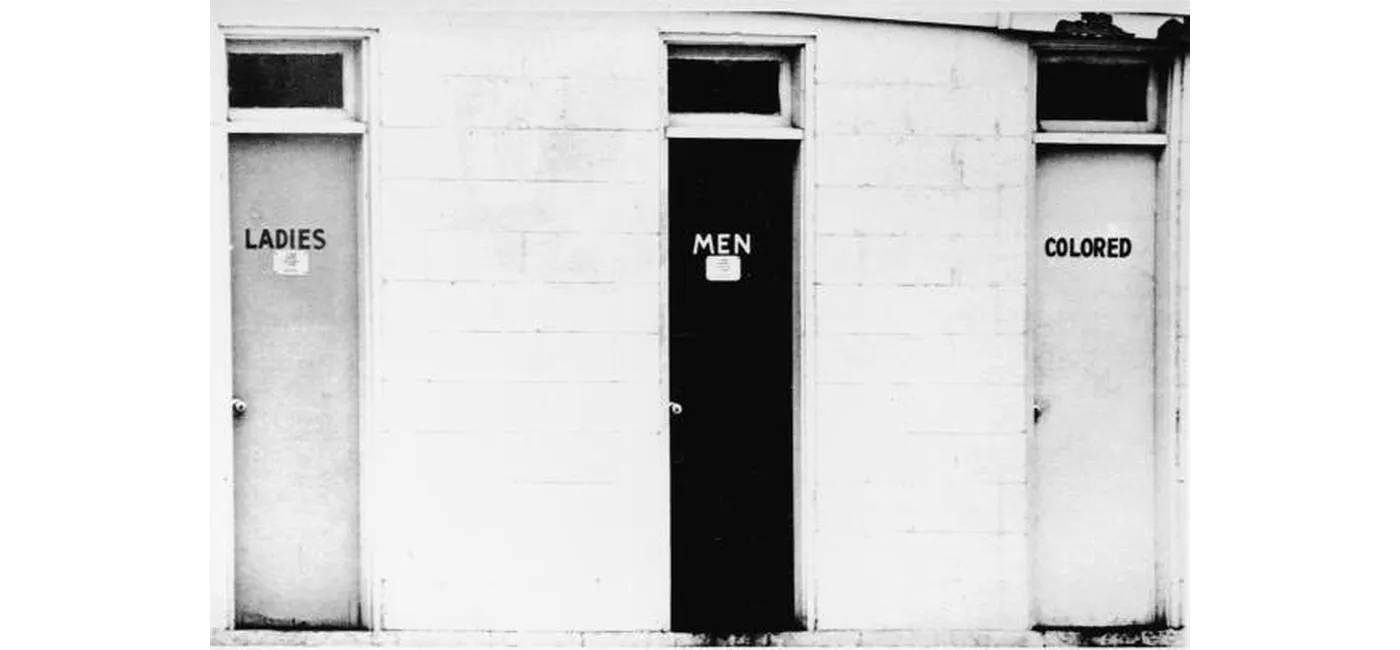
This photograph, taken as late as 1960, shows just how long these segregation practices persisted, well into the twentieth century and right up against the start of the Civil Rights Movement. Seeing this image alongside the water fountain photo reinforces how comprehensive Jim Crow segregation really was, extending even into the most mundane, everyday spaces of public life.