

3.2 - Social Life: Reuniting Black Families and the Freedmen's Bureau
The Purpose of the Freedmen's Bureau
Congress established the Bureau of Refugees, Freedmen, and Abandoned Lands, better known as the Freedmen's Bureau, in 1865, and it operated until 1872. While part of its job involved managing property that had been abandoned or confiscated during the Civil War, its real, primary mission was helping formerly enslaved people navigate the transition into full American citizenship. That support took many practical forms, providing clothing and food, legalizing marriages that had never been recognized under slavery, and establishing schools where none had existed before.
Rebuilding Families After Generations of Forced Separation
Centuries of slavery had done deep, lasting damage to African American family bonds. Relatives were routinely sold away from each other, forcibly relocated, and even had their names changed repeatedly at the whim of their enslavers, all of which made maintaining any stable sense of family incredibly difficult. And yet, despite all of this, African Americans continually found ways to build new kinship bonds and family traditions, both during slavery and after it ended.
Once emancipation came, that resilience turned into active searching. African Americans began looking for family members who had been separated from them through the domestic slave trade, relying on newspapers, word of mouth, and support from the Freedmen's Bureau as they traveled, sometimes great distances, to track down lost relatives and friends.
Marriage was another area where freedom brought real, tangible change. Under slavery, marriages between enslaved people had no legal standing whatsoever, though many couples still practiced "jumping the broom" as a meaningful symbol of their union, even without legal recognition. After abolition, thousands of formerly enslaved men and women moved quickly to formalize their relationships through legal marriage, now that the option actually existed for them. Many also chose to adopt entirely new names at this point, names that reflected their new status as free people and their ability, for the first time, to define their own identity rather than one imposed on them.
Out of this whole postemancipation effort to reconnect with lost family came a lasting cultural tradition: the African American family reunion. What began as a genuine, often difficult search for long-lost relatives evolved into an enduring practice that continues today, with modern family reunions serving as a way to preserve and celebrate Black families' history, resilience, music, and culinary traditions across generations.
Required Sources
Elizabeth Brisco, Ad in The Christian Recorder, Philadelphia, PA, 1864
Elizabeth Brisco placed this "Information Wanted" ad in March 1864, while the Civil War was still going on. She was searching for her husband, Charles Brisco, who had left Virginia several years earlier on a steamer bound for San Francisco and was last heard of working as a cook or waiter in Aspinwall (today's Colón, Panama). She asked anyone with news to write to the paper's office in Philadelphia, and the ad named his mother and sister in Georgetown, D.C., so readers who knew the family could help. The Christian Recorder, founded in 1852 as the official newspaper of the African Methodist Episcopal Church (the first Black denomination in the United States), is the oldest continuously published African American newspaper in the country. Ads like this one let a single person spread a search far beyond their own town, which is exactly how African Americans used newspapers to find family members scattered by slavery and war.
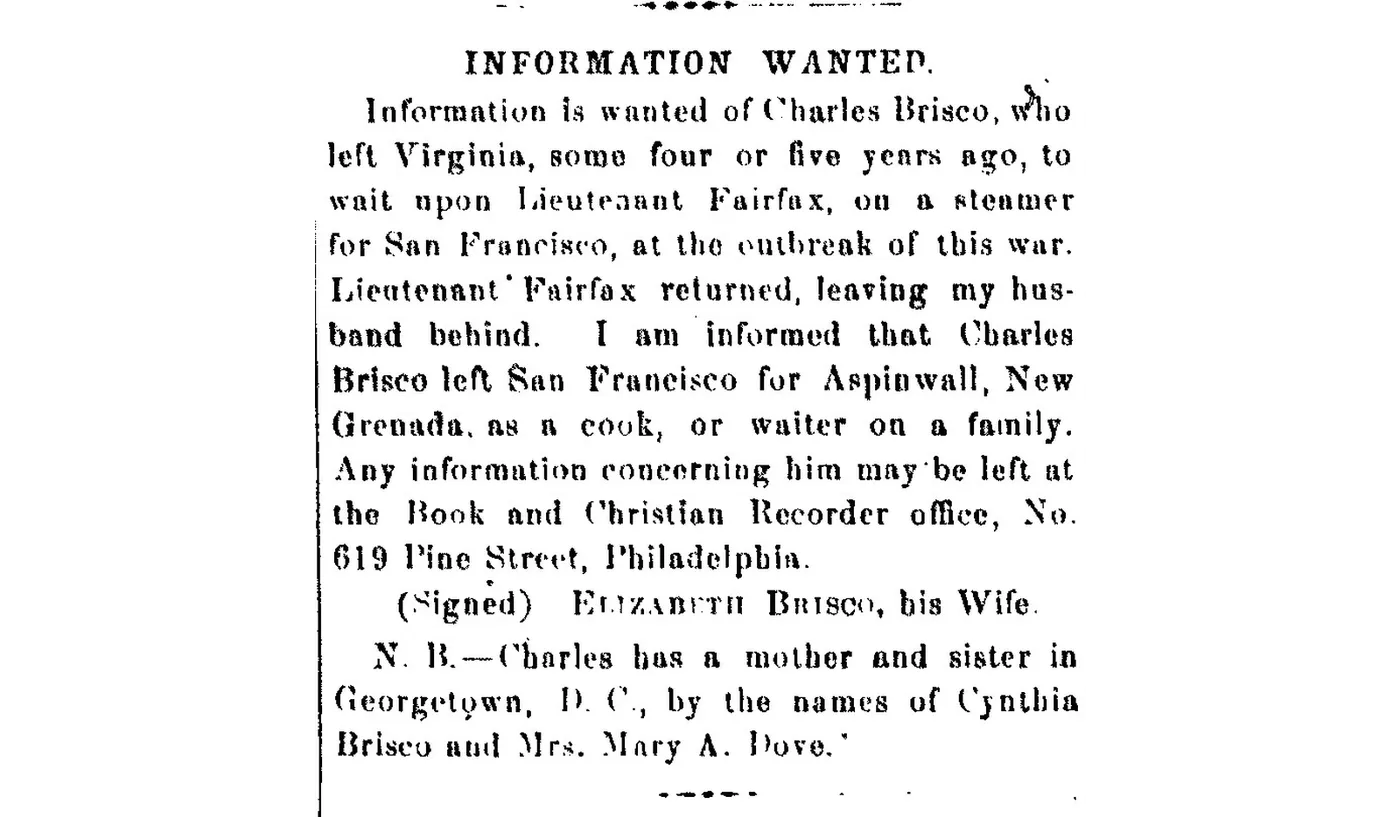
INFORMATION WANTED. Information is wanted of Charles Brisco, who left Virginia, some four or five years ago, to wait upon Lieutenant Fairfax, on a steamer for San Francisco, at the outbreak of this war. Lieutenant Fairfax returned, leaving my husband behind. I am informed that Charles Brisco left San Francisco for Aspinwall, New Grenada, as a cook, or waiter on a family. Any information concerning him may be left at the Book and Christian Recorder office, No. 619 Pine Street, Philadelphia. (Signed) Elizabeth Brisco, his Wife. N. B.: Charles has a mother and sister in Georgetown, D. C., by the names of Cynthia Brisco and Mrs. Mary A. Dove.
An Act to Establish a Bureau for the Relief of Freedmen and Refugees, 1865
Congress passed this law on March 3, 1865, a month before the war ended. It created the Bureau inside the War Department, to last for the rest of the war and one year after, under a commissioner appointed by the president (Oliver O. Howard got the job). The law gave the Bureau control of abandoned lands and "all subjects relating to refugees and freedmen" from the Confederate states, and it let the Secretary of War hand out food, clothing, and fuel to destitute refugees and freedpeople. Section 4 allowed the Bureau to set aside abandoned or confiscated land for loyal refugees and freedmen and to rent each man up to 40 acres for three years, with the option to buy it. Reading the law shows that the Bureau was meant to provide both emergency relief and a path to independent work and citizenship, even though most of the land promised in Section 4 was later returned to its former owners.
An Act to establish a Bureau for the Relief of Freedmen and Refugees.
Be it enacted by the Senate and House of Representatives of the United States of America in Congress assembled, That there is hereby established in the War Department, to continue during the present war of rebellion, and for one year thereafter, a bureau of refugees, freedmen, and abandoned lands, to which shall be committed, as hereinafter provided, the supervision and management of all abandoned lands, and the control of all subjects relating to refugees and freedmen from rebel states, or from any district of country within the territory embraced in the operations of the army, under such rules and regulations as may be prescribed by the head of the bureau and approved by the President. The said bureau shall be under the management and control of a commissioner to be appointed by the President, by and with the advice and consent of the Senate, whose compensation shall be three thousand dollars per annum, and such number of clerks as may be assigned to him by the Secretary of War, not exceeding one chief clerk, two of the fourth class, two of the third class, and five of the first class.
And the commissioner and all persons appointed under this act, shall, before entering upon their duties, take the oath of office prescribed in an act entitled "An act to prescribe an oath of office, and for other purposes," approved July second, eighteen hundred and sixty-two, and the commissioner and the chief clerk shall, before entering upon their duties, give bonds to the treasurer of the United States, the former in the sum of fifty thousand dollars, and the latter in the sum of ten thousand dollars, conditioned for the faithful discharge of their duties respectively, with securities to be approved as sufficient by the Attorney-General, which bonds shall be filed in the office of the first comptroller of the treasury, to be by him put in suit for the benefit of any injured party upon any breach of the conditions thereof.
Sec. 2. And be it further enacted, That the Secretary of War may direct such issues of provisions, clothing, and fuel, as he may deem needful for the immediate and temporary shelter and supply of destitute and suffering refugees and freedmen and their wives and children, under such rules and regulations as he may direct.
Sec. 3. And be it further enacted, That the President may, by and with the advice and consent of the Senate, appoint an assistant commissioner for each of the states declared to be in insurrection, not exceeding ten in number, who shall, under the direction of the commissioner, aid in the execution of the provisions of this act; and he shall give a bond to the Treasurer of the United States, in the sum of twenty thousand dollars, in the form and manner prescribed in the first section of this act. Each of said commissioners shall receive an annual salary of two thousand five hundred dollars in full compensation for all his services. And any military officer may be detailed and assigned to duty under this act without increase of pay or allowances. The commissioner shall, before the commencement of each regular session of congress, make full report of his proceedings with exhibits of the state of his accounts to the President, who shall communicate the same to congress, and shall also make special reports whenever required to do so by the President or either house of congress; and the assistant commissioners shall make quarterly reports of their proceedings to the commissioner, and also such other special reports as from time to time may be required.
Sec. 4. And be it further enacted, That the commissioner, under the direction of the President, shall have authority to set apart, for the use of loyal refugees and freedmen, such tracts of land within the insurrectionary states as shall have been abandoned, or to which the United States shall have acquired title by confiscation or sale, or otherwise, and to every male citizen, whether refugee or freedman, as aforesaid, there shall be assigned not more than forty acres of such land, and the person to whom it was so assigned shall be protected in the use and enjoyment of the land for the term of three years at an annual rent not exceeding six per centum upon the value of such land, as it was appraised by the state authorities in the year eighteen hundred and sixty, for the purpose of taxation, and in case no such appraisal can be found, then the rental shall be based upon the estimated value of the land in said year, to be ascertained in such manner as the commissioner may by regulation prescribe. At the end of said term, or at any time during said term, the occupants of any parcels so assigned may purchase the land and receive such title thereto as the United States can convey, upon paying therefor the value of the land, as ascertained and fixed for the purpose of determining the annual rent aforesaid.
Sec. 5. And be it further enacted, That all acts and parts of acts inconsistent with the provisions of this act, are hereby repealed.
Approved, March 3, 1865.
U.S. Congress, An Act to Establish a Bureau for the Relief of Freedmen and Refugees (1865), full text. Source: U.S. Statutes at Large, vol. 13, pp. 507 to 509, via the Freedmen and Southern Society Project, University of Maryland
Circular No. 11 from the Bureau of Refugees, Freedmen, and Abandoned Lands, 1867
This printed circular was issued in Richmond on March 19, 1866, by Colonel Orlando Brown, the Freedmen's Bureau's assistant commissioner for Virginia, and approved by the state's governor. (The AP framework dates it 1867, but the copy it links to, held by the Library of Virginia, is dated 1866.) It reprints a law Virginia passed on February 27, 1866, that made every Black couple living together as husband and wife on that date legally married and made their children legitimate. The circular then tells Bureau agents to register these couples, to explain to freedpeople that they are now legally married, with all the rights and duties that come with it, and to have the law read aloud at Black churches and meetings. Couples who married after that date needed a license like anyone else, and freedpeople who had no surname were required to choose one. The circular shows the Bureau putting the marriage and naming changes described above into practice.
Circular No. 11. Bureau of Refugees, Freedmen, & Abandoned Lands, Head Quarters Assistant Commissioner State of Virginia, Richmond, Va., March 19th, 1866.
The following Acts of the General Assembly of Virginia and instructions relating thereto are published for the information of the Officers and Agents of this Bureau, and all other persons concerned:
"An Act to amend and re-enact the Fourteenth Section of Chapter One Hundred and Eight of the Code of Virginia for Eighteen Hundred and Sixty, in regard to Registers of Marriage, and to legalize the marriages of colored persons, now cohabiting as husband and wife." Passed February 27th, 1866.
[...]
"II. Where colored persons, before the passage of this Act shall have undertaken and agreed to occupy the relation to each other of husband and wife, and shall be cohabiting together as such at the time of its passage, whether the rites of marriage shall have been celebrated between them or not, they shall be deemed husband and wife, and be entitled to the rights and privileges, and subject to the duties and obligations of that relation in like manner as if they had been duly married by law, and all their children shall be deemed legitimate, whether born before or after the passage of this Act. And when the parties have ceased to cohabit before the passage of this Act, in consequence of the death of the woman, or from any other cause, all the children of the woman, recognized by the man to be his, shall be deemed legitimate."
[...]
I. The Assistant Superintendents of the Bureau in this State will ascertain what colored persons were, on the 27th of February last, within their respective Sub-districts, cohabiting together as man and wife, and will make a registry of such persons, now married by the operation of the above quoted law, as nearly as possible in the manner above provided for the registration of future marriages by the Clerk of the County. They will also ascertain, in the case provided where the parties have at the said date ceased to cohabit, in consequence of the death of the woman, or any other cause, what children of the woman are recognized by the man; will, with all their power and influence, endeavor to obtain complete and honest recognition in such cases, and when obtained they will make a full registry thereof.
II. The Officers and Agents of the Bureau will take pains to explain to colored persons who were at the above date cohabiting together as husband and wife, that they are firmly married by the operation of the law, and will instruct them in the duties and obligations as well as rights and privileges of that relation. They will also cause the above quoted laws to be read at all religious and other meetings of the colored people until they are sufficiently informed of the important change effected by legislation in their domestic relations.
III. The Officers and Agents of the Bureau will, by all means in their power, assist the State Authorities in preventing the lewdness and adultery, made penal offences in the 4th Section of the second Act above quoted, and will impress upon colored persons the consequences as well as the crime of its violation. They will further instruct the freed people that the Act only sanctions unions existing at the date of its passage, and for all those subsequent or proposed in future, licenses must be obtained and solemnization made, without which they will be criminal offences.
IV. In order to carry out more efficiently the above laws and instructions, the freed people will also be required to assume a surname where none is now borne by them, and informed that, except in the case of a female upon her marriage, the name now used, or thus adopted, can only be changed by the Circuit Courts of the State. O. Brown, Colonel and Assistant Commissioner.
Richmond, Va., March 19th, 1866. I approve of the above instructions and recommendation, and hope all Civil Officers of the State who can assist in the performance of the duties herein named will do so. F. H. Pierpoint, Governor.
Orlando Brown, Assistant Commissioner for Virginia, Bureau of Refugees, Freedmen, and Abandoned Lands, Circular No. 11 (March 19, 1866; the AP framework lists it as 1867), excerpts. Source: Library of Virginia, New Kent County Court Records (Freedmen's Bureau records, 1866), shown in the Library of Virginia's online exhibition "Remaking Virginia: Transformation Through Emancipation"
Clarissa Reed, Ad in the Southwestern Christian Advocate, New Orleans, LA, 1883
Clarissa Reed placed this ad in the "Lost Friends" column of the Southwestern Christian Advocate, a Methodist newspaper in New Orleans, in September 1883. She was looking for her mother, Pearline, her stepfather, Sam, and her siblings, including Sophronia, Fannie, Morgan, and Anderson. She had been sold away from her family in St. Charles County, Missouri, later taken to Kentucky, and then sold to New Orleans, and she wrote that she had not seen or heard from them in about 46 years. Readers with news could reply through the pastor of her church. Published almost two decades after Elizabeth Brisco's ad, it shows that the search for family separated by the domestic slave trade went on for decades after emancipation, and that Black newspapers and churches kept helping people look.
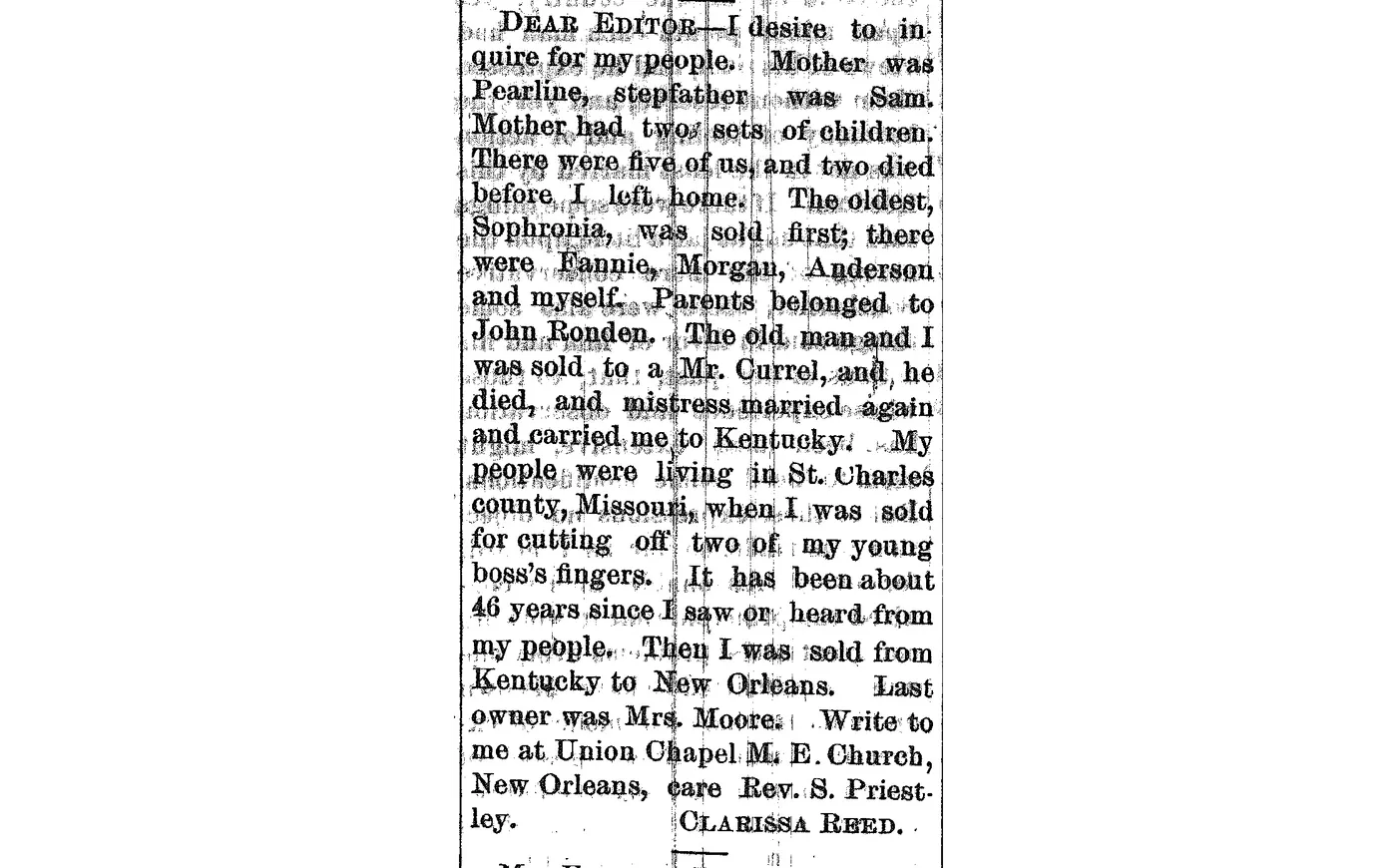
Dear Editor: I desire to inquire for my people. Mother was Pearline, stepfather was Sam. Mother had two sets of children. There were five of us, and two died before I left home. The oldest, Sophronia, was sold first; there were Fannie, Morgan, Anderson and myself. Parents belonged to John Ronden. The old man and I was sold to a Mr. Currel, and he died, and mistress married again and carried me to Kentucky. My people were living in St. Charles county, Missouri, when I was sold for cutting off two of my young boss's fingers. It has been about 46 years since I saw or heard from my people. Then I was sold from Kentucky to New Orleans. Last owner was Mrs. Moore. Write to me at Union Chapel M. E. Church, New Orleans, care Rev. S. Priestley. Clarissa Reed.