

3.18 - The Universal Negro Improvement Association
The Mission of the UNIA
Marcus Garvey led the largest pan-African movement in the history of African American politics as the founder of the Universal Negro Improvement Association, better known as the UNIA. The organization's goal was ambitious and expansive: to unite all Black people, and it grew to maintain thousands of members across countries throughout the Caribbean, Latin America, and Africa, making it a genuinely global movement rather than a purely American one.
Garvey, born in Jamaica in 1887, founded the UNIA there in 1914 with Amy Ashwood (who later became his first wife) and moved to the United States in 1916. He set up the UNIA's headquarters in Harlem, and by the early 1920s it had hundreds of branches across the United States, the Caribbean, Central America, and Africa. Members marched through Harlem in uniformed parades, and at its first international convention in 1920, opened with a huge rally at Madison Square Garden, the UNIA adopted the Declaration of the Rights of the Negro Peoples of the World and the red, black, and green flag.
One of the UNIA's most defining efforts was Garvey's Back-to-Africa movement, which popularized the phrase "Africa for the Africans." As part of this vision, Garvey founded the Black Star Line, a steamship company created specifically to help repatriate African Americans to Africa, turning the movement's ideological vision into a real, practical enterprise.
The Black Star Line, launched in 1919, sold stock only to Black investors, but its ships were old and poorly managed, and the company collapsed in 1922. Garvey was convicted of mail fraud in 1923 over how the stock was sold, went to federal prison in 1925, and was deported to Jamaica in 1927. In January 2025, President Joe Biden granted him a posthumous pardon. Even though the shipping line failed, it made the idea of Black economic independence feel real to thousands of people.
Garvey's Impact on Black Political Thought
Garvey's message resonated powerfully with African Americans who had endured intense racial violence and discrimination, inspiring them to embrace their shared African heritage as a source of pride rather than shame. He championed industrial, political, and educational advancement, along with genuine self-determination, achieved specifically through separate, independently built Black institutions rather than integration into existing white-led systems.
Garvey laid out the UNIA's core objective clearly: achieving Black liberation from colonialism across the entire African diaspora, not just within the United States. This framework went on to become the model for subsequent Black nationalist movements throughout the rest of the twentieth century, shaping political thought well beyond Garvey's own lifetime. The UNIA's red, black, and green flag remains a lasting symbol of this legacy, still used today by advocates of Black solidarity and freedom around the world.
Required Sources
"Address to the Second UNIA Convention" by Marcus Garvey, 1921
This speech gives a direct, firsthand look at Garvey's own vision for the UNIA and Black liberation more broadly, delivered to an audience of his own followers at a major organizational gathering. Reading his words directly shows how he articulated the movement's global ambitions, framing Black liberation as a project spanning the entire African diaspora rather than a purely domestic American concern.
Garvey gave this speech at Liberty Hall in Harlem on August 31, 1921, the closing night of the UNIA's second international convention, a month-long meeting that brought together delegates from across the Americas and Africa.
Marcus Garvey, closing address to the Second International Convention of the Negro Peoples of the World (UNIA), New York, August 31, 1921
Garvey gave this speech on the last night of the UNIA's month-long 1921 convention, speaking for what he called the 400 million Black people of the world. He lists their grievances, from Europe's carving up of Africa to lynching and Jim Crow in the United States, and calls for a free Africa governed by its own people under the slogan "Africa for the Africans, those at home and those abroad." The speech shows the global reach of Garveyism: Black freedom as one struggle across the whole diaspora.
It's also worth knowing that the UNIA's newspaper, Negro World, co-founded by Garvey's wife Amy Ashwood, circulated in over 40 countries, showing just how far the organization's reach and influence actually extended beyond speeches and conventions alone.
Marcus Garvey at His Desk, 1924
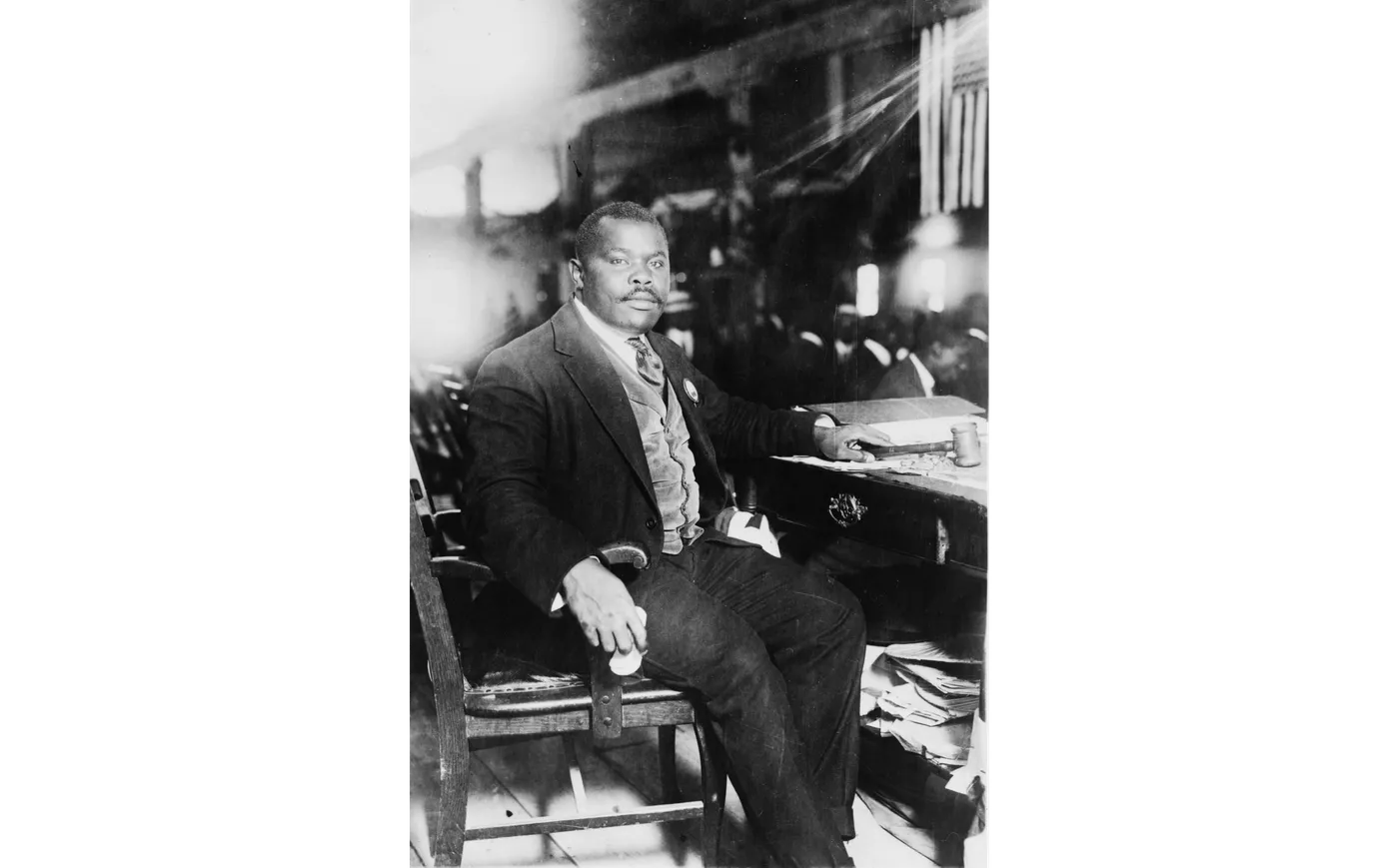
This image presents Garvey in a position of administrative authority and leadership, reflecting the scale and organization required to run a movement with members spread across multiple continents.
Marcus Garvey in Harlem, 1924
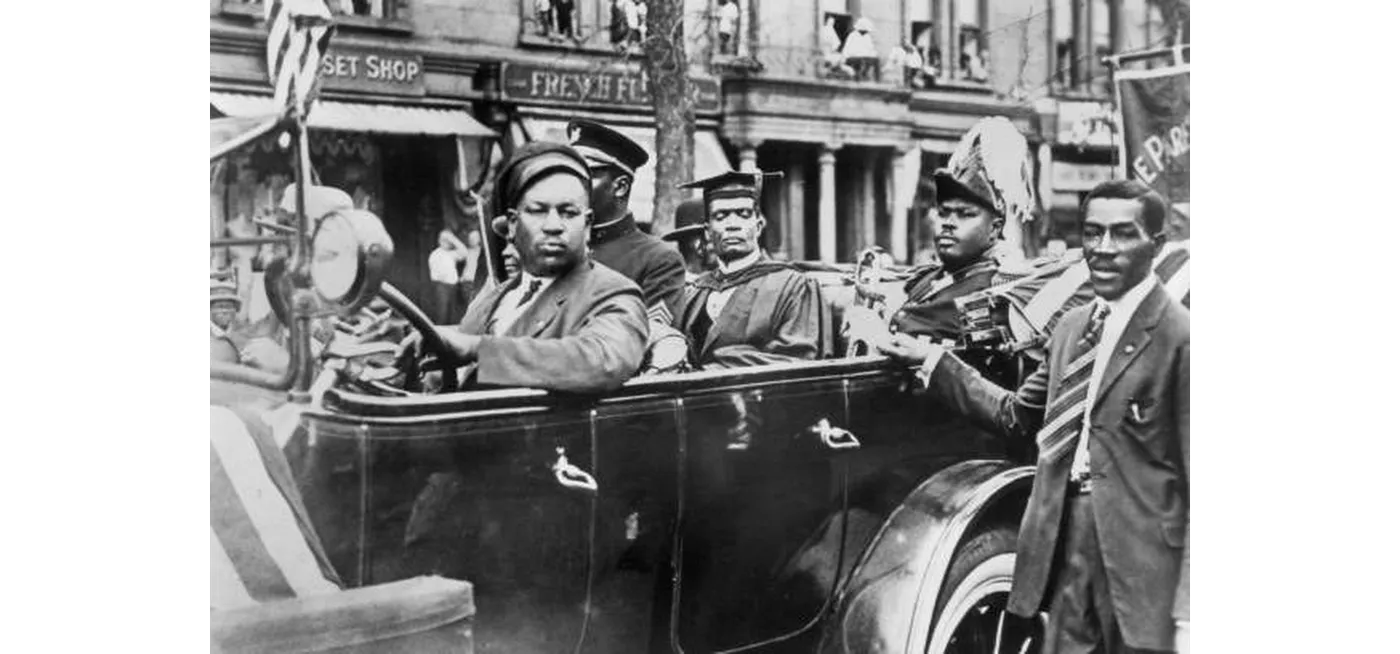
This photograph situates Garvey within Harlem, the neighborhood that served as a central hub for Black political and cultural life during this era. Seeing Garvey there reinforces how closely the UNIA's rise was tied to the broader currents of Black political thought and organizing that were converging in Harlem at the same time.
This photograph was taken by James Van Der Zee, the same Harlem photographer whose portraits appear with Photography and Social Change. He photographed many UNIA parades and events in 1924.