

3.3 - Black Codes, Land, and Labor
How Black Codes Undermined Freedom
In 1865 and 1866, during a period known as Presidential Reconstruction, many state governments passed a set of restrictive laws called Black Codes. These laws were designed to undercut the legal rights African Americans had just gained, specifically by controlling their movement and their labor. In many ways, Black Codes were a direct attempt to recreate the same social control and surveillance that had existed under the earlier slave codes, just repackaged for a post-slavery legal landscape.
These codes restricted advancement in very concrete ways, limiting property ownership or forcing people into labor contracts. Many of these annual labor contracts offered extremely little pay, and if someone tried to break free from one, they could be whipped as punishment. Even worse, anyone caught without a labor contract at all could be fined or imprisoned simply for "vagrancy," a charge that essentially criminalized being unemployed.
Mississippi and South Carolina passed the first Black Codes in late 1865. Mississippi's code, for example, required Black workers to show written proof each January that they had a job for the coming year, and a worker who quit before the contract ended could be arrested and lose the wages already earned. Outrage in the North over laws like these helped push Congress to pass the Civil Rights Act of 1866 and the Fourteenth Amendment.
Some Black Codes went even further, targeting families directly. Certain laws allowed the state to seize African American children and force them into unpaid apprenticeships, entirely without their parents' consent, a chilling continuation of the same family separation that had defined slavery itself.
New Systems of Economic Control
There was a brief window where real, meaningful economic opportunity seemed possible. In January 1865, Union General William T. Sherman issued Special Field Orders No. 15, which set aside about 400,000 acres of coastal land (the Sea Islands and the abandoned rice fields along the coast from Charleston, South Carolina, through Georgia to the St. Johns River in Florida) for newly freed African American families, in plots of up to 40 acres each. Sherman issued the order after he and Secretary of War Edwin Stanton met with Black ministers in Savannah, who told them that what freedpeople wanted most was land of their own to farm. Some families were also given army mules, which is where the phrase "forty acres and a mule" comes from.
That opportunity didn't last. President Andrew Johnson revoked Special Field Orders No. 15, and the confiscated plantations were handed back to their former owners or sold off to northern investors instead. As a direct result, African Americans who had settled on this land were evicted, or pushed into a different, far more limiting arrangement: sharecropping.
Under sharecropping, landowners provided land and equipment to formerly enslaved people, or to poor white farmers, in exchange for a large portion of whatever crops were harvested. This system made real economic advancement nearly impossible, since so much of what farmers grew went straight back to the landowner rather than into their own pockets.
Making matters worse, many farmers who started with little or no cash turned to crop liens, essentially borrowing food and supplies on credit against their future harvest. But the harvest itself often didn't generate enough money to actually pay off that debt, trapping farmers in an ongoing cycle of accumulating debt year after year, with little realistic path out.
Perhaps the most brutal system of all was convict leasing. Southern prisons profited by leasing out African American men, often imprisoned on flimsy charges like debt, false arrest, or minor offenses, to landowners and corporations, who then used them as unpaid labor under conditions that closely mirrored slavery itself. In effect, this system used the criminal justice system as a backdoor to recreate forced, unpaid Black labor, even though slavery was technically illegal.
Convict leasing was legal because of the exception in the Thirteenth Amendment, which still allowed involuntary servitude "as a punishment for crime." Vagrancy laws and other Black Codes made it easy to arrest Black men, and the states then leased them out to work on plantations, railroads, and mines. Many prisoners died from the brutal conditions. Alabama, one of the last states to end the system, didn't abolish it until 1928.
Required Sources
Land Order for Richard Brown, 1865
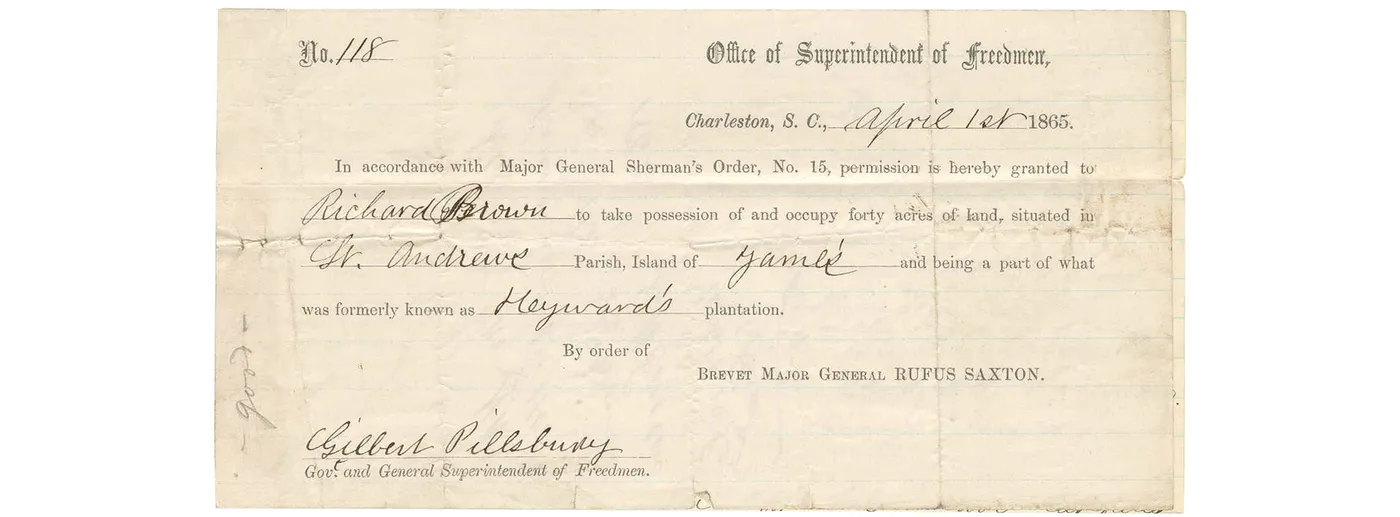
This is a real land order issued under Special Field Orders No. 15. Dated April 1, 1865, in Charleston, South Carolina, and issued by order of General Rufus Saxton, it gave Richard Brown "permission" to "take possession of and occupy forty acres of land" on James Island, on part of what had been Heyward's plantation. Notice the wording: it gave Brown the right to occupy the land, not full legal ownership. That is why, when President Johnson pardoned former Confederates and ordered their land returned, families like Brown's could be pushed off. Seeing a real, named recipient makes the policy concrete, and makes its reversal feel like a personal loss, not just an abstract policy shift.
Circular No. 8 from the Bureau of Refugees, Freedmen, and Abandoned Lands, 1866
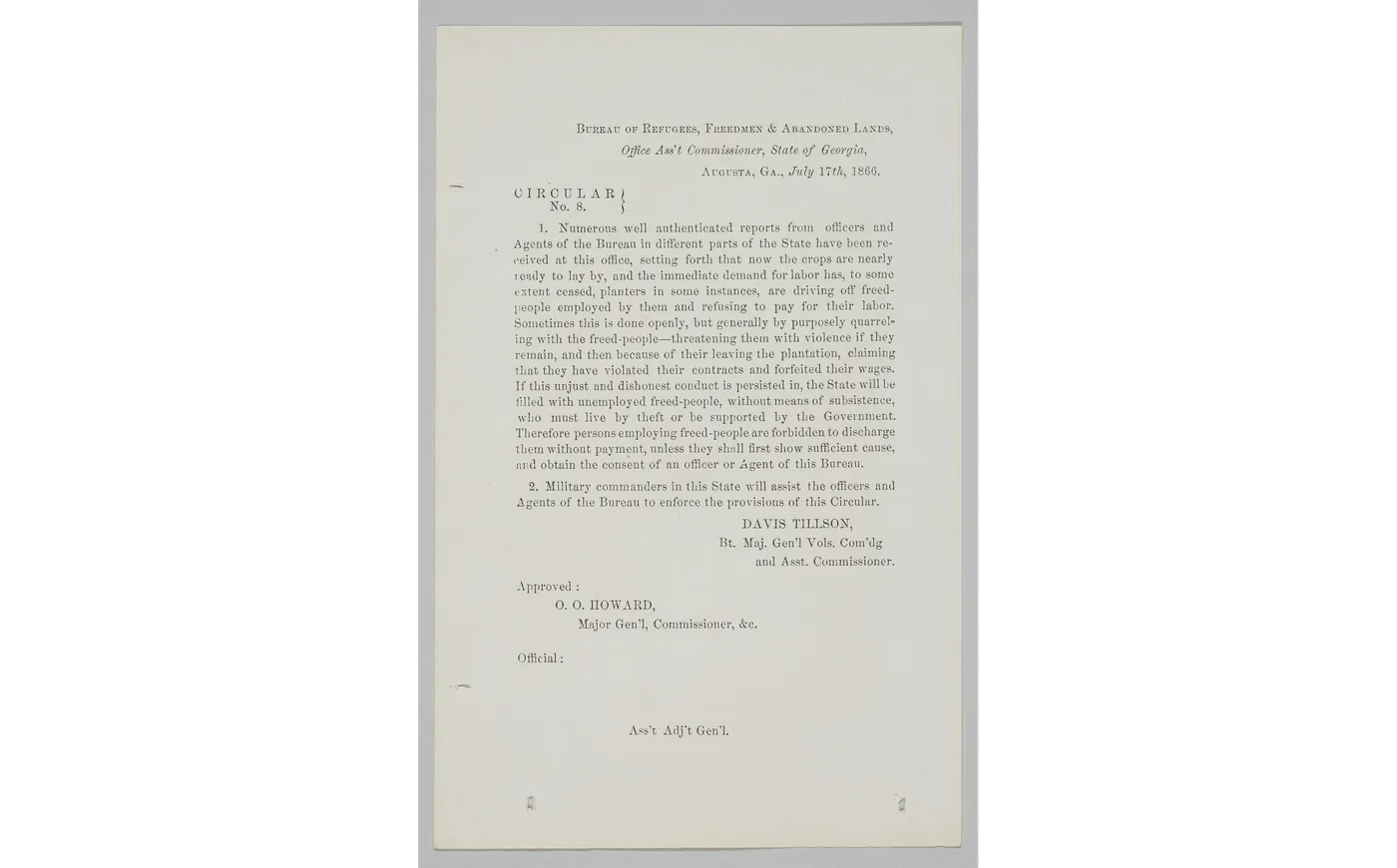
Davis Tillson, the Freedmen's Bureau's assistant commissioner for Georgia, issued this printed order in Augusta on July 17, 1866, and Bureau commissioner O. O. Howard approved it. Bureau agents across Georgia had reported that once the crops were nearly "laid by" (past the stage of needing daily work before harvest), some planters were driving off the freedpeople they had hired and refusing to pay them. Usually they did it by picking fights or threatening violence, then claiming the workers had broken their contracts and lost their wages. The circular forbade employers from firing freedpeople without paying them unless they first showed good cause and got the consent of a Bureau officer, and it told military commanders to help enforce the rule. It shows how the annual labor contracts described above could be used to cheat Black workers, and how the Bureau tried, with limited power, to protect them.
Juvenile Convicts at Work in the Fields, 1903
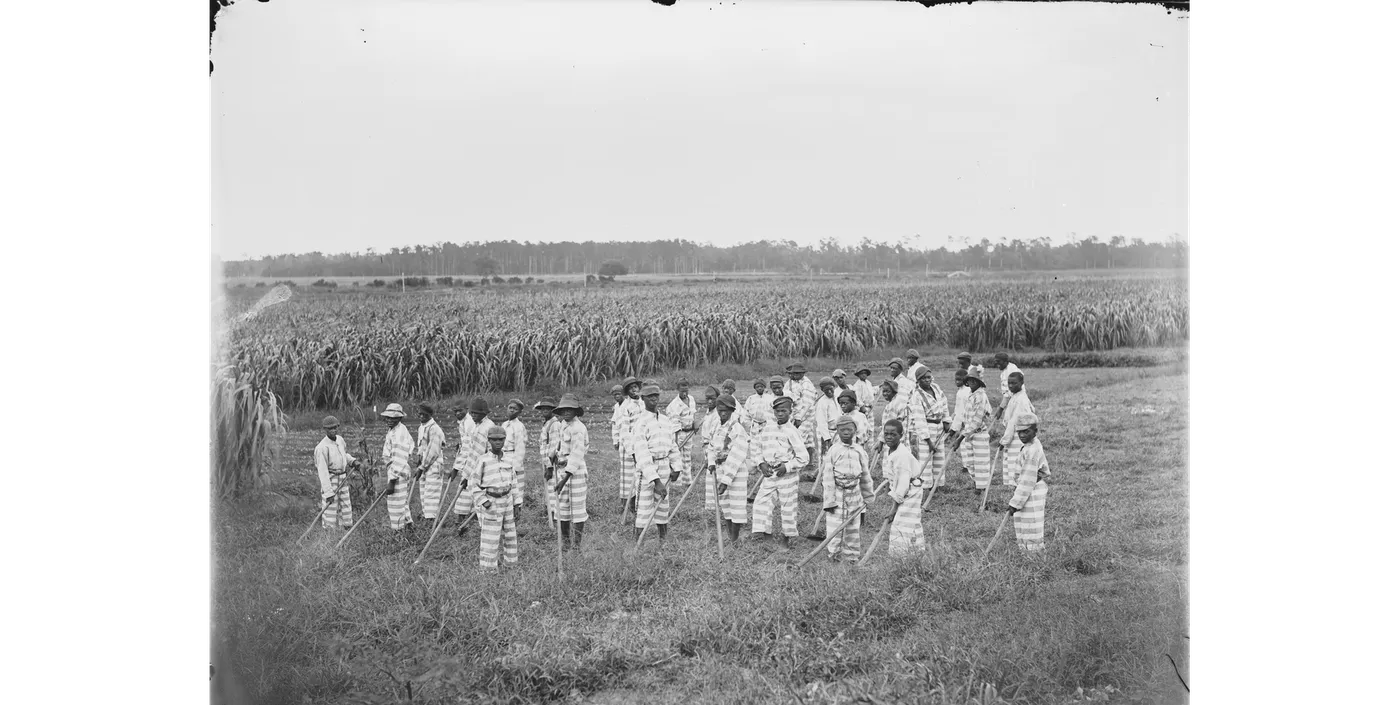
This photograph shows convict leasing in direct practice, and the fact that it depicts juveniles specifically makes the exploitative nature of the system even starker. It's a visual confirmation of exactly how thoroughly the criminal justice system was used to funnel Black labor, including child labor, into conditions resembling slavery decades after slavery's formal abolition.
Picture Postcard of a North Carolina Convict Camp, Circa 1910
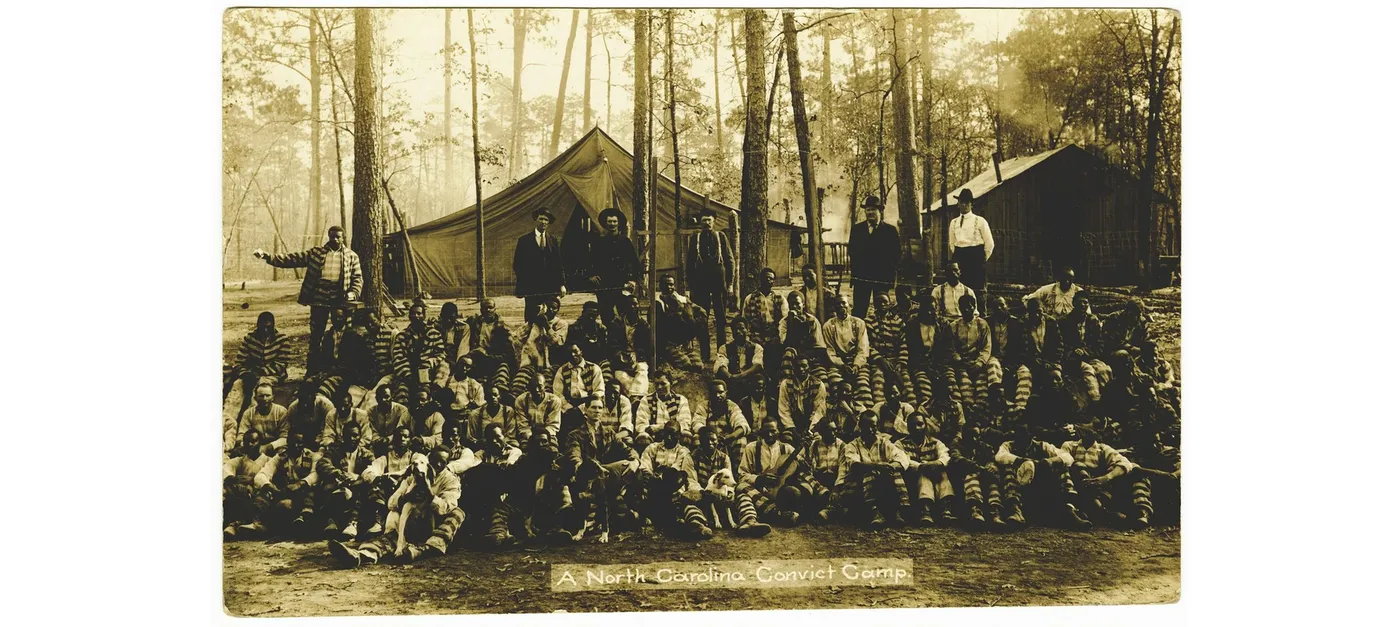
This postcard is a particularly unsettling artifact, since postcards were meant to be casually shared and collected, meaning scenes like a convict labor camp were treated as ordinary, even novel, imagery at the time rather than something scandalous or hidden. That casualness underscores just how normalized convict leasing had become in Southern society by the early twentieth century.