

8.10 - Volume with Disc Method: Revolving Around Other Axes
Review: The Disk Method
From the previous lesson, the volume of a solid of revolution is
where is the radius from the axis of revolution out to the edge of the solid.
This lesson’s focus: revolving around lines other than the -axis or -axis, like , , or .
Key Concept: Finding the Radius with Shifted Axes
When the axis of revolution isn’t the -axis or -axis, the radius calculation changes.
The radius is still the distance from the axis of revolution to the outer curve.
What’s new: you have to account for the gap between the axis and the region.
Method 1: Subtract the Gap
For Horizontal Lines (like )
If you’re revolving around the line :
Why? Because you’re measuring from to the curve, not from .
If the line is above the region instead, flip the order: . Example 4 below does this.
For Vertical Lines (like )
If you’re revolving around the line :
which one depends on which side of the line the region sits.
Example 1: Revolution Around
Problem: find the volume of the solid formed by rotating the region bounded by and around the line .
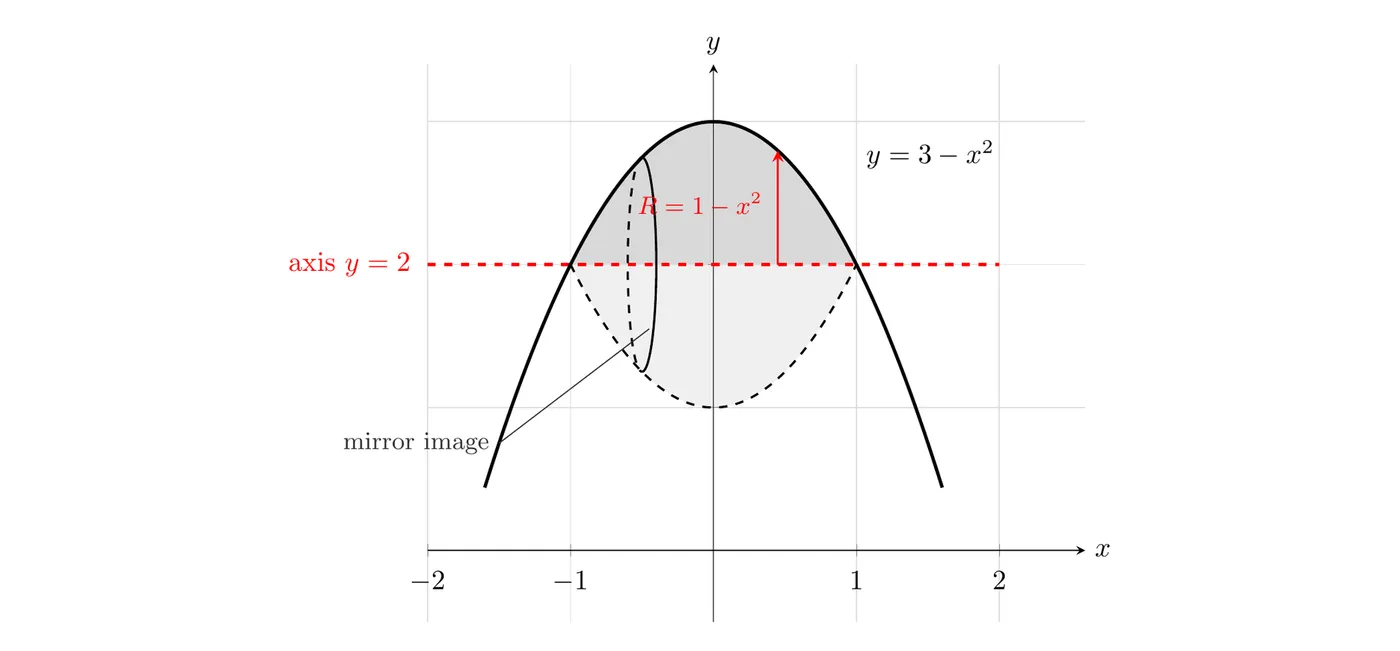
Step 1: Find the intersection points.
Set the curves equal:
Step 2: Identify the radius.
The radius runs from the line (the axis of revolution) out to the parabola .
Think of it this way:
- The distance from the -axis to the parabola is
- Subtract the unused portion from the -axis up to , which is 2
Step 3: Set up the integral.
Step 4: Expand and integrate.
Volume: cubic units
Method 2: Shift the Region
Instead of subtracting the gap, you can shift the whole region so that the axis of revolution becomes the -axis or -axis.
Example 1, the Alternative Approach
Original: revolve around .
Shift: subtract 2 from all the -values to move the axis down to .
New curve:
New axis: , the -axis.
Setup:
Notice this is identical to what Method 1 gave us.
Example 2: Revolution Around
Problem: find the volume formed by rotating the region bounded by and around the line .
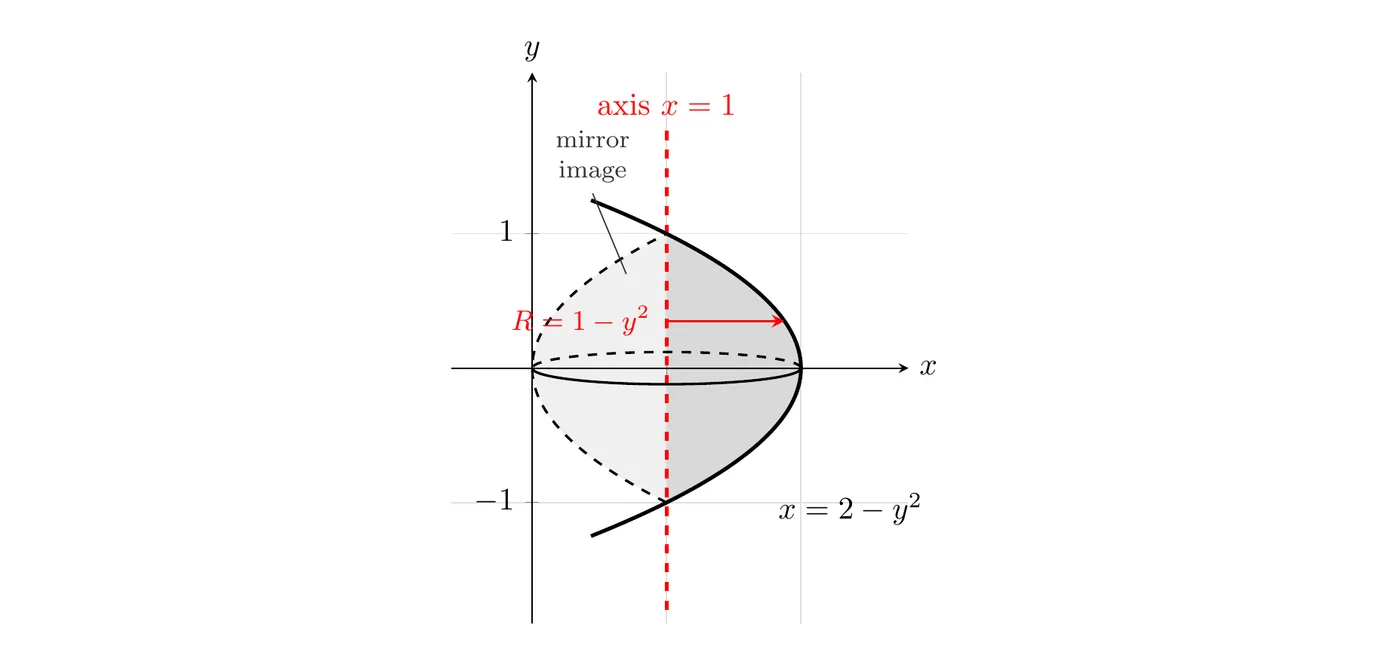
Step 1: Find the intersection points.
Step 2: Identify the radius.
Important: since we’re revolving around a vertical line, we integrate with respect to .
The radius runs from to the parabola :
Step 3: Set up the integral.
Step 4: Evaluate.
Same calculation as Example 1.
Example 3: Revolution Around
Problem: find the volume formed by rotating the region bounded by , , , and around the line .
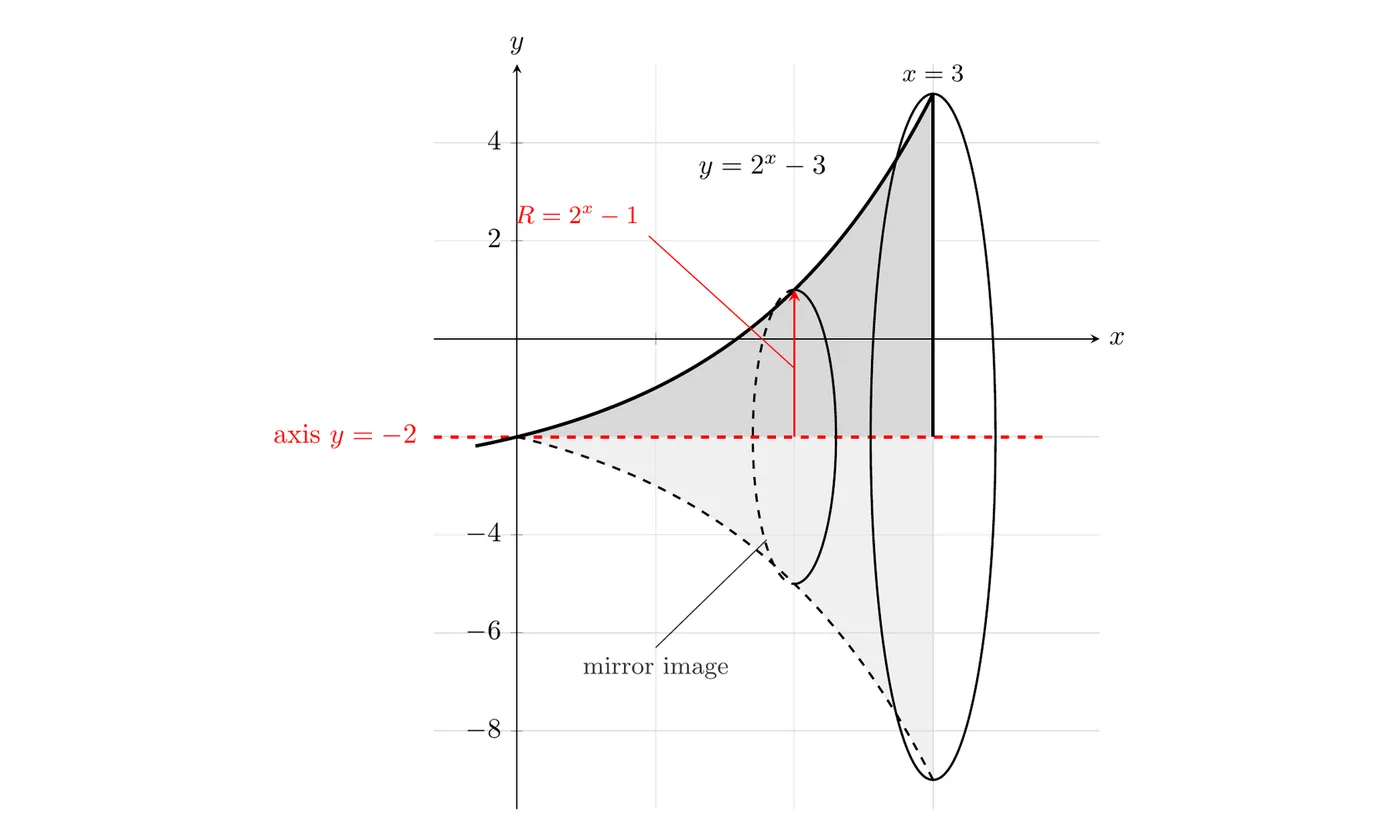
Step 1: Identify the boundaries. From to .
Step 2: Calculate the radius.
The distance from to the curve :
Think, “from the -axis to the curve is , but I want the distance from to the curve.” The line sits 2 units below the -axis, so subtract (that is, add 2):
Step 3: Set up the integral.
Alternative: shift the region.
Shift everything up by 2 by adding 2 to all the -values:
- New curve:
- New axis: , the -axis
Same result.
Volume: cubic units (with a calculator)
Important Observation: Order Matters (Sort Of)
If you subtract in the other order, the radius looks different.
Axis minus curve:
Curve minus axis (Example 3, and what the shift gives):
These look like opposites, but here’s the key:
Why? Because squaring wipes out the sign difference:
Conclusion: when the radius gets squared, the order of subtraction doesn’t matter. Both give the same volume.
Example 4: Revolution Around (Axis Above the Region)
Problem: find the volume of the solid formed by rotating the region bounded by and around the line .
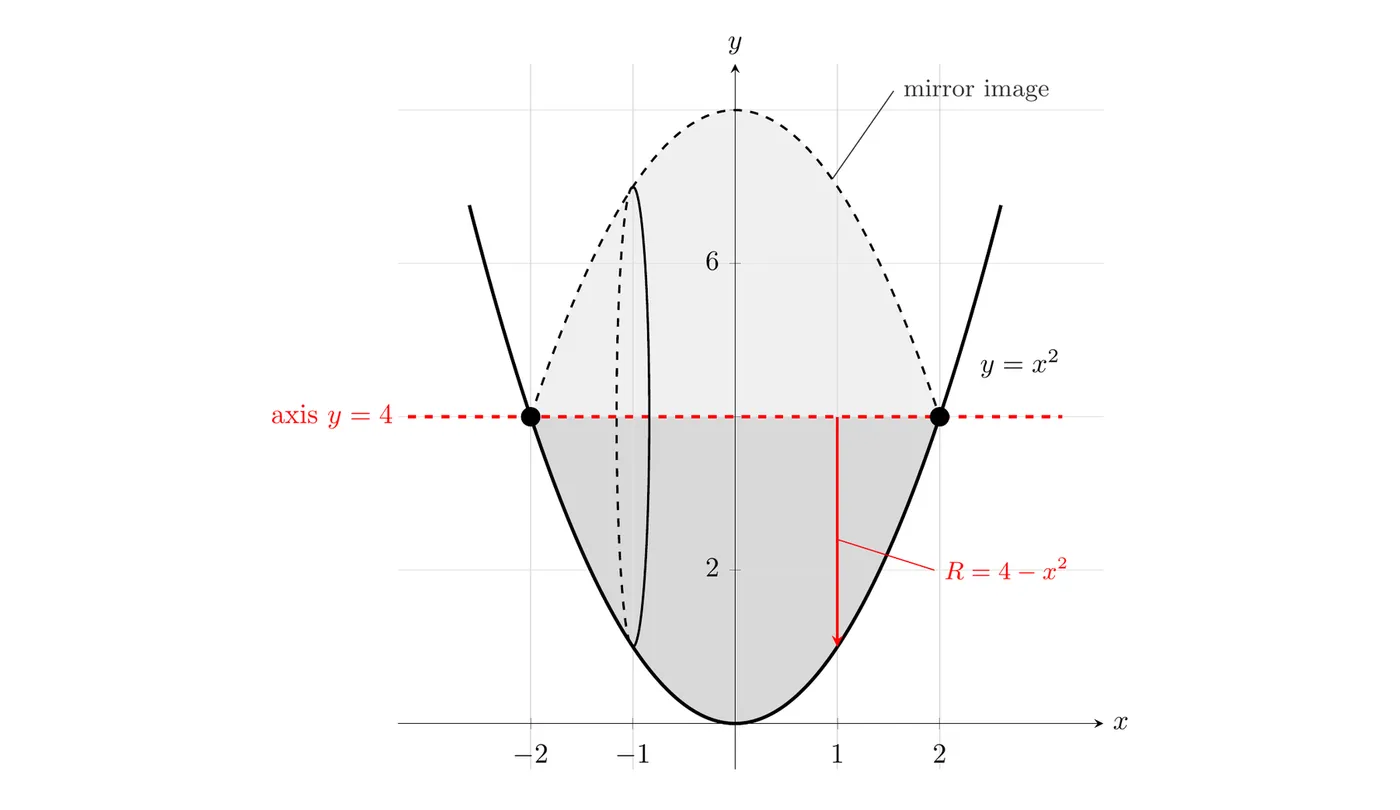
Step 1: Find the intersection points.
Step 2: Identify the radius.
This time the axis is the top edge of the region, so the radius runs down from to the parabola. Take the bigger value minus the smaller one:
(Writing would give the same volume once it’s squared, but is the actual distance, which is never negative here.)
Step 3: Set up the integral.
Step 4: Expand and integrate.
Volume: cubic units
Decision Tree: Which Method Should You Use?
Method 1: Direct Calculation
- Identify the axis of revolution
- Calculate [outer function] minus [axis value]
- Set up the integral with that as
Best when: the subtraction is straightforward.
Method 2: Shift the Region
- Add or subtract to move the axis onto the -axis or -axis
- Adjust all the equations to match
- Set up the integral as if you’re revolving around a standard axis
Best when: you want to picture it as a standard rotation.
Both methods give the same answer, though the terms may come out in a different order before you square.
Summary of Radius Formulas
Axis of Revolution | Radius Formula | Notes |
(above the region) | Subtract the curve from the line | |
(below the region) | Subtract the line from the curve | |
(right of the region) | Convert to | |
(left of the region) | Convert to |
General rule: radius = [outer edge] minus [inner edge], measured perpendicular to the axis.
Problem-Solving Strategy
Step 1: Sketch the region. Draw all the boundary curves, draw the axis of revolution, and shade the region you’re rotating.
Step 2: Find the intersection points. Set the curves equal to find the boundaries. Those become your limits of integration.
Step 3: Determine the radius. Ask what the distance is from the axis to the outer curve, then pick Method 1 (direct) or Method 2 (shift).
Step 4: Set up the integral. Use for horizontal axes and for vertical axes. Don’t forget the and don’t forget to square .
Step 5: Evaluate. Expand if you need to, integrate term by term, and simplify.
Common Mistakes to Avoid
Forgetting to subtract the axis location. The radius has to account for where the axis sits: .
Using the wrong sign. Think carefully about which is bigger, the curve value or the axis value.
Worrying about sign once it’s squared. You don’t need to. Since , the order doesn’t ultimately matter.
Using when you should use . A horizontal axis () means , and a vertical axis () means .
Not converting to for vertical axes. Always solve for when rotating around a vertical line.
Key Takeaways
- Revolution around any line uses the same method as the - or -axis. You just adjust the radius calculation
- Radius formula:
- Horizontal lines (): integrate with respect to , using
- Vertical lines (): integrate with respect to , using
- Two equivalent methods: direct calculation, or shift the region
- Order doesn’t matter once squared:
- Always square the radius: volume is
- Shifting insight: adding or subtracting constants from the equations moves the graph
- Sketching helps. Drawing it out clarifies which curve is the outer edge and where the axis is
- Check your setup. Does the radius make geometric sense?