

8.7 - Volumes with Cross Sections: Squares and Rectangles
Introduction to Cross-Sections
We’ve been finding the area between curves. Now we use those regions as the base of a three-dimensional solid.
Picture looking straight down at a solid from above. All you see is the outline of its base, the bounded region. To get the volume, we need to know about cross-sections.
A cross-section is what you see when you slice through a solid perpendicular to an axis. Think of slicing a loaf of bread. Each slice shows you a cross-section.
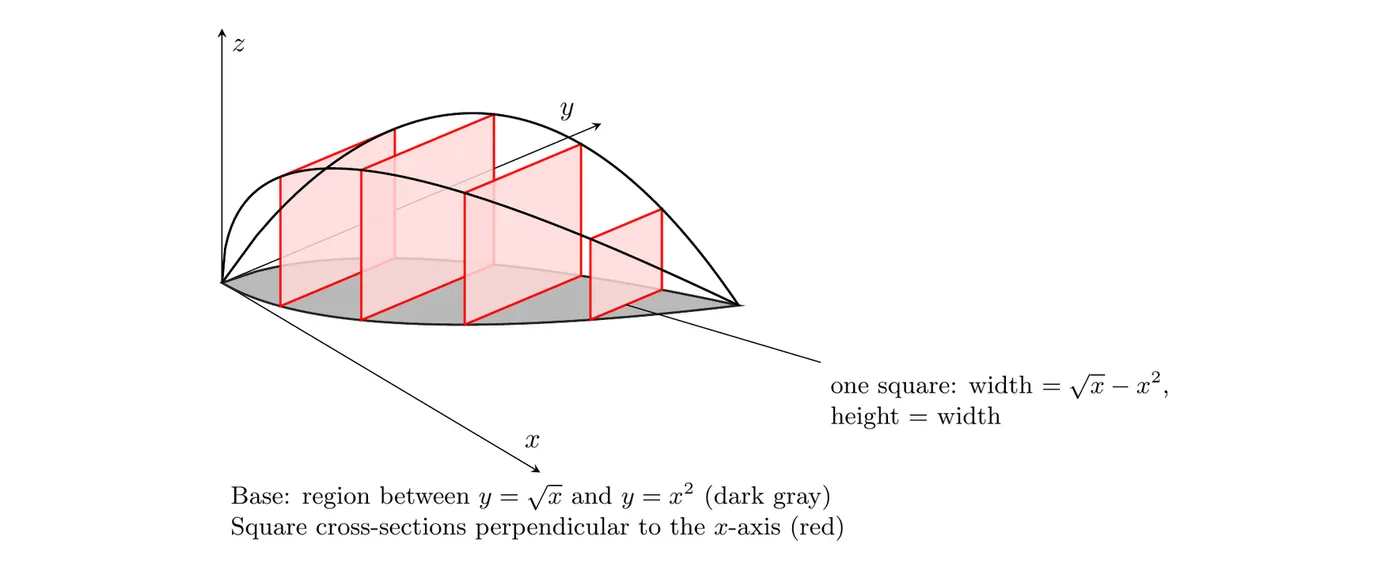
Two things matter every time:
- Perpendicular to which axis? This determines the slicing direction and your integration variable
- What shape is the cross-section? Square, rectangle, triangle, and so on, which determines the area formula
As you move along the base, each cross-section changes size based on the distance between the boundary curves at that location.
Volume Formula for Cross-Sections
where:
- is the area of one cross-section at position
- is the interval the base spans
- The integral sums up all the infinitely many cross-sections
Perpendicular to the -axis instead:
Square Cross-Sections
For a square:
where is the side length, which equals the distance between the boundary curves:
with the upper curve and the lower one. So:
Example 1: Squares Perpendicular to the x-axis
Find the volume of the solid whose base is bounded by and , with square cross-sections perpendicular to the -axis.
Step 1: find the intersection points
Step 2: which function is on top? At : and . So is on top.
Step 3: side length
Step 4: set up
Step 5: expand and integrate
Volume: cubic units
Example 2: Squares Perpendicular to the y-axis
Same base region, but with square cross-sections perpendicular to the -axis.
Step 1: convert to form
(taking the positive root)
Step 2: boundaries. The curves meet at and , so runs from 0 to 1.
Step 3: which is on the right? At : (left) and (right). So is on the right.
Step 4: set up
Notice this is structurally identical to Example 1, just with in place of , so it evaluates to the same . That happens here because the base region is symmetric about the line .
Rectangular Cross-Sections
For a rectangle:
The big difference from squares: the height is extra information the problem has to give you. It isn’t automatically equal to the width.
Common phrasings:
- “Height is twice the width” →
- “Height is constant at 5 units” →
- “Height equals ” →
Example 3: Rectangles with Height Proportional to Width
The base is bounded by , the -axis, and . Cross-sections perpendicular to the -axis are rectangles whose height is 3 times the width.
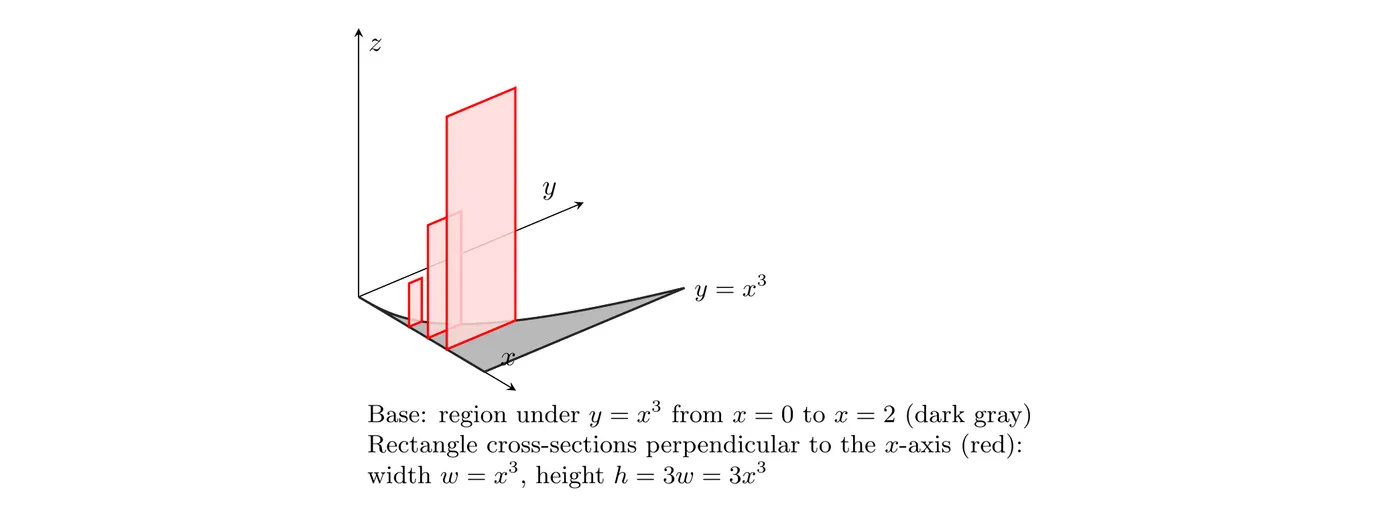
Step 1: width. The distance from the -axis to the curve:
Step 2: height. Three times the width:
Step 3: set up
Step 4: evaluate
Volume: cubic units
Example 4: Rectangles Perpendicular to the y-axis
Same base as Example 3, but rectangles perpendicular to the -axis with a constant height of 4.
Step 1: convert. From :
Step 2: boundaries. When , . So runs from 0 to 8.
Step 3: width and height
Width: from the left edge to the right edge.
- Left:
- Right:
- So
Height: given as constant, .
Step 4: set up and evaluate
Volume: cubic units
Example 5: No Graph Given
Find the volume of the solid whose base is bounded by and , with square cross-sections perpendicular to the -axis.
Step 1: find the intersections
Step 2: which is on top? Test :
- (top)
- (bottom)
So is on top.
Step 3: side length
Step 4: set up
Step 5: expand and evaluate
Volume: cubic units
Common Patterns and Tips
Width determination
Orientation | Width Formula |
Perpendicular to -axis | (top minus bottom) |
Perpendicular to -axis | (right minus left) |
Height given as…
Description | Formula |
“Height equals width” | (that makes it a square) |
“Height is twice the width” | |
“Height is constant at ” | |
“Height equals ” |
Setup checklist
Before you integrate, check:
- Perpendicular to which axis? (determines your integration variable)
- What shape? (determines the area formula)
- Did you find the intersection points? (they’re your limits)
- Which curve is on top or right? (test a point if you’re unsure)
- Is the height specified correctly? (for rectangles)
Units
If the base is measured in cm, the volume comes out in cm³. Area involves length × length; volume involves length × length × length.
Calculator: set up the integral, then use MATH → 9:fnInt( to evaluate numerically. This is especially handy when expanding a square creates a messy integral.
Problem-Solving Strategy
Step 1: identify the base region. Sketch it, and find the intersection points if they aren’t given.
Step 2: determine orientation. Perpendicular to -axis means . Perpendicular to -axis means , and convert the equations.
Step 3: identify the cross-section shape.
- Square: , where is the distance between curves
- Rectangle: , where is the distance and is given
Step 4: set up the integral.
Step 5: evaluate. Expand if needed, integrate term by term, or use a calculator.
Common Mistakes to Avoid
- Forgetting to square for square cross-sections. It’s , not
- Wrong curve order. Always subtract bottom from top (or left from right)
- Confusing width with height for rectangles. Width is the distance between curves; height is extra given information
- Wrong integration variable. Perpendicular to -axis means ; perpendicular to -axis means
- Not converting equations for integrals. Always solve for
Key Takeaways
- Cross-sections: slices through a solid perpendicular to an axis
- Volume formula: , where is the area of one cross-section
- Square cross-sections:
- Rectangular cross-sections:
- Width always equals the distance between the boundary curves
- Height (for rectangles) has to be given in the problem
- Perpendicular to -axis: integrate with
- Perpendicular to -axis: integrate with , converting equations to
- Most common on the AP: squares perpendicular to the -axis
- Calculator friendly: set up the integral, then use fnInt(
- Units: volume is always in cubic units