Dove's LibraryDove's Library

8.8 - Volumes with Cross Sections: Triangles and Semicircles

Review

V=∫abA(x) dxV = \int_{a}^{b} A(x)\,dx
where A(x)A(x) is the area of one cross-section at position xx. This lesson covers triangles and semicircles.
8.8 - Volumes with Cross Sections: Triangles and Semicircles
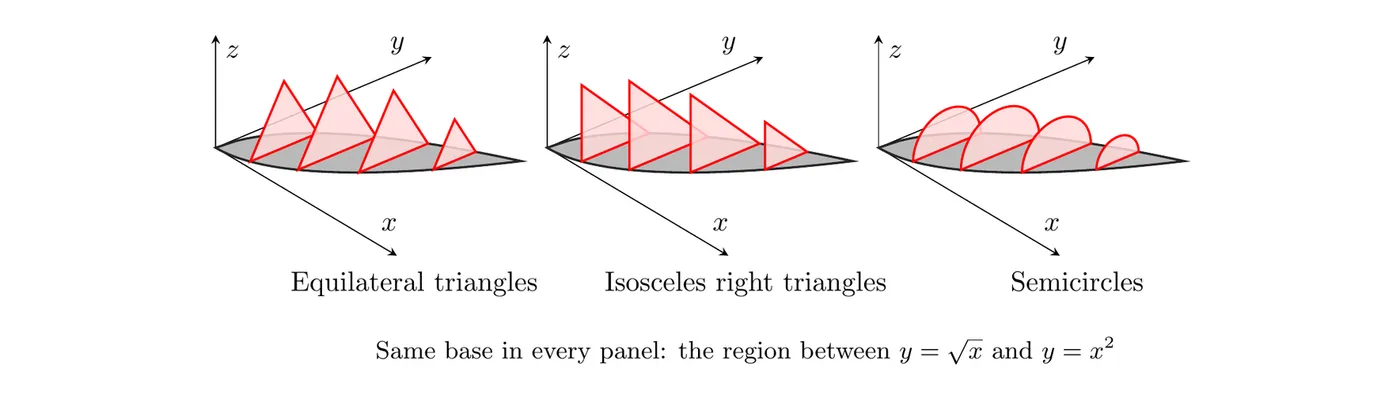
Key observation: the same base region produces a totally different solid depending on the cross-section shape.

Equilateral Triangle Cross-Sections

An equilateral triangle has three equal sides.
A=34s2\boxed{A = \frac{\sqrt{3}}{4}s^2}
where ss is the length of one side (any side, since they’re all the same).
This formula is not provided on the AP exam (there’s no formula sheet), so you have to memorize it.
The side length equals the distance between the boundary curves:
s=f(x)−g(x)s = f(x) - g(x)
So:
V=∫ab34[f(x)−g(x)]2 dx\boxed{V = \int_{a}^{b} \frac{\sqrt{3}}{4}[f(x) - g(x)]^2\,dx}

Example 1: Equilateral Triangles Perpendicular to the x-axis

Base bounded by y=xy = \sqrt{x} and y=x2y = x^2 (from x=0x = 0 to x=1x = 1), with equilateral triangle cross-sections perpendicular to the xx-axis.
Step 1: side length
s=x−x2s = \sqrt{x} - x^2
Step 2: set up
V=∫0134(x−x2)2 dx=34∫01(x−x2)2 dxV = \int_{0}^{1} \frac{\sqrt{3}}{4}(\sqrt{x} - x^2)^2\,dx = \frac{\sqrt{3}}{4}\int_{0}^{1} (\sqrt{x} - x^2)^2\,dx
Step 3: expand
(x−x2)2=x−2x5/2+x4(\sqrt{x} - x^2)^2 = x - 2x^{5/2} + x^4
Step 4: evaluate
V=34[x22−4x7/27+x55]01=34[12−47+15]=34⋅970=93280V = \frac{\sqrt{3}}{4}\left[\frac{x^2}{2} - \frac{4x^{7/2}}{7} + \frac{x^5}{5}\right]_{0}^{1} = \frac{\sqrt{3}}{4}\left[\frac{1}{2} - \frac{4}{7} + \frac{1}{5}\right] = \frac{\sqrt{3}}{4} \cdot \frac{9}{70} = \frac{9\sqrt{3}}{280}
Volume: 93280\frac{9\sqrt{3}}{280} cubic units

Isosceles Right Triangle Cross-Sections

An isosceles right triangle has two equal legs, a 90° angle between them, and a 45-45-90 configuration.
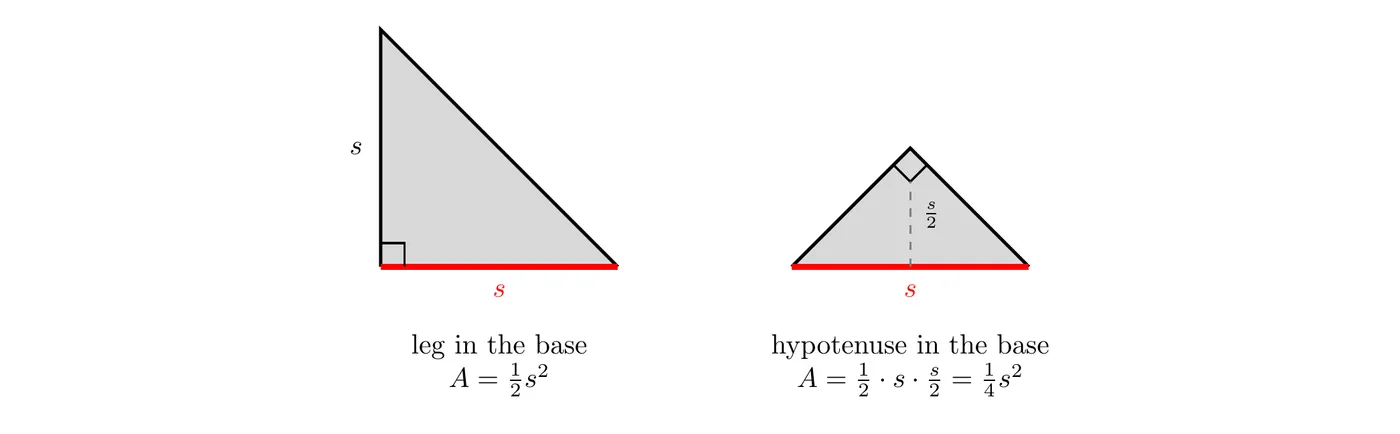
Important: for these problems, the equal legs (not the hypotenuse) sit on the bounded region.
A=12s2\boxed{A = \frac{1}{2}s^2}
where ss is one of the equal legs. The reasoning is simple: an isosceles right triangle is exactly half of a square with side length ss.
Since s=f(x)−g(x)s = f(x) - g(x):
V=∫ab12[f(x)−g(x)]2 dx\boxed{V = \int_{a}^{b} \frac{1}{2}[f(x) - g(x)]^2\,dx}

Example 2: Isosceles Right Triangles

Same base (y=xy = \sqrt{x} and y=x2y = x^2), with isosceles right triangle cross-sections perpendicular to the xx-axis.
V=∫0112(x−x2)2 dx=12∫01(x−2x5/2+x4) dxV = \int_{0}^{1} \frac{1}{2}(\sqrt{x} - x^2)^2\,dx = \frac{1}{2}\int_{0}^{1} (x - 2x^{5/2} + x^4)\,dx=12[x22−4x7/27+x55]01=12[12−47+15]=12⋅970=9140= \frac{1}{2}\left[\frac{x^2}{2} - \frac{4x^{7/2}}{7} + \frac{x^5}{5}\right]_{0}^{1} = \frac{1}{2}\left[\frac{1}{2} - \frac{4}{7} + \frac{1}{5}\right] = \frac{1}{2} \cdot \frac{9}{70} = \frac{9}{140}
Volume: 9140\frac{9}{140} cubic units

Semicircular Cross-Sections

A semicircle is half a circle, so:
A=12πr2\boxed{A = \frac{1}{2}\pi r^2}
Here’s where people mess up. The distance between the boundary curves gives you the diameter, not the radius.
Diameter=f(x)−g(x)Radius=12[f(x)−g(x)]\text{Diameter} = f(x) - g(x) \qquad\qquad \text{Radius} = \frac{1}{2}[f(x) - g(x)]
So:
V=∫ab12π[f(x)−g(x)2]2 dx=∫abπ8[f(x)−g(x)]2 dx\boxed{V = \int_{a}^{b} \frac{1}{2}\pi \left[\frac{f(x) - g(x)}{2}\right]^2\,dx} \quad = \quad \int_{a}^{b} \frac{\pi}{8}[f(x) - g(x)]^2\,dx
Where the π8\frac{\pi}{8} comes from:
12π⋅14[f(x)−g(x)]2=π8[f(x)−g(x)]2\frac{1}{2}\pi \cdot \frac{1}{4}[f(x) - g(x)]^2 = \frac{\pi}{8}[f(x) - g(x)]^2

Example 3: Semicircles, Step by Step

Same base (y=xy = \sqrt{x} and y=x2y = x^2), with semicircular cross-sections perpendicular to the xx-axis.
Step 1: basic semicircle area
A=12πr2A = \frac{1}{2}\pi r^2
Step 2: identify the radius. The diameter is x−x2\sqrt{x} - x^2, so:
r=12(x−x2)r = \frac{1}{2}(\sqrt{x} - x^2)
Step 3: substitute
A=12π[x−x22]2A = \frac{1}{2}\pi \left[\frac{\sqrt{x} - x^2}{2}\right]^2
Step 4: simplify
A=12π⋅(x−x2)24=π8(x−x2)2A = \frac{1}{2}\pi \cdot \frac{(\sqrt{x} - x^2)^2}{4} = \frac{\pi}{8}(\sqrt{x} - x^2)^2
Step 5: set up the volume integral
V=∫01π8(x−x2)2 dx=π8∫01(x−x2)2 dxV = \int_{0}^{1} \frac{\pi}{8}(\sqrt{x} - x^2)^2\,dx = \frac{\pi}{8}\int_{0}^{1} (\sqrt{x} - x^2)^2\,dx
Step 6: evaluate
V=π8[x22−4x7/27+x55]01=π8⋅970=9π560V = \frac{\pi}{8}\left[\frac{x^2}{2} - \frac{4x^{7/2}}{7} + \frac{x^5}{5}\right]_{0}^{1} = \frac{\pi}{8} \cdot \frac{9}{70} = \frac{9\pi}{560}
Volume: 9π560\frac{9\pi}{560} cubic units

Why Semicircles Are Tricky

Error 1: using the diameter as the radius
Wrong:
V=∫01π2(x−x2)2 dxV = \int_{0}^{1} \frac{\pi}{2}(\sqrt{x} - x^2)^2\,dx
This treats the full distance between the curves as the radius.
Error 2: forgetting to square the radius
Wrong:
V=∫01π2⋅x−x22 dxV = \int_{0}^{1} \frac{\pi}{2} \cdot \frac{\sqrt{x} - x^2}{2}\,dx
You need r2r^2, not just rr.
Correct:
V=∫01π2[x−x22]2 dx=∫01π8(x−x2)2 dxV = \int_{0}^{1} \frac{\pi}{2}\left[\frac{\sqrt{x} - x^2}{2}\right]^2\,dx = \int_{0}^{1} \frac{\pi}{8}(\sqrt{x} - x^2)^2\,dx

Where Each Fraction Comes From

V=∫abπ8[f(x)−g(x)]2 dxV = \int_{a}^{b} \frac{\pi}{8}[f(x) - g(x)]^2\,dx
The first 12\frac{1}{2}: a semicircle is half a circle.
Circle=πr2⇒Semicircle=12πr2\text{Circle} = \pi r^2 \quad \Rightarrow \quad \text{Semicircle} = \frac{1}{2}\pi r^2
The second 12\frac{1}{2}: the radius is half the diameter.
r=d2=f(x)−g(x)2r = \frac{d}{2} = \frac{f(x) - g(x)}{2}
Combined:
12π[f(x)−g(x)2]2=12π⋅[f(x)−g(x)]24=π8[f(x)−g(x)]2\frac{1}{2}\pi \left[\frac{f(x) - g(x)}{2}\right]^2 = \frac{1}{2}\pi \cdot \frac{[f(x) - g(x)]^2}{4} = \frac{\pi}{8}[f(x) - g(x)]^2

Summary Table: Cross-Section Formulas

Shape
Area Formula
Volume Integral
Square
A=s2A = s^2
∫ab[f(x)−g(x)]2 dx\int_{a}^{b} [f(x) - g(x)]^2\,dx
Equilateral triangle
A=34s2A = \frac{\sqrt{3}}{4}s^2
∫ab34[f(x)−g(x)]2 dx\int_{a}^{b} \frac{\sqrt{3}}{4}[f(x) - g(x)]^2\,dx
Isosceles right triangle
A=12s2A = \frac{1}{2}s^2
∫ab12[f(x)−g(x)]2 dx\int_{a}^{b} \frac{1}{2}[f(x) - g(x)]^2\,dx
Semicircle
A=π8d2A = \frac{\pi}{8}d^2
∫abπ8[f(x)−g(x)]2 dx\int_{a}^{b} \frac{\pi}{8}[f(x) - g(x)]^2\,dx
In every case, ss or dd is the distance between the boundary curves, f(x)−g(x)f(x) - g(x).

Other Cross-Sections

Squares, rectangles, triangles, and semicircles are the usual shapes, but the method works for any cross-section you can find the area of. Write the area of one slice as a function of xx (or yy), then integrate it.
  • Isosceles right triangle with the hypotenuse in the base: now the distance between the curves is the hypotenuse ss, not a leg. The height to the hypotenuse is s2\frac{s}{2}, so A=12⋅s⋅s2=14s2A = \frac{1}{2} \cdot s \cdot \frac{s}{2} = \frac{1}{4}s^2. Read the problem carefully to see which side sits in the base.
  • Full circles: A=πr2A = \pi r^2. If you know the diameter dd, then A=π(d2)2=π4d2A = \pi\left(\frac{d}{2}\right)^2 = \frac{\pi}{4}d^2, twice the semicircle area.
  • Area given directly: if the problem hands you the cross-sectional area A(x)A(x), skip the geometry and integrate it.
8.8 - Volumes with Cross Sections: Triangles and Semicircles

Example 4: Hypotenuse in the Base

Same base (y=xy = \sqrt{x} and y=x2y = x^2), with isosceles right triangle cross-sections perpendicular to the xx-axis whose hypotenuse lies in the base.
V=∫0114(x−x2)2 dx=14⋅970=9280V = \int_{0}^{1} \frac{1}{4}(\sqrt{x} - x^2)^2\,dx = \frac{1}{4} \cdot \frac{9}{70} = \frac{9}{280}
Volume: 9280\frac{9}{280} cubic units. That’s half of Example 2’s 9140\frac{9}{140}, because each triangle has half the area.

Example 5: Cross-Sectional Area Given as a Function

A solid lies along the xx-axis from x=0x = 0 to x=4x = 4, measured in centimeters. Its cross-section perpendicular to the xx-axis at xx has area A(x)=3xA(x) = 3\sqrt{x} square centimeters. Find its volume.
V=∫043x dx=[2x3/2]04=2(8)−0=16V = \int_{0}^{4} 3\sqrt{x}\,dx = \left[2x^{3/2}\right]_{0}^{4} = 2(8) - 0 = 16
Volume: 1616 cubic centimeters

With Respect to y

All of these work the same way for cross-sections perpendicular to the yy-axis:
  1. Convert equations to x=f(y)x = f(y) form
  1. Use yy-boundaries as the limits
  1. The distance becomes xright−xleftx_{\text{right}} - x_{\text{left}}
  1. Integrate with dydy instead of dxdx
For example, if the base is bounded by x=y2x = y^2 (left) and x=yx = \sqrt{y} (right) from y=0y = 0 to y=1y = 1, with semicircular cross-sections:
V=∫01π8(y−y2)2 dyV = \int_{0}^{1} \frac{\pi}{8}(\sqrt{y} - y^2)^2\,dy

Calculator Strategy

  1. Set up the integral with the correct constant and squared expression
  1. Use MATH → 9:fnInt( to evaluate
  1. Keep π\pi symbolic (don’t approximate it as 3.14) until the very end
Example entry:
(π/8) * fnInt((√(X) - X²)², X, 0, 1)

Problem-Solving Checklist

Before integrating, verify: - Shape identified? (which triangle type, or semicircle) - Correct area formula, especially the constant out front? - Distance formula right? (top minus bottom, or right minus left) - Semicircle radius handled? (did you halve the diameter) - Everything squared? - Perpendicular to which axis? (determines dxdx or dydy)

Common AP Exam Patterns

  • Very common: semicircular cross-sections perpendicular to the xx-axis (squares from 8.7 are the other big one)
  • Also common: equilateral triangles perpendicular to the xx-axis
  • Less common: isosceles right triangles, or anything with the yy-axis
Master semicircles first. They show up often and have the trickiest setup.

Key Takeaways

  • Equilateral triangles: A=34s2A = \frac{\sqrt{3}}{4}s^2 (not given on the exam)
  • Isosceles right triangles: A=12s2A = \frac{1}{2}s^2 (half a square)
  • Semicircles: A=π8d2A = \frac{\pi}{8}d^2, where dd is the diameter
  • Critical for semicircles: radius = 12\frac{1}{2}(diameter), so remember to halve the distance
  • Distance between curves: s=f(x)−g(x)s = f(x) - g(x) gives the side length or the diameter
  • Always square it. All these formulas involve [f(x)−g(x)]2[f(x) - g(x)]^2
  • Constants to remember: equilateral 34\frac{\sqrt{3}}{4}, isosceles right 12\frac{1}{2}, semicircle π8\frac{\pi}{8}
  • Perpendicular to the yy-axis: same formulas, just use dydy and convert equations
  • Calculator friendly: set up correctly, then use fnInt(
  • Other shapes: same method, V=∫A(x) dxV = \int A(x)\,dx. A hypotenuse in the base gives 14s2\frac{1}{4}s^2, and a full circle gives π4d2\frac{\pi}{4}d^2
  • Practice semicircles. They’re common and the most error-prone

AP® is a registered trademark of the College Board, which is not affiliated with Dove's Library and was not involved in the production of, and does not endorse, this website.

Providing free, high-quality AP notes to help students succeed, earn college credit, and reach their educational goals, ensuring everyone has access to the resources they need.

© 2026 Standard Learning Group, Inc., which operates Dove's Library. All rights reserved.