

8.9 - Volume with Disc Method: Revolving Around the x- or y-Axis
What Is a Solid of Revolution?
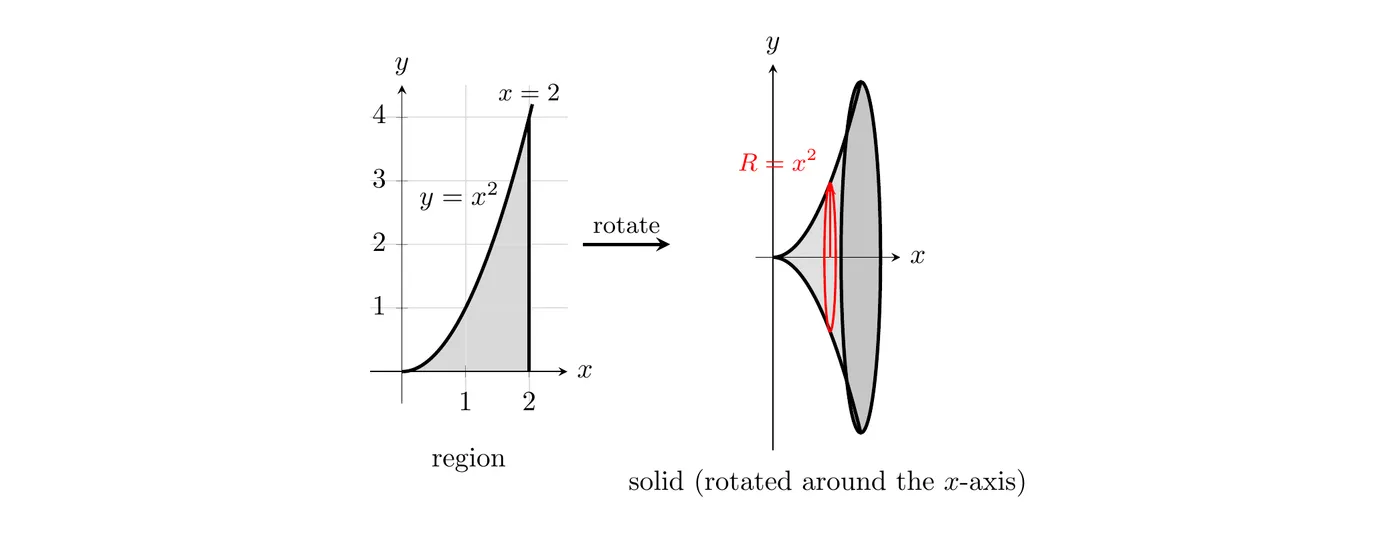
A solid of revolution is a 3D object created by rotating a 2D region around an axis, called the axis of revolution.
Take a bounded region in the plane and spin it 360° around a line (usually the -axis or -axis). As it rotates, it sweeps out a solid.
For example, the region bounded by , , and , rotated around the -axis, creates a funnel-like solid.
Sketching Solids of Revolution on Paper
Step 1: Draw the original region.
Step 2: Draw the mirror image across the axis of revolution.
Step 3: Connect the edges with curved lines to suggest the 3D shape. Draw elliptical curves at the ends, use dashed lines for hidden back edges, and add shading or perspective lines.
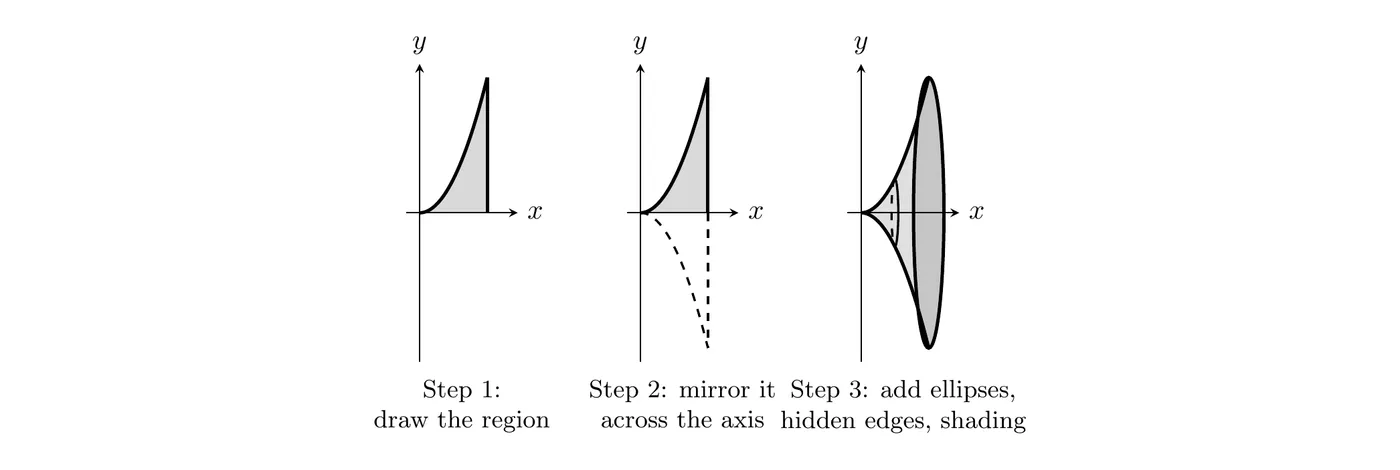
Important: even though the middle looks empty in a 2D sketch, the solid is completely filled. There are no hollow spaces.
Cross-Sections: The Key to the Volume
At any position along the axis of revolution, slicing perpendicular to the axis gives you a circle (a disk). Why circles? Because we rotated around an axis, so every point traces a circular path.
The area of one circular cross-section is:
Finding the radius. The radius runs from the axis of revolution out to the outer edge of the solid. For a region bounded by rotated around the -axis:
The radius at position is just the function value, the distance from the axis to the curve.
The Disk Method Formula
where:
- is the radius function (distance from the axis of revolution to the outer edge)
- is the interval along the axis of revolution
- We use capital for the outer radius
We’re summing up the areas of infinitely many circular disks from to .
Example 1: Revolution Around the x-axis
Find the volume of the solid formed by rotating the region bounded by , , and around the -axis.
Step 1: radius function. The distance from the -axis to the curve:
Step 2: bounds. From to .
Step 3: set up
Step 4: factor out the constant and integrate
Volume: cubic units
Example 2: Exponential Functions
Find the volume formed by rotating the region bounded by , , , and around the -axis.
Step 1: set up. Radius :
Step 2: simplify. :
Step 3: substitution. Let , so and . When , . When , .
Step 4: integrate
Volume: cubic units
Revolution Around the y-axis
When you rotate around the -axis instead:
- Integrate with respect to (use )
- Convert equations to form
- Use -boundaries as your limits
- The radius is now horizontal, measured in the -direction
where is expressed as a function of .
Example 3: Revolution Around the y-axis
Set up (but don’t evaluate) an integral for the volume formed by rotating the region bounded by , , and the -axis around the -axis.
Step 1: convert to
Step 2: find the -boundaries. When , (the top). The bottom is at . So runs from 0 to 4.
Step 3: radius. The distance from the -axis (where ) out to the line:
Step 4: set up
To evaluate, you’d expand the squared term and integrate, but the setup is the skill being tested.
Another y-axis Example
Find the volume formed by rotating the region bounded by , , and around the -axis.
Step 1: radius and bounds. Already in form, so , with from 0 to 4.
Step 2: set up and evaluate
Volume: cubic units
Problem-Solving Strategy
Step 1: sketch the region and identify the axis of revolution.
Step 2: determine the radius function. Measure from the axis of revolution to the curve.
Step 3: identify the limits. Find where the region starts and ends along the axis of revolution.
Step 4: set up the integral. Use for the -axis, for the -axis.
Step 5: evaluate. Factor out , expand squared terms, integrate, and evaluate at the bounds.
Common Patterns and Tips
When to use vs.
Axis of Revolution | Integration Variable | Function Form Needed |
-axis | ||
-axis |
Simplifying
Always simplify the squared function:
-
-
-
-
Working with
On non-calculator sections, leave in the answer (, not ), and factor it out of the integral early.
On calculator sections, you can approximate: .
Visualization Tips
- Imagine the sweeping motion. The region traces out a path as it spins
- Think in slices. Every thin vertical (or horizontal) strip becomes a disk
- The radius varies. As you move along the axis, each disk’s radius changes with the function
- It’s solid throughout. Not hollow. Every point in the region traces a circle
Common Mistakes to Avoid
- Forgetting to square the radius. It’s , not
- Using the wrong variable. -axis rotation uses ; -axis rotation uses
- Not converting for -axis problems. Always solve for
- Squaring incorrectly. , not
- Forgetting , which happens easily once you factor it out
- Wrong bounds. For the -axis use -values; for the -axis use -values
Summary Table
Scenario | Volume Formula | Notes |
Around the -axis | Radius = | |
Around the -axis | Need form | |
General form | = radius function |
Key Takeaways
- Solid of revolution: rotate a 2D region around an axis to make a 3D solid
- Disk method: every cross-section perpendicular to the axis is a circle
- Volume formula: (or for the -axis)
- Radius : the distance from the axis of revolution to the outer edge
- -axis rotation: use , radius is , bounds are -values
- -axis rotation: use , convert to , bounds are -values
- Always square the radius. A disk’s area is , not
- Sketching helps. Drawing the region and its mirror image clarifies the setup
- is a constant. Factor it out for easier computation
- Leave answers in terms of unless you’re asked to approximate
- This is the foundation for disks around other axes and the washer method, coming next