

8.11 - Volume with Washer Method: Revolving Around the x- or y-Axis
Introduction: When There’s a Gap
In earlier lessons, we rotated regions around an axis to create solid objects using the disk method. Now we handle cases where the solid has a hole in the middle, like a donut or a washer.
Key difference: the region being rotated doesn’t touch the axis of revolution, which leaves empty space in the center.
Visualizing a Washer
When you rotate a region that doesn’t touch the axis, you get a hollow solid. If you slice through it perpendicular to the axis, the cross-section looks like a washer, meaning a disk with a hole in it.
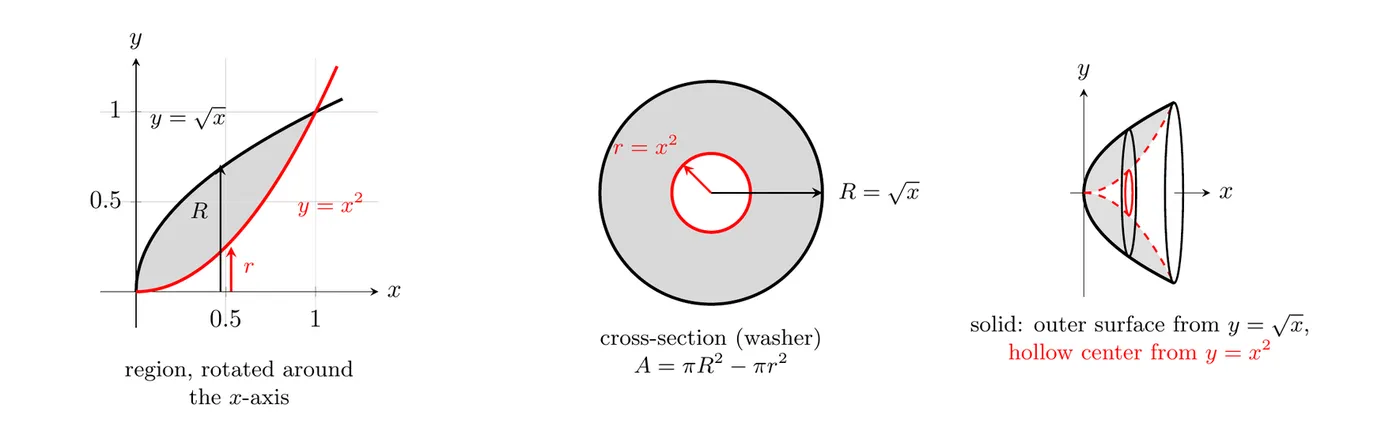
Key insight: the volume equals the volume of the outer solid minus the volume of the inner cavity.
The Washer Method Formula
where:
- is the outer radius, from the axis to the outer curve
- is the inner radius, from the axis to the inner curve
- is the interval along the axis of revolution
Alternative Form (Two Separate Integrals)
That’s the volume of the outer solid minus the volume of the inner cavity.
Why This Works
At each position along the axis:
- Area of the washer = (area of the outer disk) minus (area of the inner disk)
Integrating adds up all those washer areas to get the total volume.
Critical Warning: A Common Mistake
Wrong:
Do not subtract the radii first and then square.
Correct:
Rule: square each radius individually, then subtract.
Remember that . Expanding gives , which has a middle term we don’t want.
Example 1: Basic Washer Around the x-axis
Problem: find the volume of the solid formed by rotating the region bounded by and around the -axis.
Step 1: Find the intersection points.
Step 2: Identify the radii.
Since we’re rotating around the -axis:
- Outer radius: the distance from the -axis to , which is the curve farther from the axis
- Inner radius: the distance from the -axis to , which is the curve closer to the axis
Step 3: Set up the integral.
Method A (two integrals):
Method B (combined, and generally preferred):
Step 4: Integrate.
Volume: cubic units
Example 2: Washer Around the y-axis
Problem: set up an integral for the volume formed by rotating the region bounded by , , , and around the -axis.
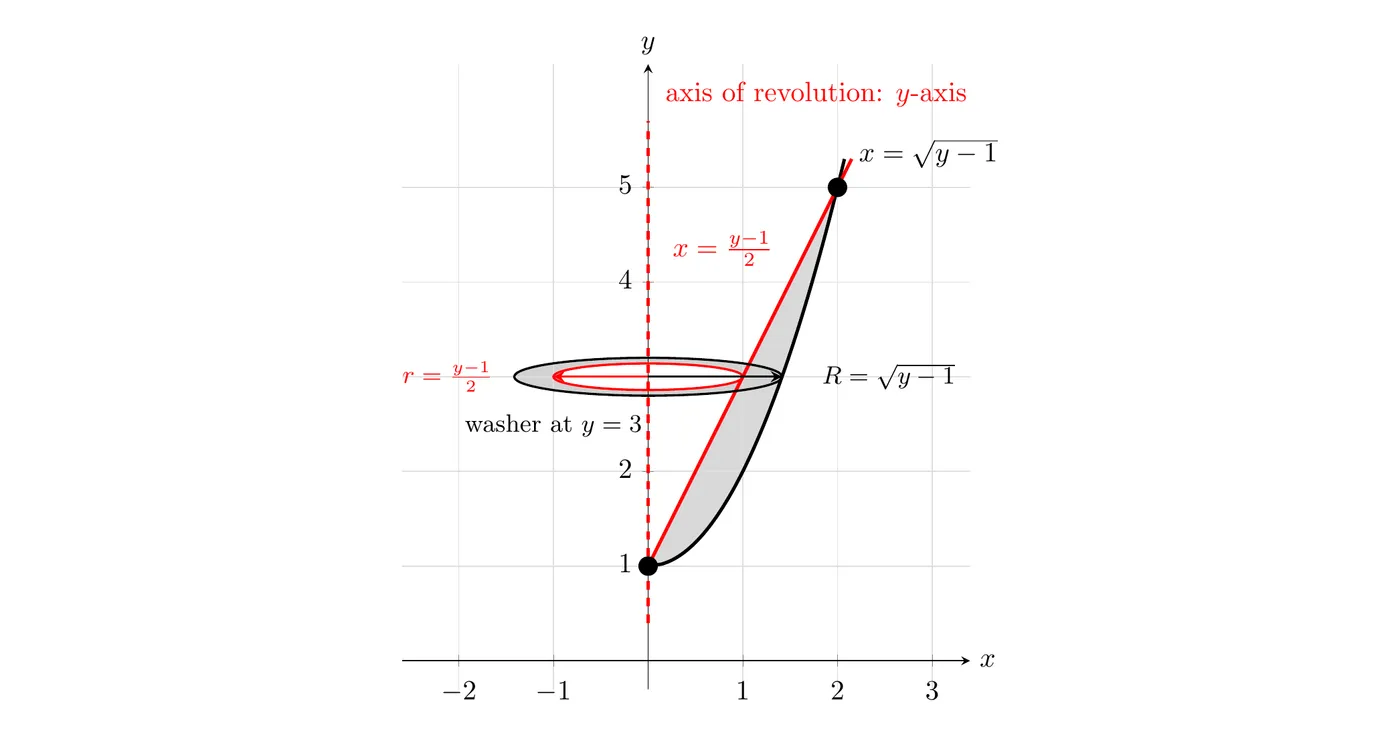
Step 1: Identify the boundaries. From to .
Step 2: Identify the radii, measured horizontally.
- Outer radius: the distance from the -axis to the curve farther right
- Inner radius: the distance from the -axis to the line closer to the axis
Step 3: Set up the integral.
Step 4: Simplify.
Note: to evaluate this fully, you’d expand and integrate term by term.
Washers Around Shifted Axes
When the axis of revolution is something other than the - or -axis, like or , the radius calculations adjust.
For the axis
For the axis
The order may flip depending on which side of the line the region sits.
Example 3: Washer Around
Problem: set up an integral for the volume formed by rotating the region bounded by and around the line .
Step 1: Find the intersections.
Step 2: Identify the radii.
We’re rotating around , which is below the region.
- Outer radius: from to , the curve farther from the axis
- Inner radius: from to , the curve closer to the axis
Step 3: Set up the integral.
Step 4: Expand.
Then integrate term by term.
How to Identify Outer vs. Inner Radius
Visual method: sketch the region and the axis.
- The curve farther from the axis is the outer radius
- The curve closer to the axis is the inner radius
Algebraic method: pick a test point in the interval.
- Evaluate both curves there
- Whichever has the larger distance from the axis is
- Whichever has the smaller distance is
Problem-Solving Strategy
Step 1: Sketch the region. Draw all the boundary curves, mark the axis of revolution, and shade the region you’re rotating.
Step 2: Find the intersection points to get your limits of integration.
Step 3: Identify which curve is which. Figure out the outer curve (farther from the axis) and the inner curve (closer).
Step 4: Write the radius expressions. is the distance from the axis to the outer curve, and is the distance from the axis to the inner curve.
Step 5: Set up the integral.
Step 6: Simplify and evaluate. Expand the squared terms, combine like terms, and integrate.
Disk vs. Washer: When to Use Which?
Method | When to Use | Formula |
Disk | The region touches the axis of revolution | |
Washer | There’s a gap between the region and the axis |
Quick check: does one edge of the region run right along the axis for the whole interval? If yes, use the disk method. If there’s a gap anywhere, use the washer method. Touching the axis at a single point doesn’t count: in Example 1 the region touches the -axis only at the origin, and it’s still a washer problem.
Common Mistakes to Avoid
Squaring the difference, . Square individually instead: .
Forgetting to square both radii. It’s , not .
Mixing up inner and outer. The outer one is always farther from the axis, and the inner one is closer.
Forgetting the . You can factor it out, but remember to multiply it back in at the end.
Using the wrong integration variable. A horizontal axis means , and a vertical axis means .
Not subtracting the axis location for shifted axes. The radius is [curve] minus [axis value], for both and .
Summary: Disk vs. Washer
Disk Method (solid, no hole)
- One radius, , from the axis to the curve
- Formula:
Washer Method (hollow, with a hole)
- Two radii, (outer) and (inner)
- Formula:
Both methods can revolve around the -axis, the -axis, or any horizontal or vertical line, and both require careful identification of which function is which radius.
Key Takeaways
- Washer method is for when the region doesn’t touch the axis of revolution
- Cross-sections are washers, meaning circular rings with hollow centers
- Two radii are needed: an outer radius and an inner radius
- Formula: , or for vertical axes
- Square individually. It’s , never
- Outer radius : the distance from the axis to the curve farther away
- Inner radius : the distance from the axis to the curve closer in
- Think of it as the outer solid minus the inner cavity
- Works with shifted axes by adjusting the radii with the axis value
- Don’t forget the . Factor it out, but keep it in the final answer