

8.12 - Volume with Washer Method: Revolving Around Other Axes
Review: The Washer Method
From the previous lesson, when a region doesn’t touch the axis of revolution:
where is the outer radius (axis to outer curve) and is the inner radius (axis to inner curve).
This lesson: apply the washer method when revolving around lines other than the - or -axis.
Key Concept: Two Approaches
When the axis of revolution is shifted, like or , you have two options:
Method 1: calculate the radii directly from the shifted axis
Method 2: shift the entire region so the axis becomes the - or -axis
Both methods produce the same answer.
Example 1: Washer Around
Problem: find the volume of the solid formed by rotating the region bounded by and around the line .
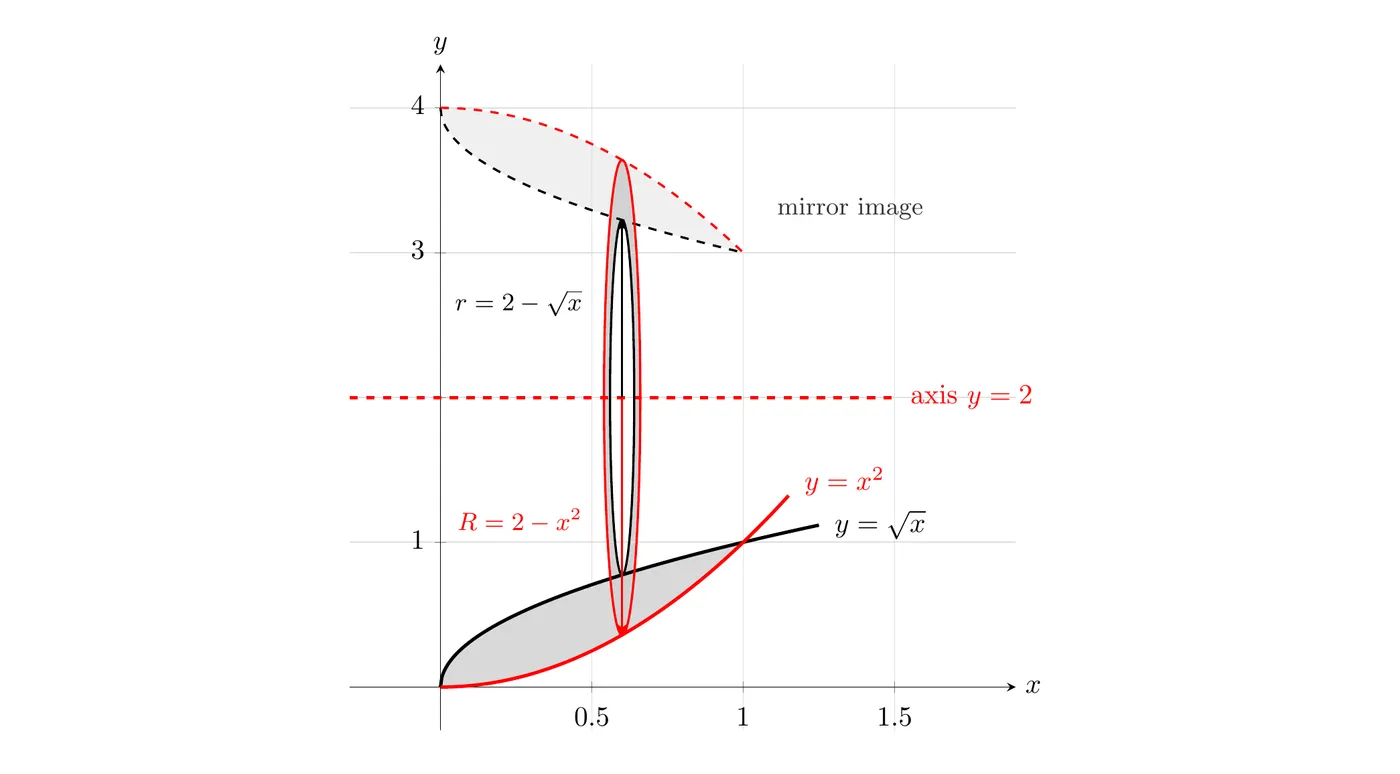
Step 1: Find the intersection points.
Method 1: Direct Calculation from
Outer radius: from down to the parabola , which is farther away.
Think, “the entire distance from the -axis to the parabola is , but I want the distance from to the parabola.” The distance from the -axis to is 2, so
Inner radius: from to the curve , which is closer to the axis.
Set up the integral:
Method 2: Shift the Region Down
Shift everything down by 2, subtracting 2 from all the -values.
New curves:
New axis: , the -axis.
Now we revolve around the -axis with the shifted curves:
Comparison
Direct: and
Shifted: and
The terms are in opposite order, but , because squaring kills the sign:
Conclusion: both methods give identical results.
Evaluate:
Volume: cubic units
Example 2: Washer Around
Problem: find the volume formed by rotating the region bounded by , , , and around the line .
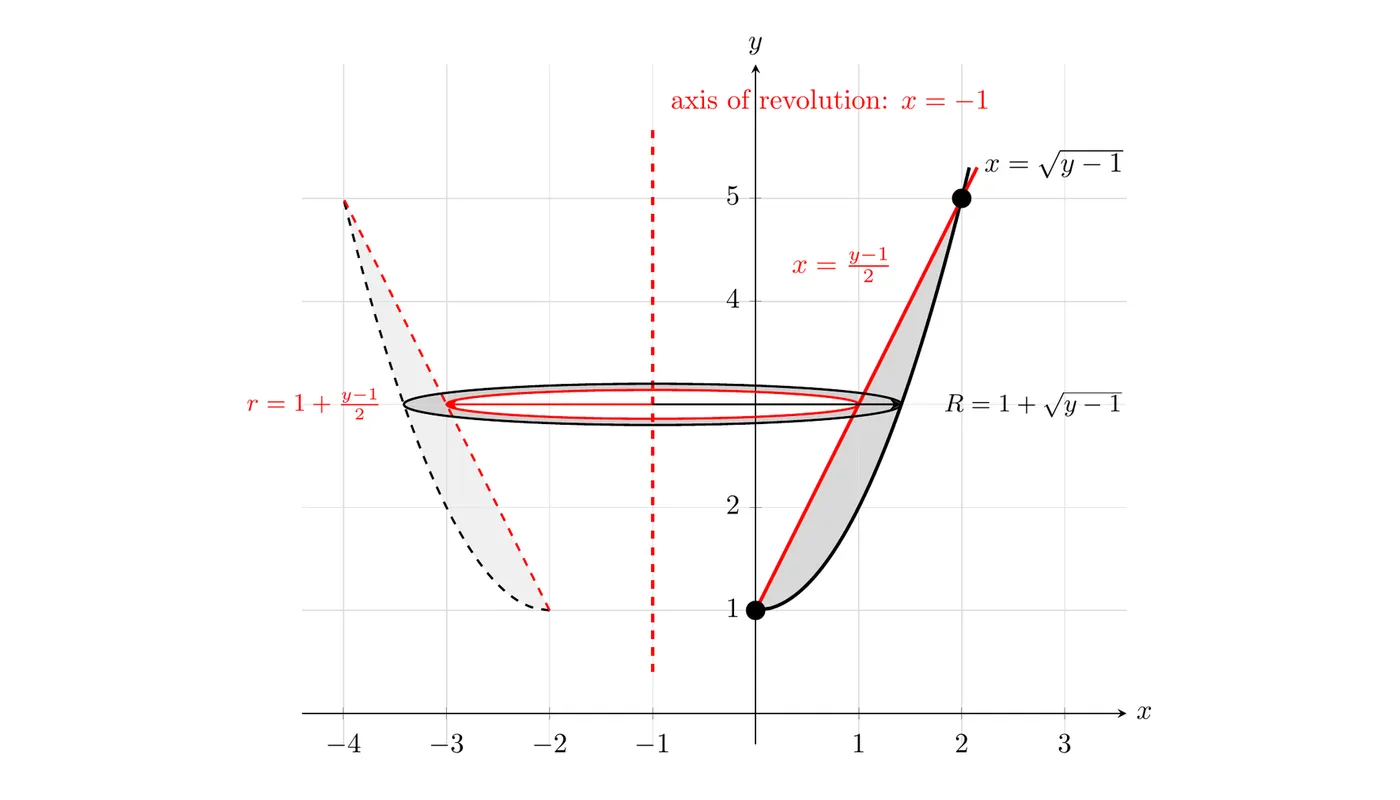
Step 1: Find the boundaries. Both curves meet at and , which we’re given.
Method 1: Direct Calculation from
Outer radius: from to , which is farther right.
The distance from the -axis to the curve is , and the distance from the -axis to is 1 unit to the left, so
Inner radius: from to , which is closer to the axis.
Set up the integral:
Method 2: Shift the Region Right
Shift everything right by 1, adding 1 to all the -values.
New curves:
New axis: , the -axis.
Again, this is identical to Method 1.
Evaluate: let , so runs from 0 to 4 and the integrand becomes .
Volume: cubic units
Why Both Methods Work
The key insight: when radii get squared, the order of subtraction doesn’t matter.
Proof:
They’re identical. For our purposes, that means
So whether you calculate the radius as or shift and get , squaring produces the same result.
Choosing Your Method
Method 1: Direct Calculation
- Identify where the shifted axis is
- Calculate [axis value] minus [curve], or [curve] minus [axis value]
- Set up the integral
Best when: you’re comfortable visualizing distances from shifted axes.
Method 2: Shift the Region
- Add or subtract to move the axis to or
- Apply the same shift to all the equations
- Set up the integral as if you’re revolving around a standard axis
Best when: you’d rather work with standard axes.
Recommendation: try both on practice problems and see which one feels more natural.
Summary of Radius Formulas (Shifted Axes)
For (a horizontal line)
Method 1 (direct):
- If the region is below the line: and
- If the region is above the line: and
Method 2 (shift):
- Subtract from all the -values
- New curves:
- Revolve around
For (a vertical line)
Method 1 (direct):
- If the region is right of the line: and
- If the region is left of the line: and
Method 2 (shift):
- Subtract from all the -values, which shifts right if is negative
- New curves:
- Revolve around
Problem-Solving Strategy
Step 1: Sketch and identify. Draw the region, mark the axis of revolution, and note whether it’s shifted.
Step 2: Choose your method. Direct calculation or shifting the region.
Step 3: Find the radii. Outer radius (farther from the axis) and inner radius (closer).
Step 4: Set up the integral.
Step 5: Evaluate. Expand the squared terms, integrate, and simplify.
Review: All the Volume Methods from Unit 8
To help you prep for the test, here’s when to use each one:
Method | When to Use | Formula |
Cross-sections | You’re given a shape perpendicular to the axis | , where is the area formula |
Disk | Solid revolution, region touches the axis | |
Washer | Hollow revolution, region doesn’t touch the axis | |
Shifted disk | Solid revolution around a shifted axis | with adjusted |
Shifted washer | Hollow revolution around a shifted axis | with adjusted radii |
AP Exam Preparation Tips
Practice Strategy
1. Take timed practice exams. Use official released exams if you can get them. Barron’s and Princeton Review are both solid. Stick to the actual time limits and don’t give yourself extra time.
2. Review your mistakes. Go through what you missed, understand WHY you missed it, and look for patterns in your errors.
3. Don’t stress about the hardest problems. Only a couple of students out of hundreds of thousands get perfect scores. Around 65% typically earns a 5, and if you’re getting about half the questions right, you’re on track for a 4.
4. Skip and come back. Don’t get stuck on a brutal problem. Move on and return if you have time. Partial credit beats no answer.
Procedural Skills Should Be Automatic
You should be able to do these without hesitating:
- Derivatives: chain rule, product rule, quotient rule. For example, find
- Integrals: u-substitution and basic antiderivatives. For example, evaluate
- Recognizing problem types: area, volume, related rates, optimization
If these aren’t automatic yet, drill them now.
Common Mistakes to Avoid
Forgetting which method to use. Review the summary table above before the exam.
Not squaring the radii individually. It’s always , never .
Mixing up inner and outer. Sketch it out to see which curve is farther from the axis.
Forgetting the . Every revolution problem has a somewhere.
Wrong integration variable. Horizontal axis means , and vertical axis means .
Key Takeaways
- Washer method with shifted axes is the same concept as before, just with adjusted radii
- Two valid approaches: direct calculation, or shifting the region
- Both give the same answer, because squaring eliminates sign differences
- Order doesn’t matter once squared:
- Choose whichever method makes sense to you. Practice both and use whichever is clearer
- For : adjust by adding or subtracting from the -values
- For : adjust by adding or subtracting from the -values
- Review all of Unit 8: cross-sections, disks, washers, and shifted axes
- Practice exams are crucial. Time yourself and review your mistakes
- You’ve learned an entire year of calculus, so be proud and go in confident
Congratulations on completing AP Calculus AB.