

8.3 - Using Accumulation Functions and Definite Integrals in Applied Contexts
Fundamental Principle: Integrating Rates
When you integrate a rate of change, you get the net change in the quantity:
Same idea as velocity and position: integrating velocity (the rate of change of position) gives displacement (the net change in position).
Key insight: this goes way beyond motion problems. It applies to any context involving a rate.
Example 1: Beach Erosion
Problem: During a storm, sand washes away from a beach and the distance between a road and the water’s edge shrinks. The rate of decrease is
with in hours after the storm began. The water’s edge starts 250 feet from the road. If the storm lasts 5 hours, how far is the water from the road afterward?
Step 1: Set it up. Start with the initial distance and subtract the net change, since the distance is decreasing.
Step 2: Evaluate the integral.
Step 3: Final distance.
Example 2: Writing an Integral Equation (Without Solving)
Problem: A concert venue opens its doors. People enter at a rate of people per minute. When the doors open there are already 50 people inside (staff and VIPs). Write, but do not solve, an equation involving an integral to find the time when there are 300 people inside. Nobody leaves.
Breaking down each piece:
- 50: the initial number of people
- : the net change, meaning everyone who entered between and
- 300: the target
- : the unknown time you’re solving for
This “write but do not solve” setup is a very common AP question type.
Example 3: Using Tables with Riemann Sums
Problem: Water flows into a reservoir at a rate of liters per hour.
(hours) | 0 | 2 | 5 | 8 | 10 |
(L/hr) | 4000 | 3500 | 2800 | 2000 | 1500 |
is differentiable and decreasing on . At the reservoir holds 8000 liters.
Part (a): What does represent?
The amount of water, in liters, that flowed into the reservoir over the 10 hours. Integrating a rate of flow gives you the total quantity that flowed.
Part (b): Estimate it with a left Riemann sum
The subintervals have different widths: has , has , has , and has .
Part (c): How much water is in the reservoir after 10 hours?
Example 4: Fundamental Theorem Application
Problem: The amount of oil in a tank is gallons, in hours.
(hours) | 0 | 2 | 5 | 8 | 10 |
(gal) | 8000 | 12500 | 17200 | 20800 | 23000 |
Find and explain what it means.
By the Fundamental Theorem of Calculus:
That’s the net change in the oil in the tank over 10 hours. 15,000 gallons were added.
Important Distinction
When the table gives you (an amount, not a rate): use the Fundamental Theorem. . Just subtract table values.
When the table gives you (a rate): use a Riemann sum to approximate the integral. Multiply rate by time for each interval.
Pattern Recognition Guide
Scenario 1: Given a rate, find the total change
Use plus if the quantity is increasing, minus if it’s decreasing.
Phrases that signal a rate: “at a rate of,” “the rate of change is,” “modeled by [units per time].”
Scenario 2: Write an equation to find an unknown time
where is the unknown.
Scenario 3: Estimate from a table (rate given)
Left, right, or midpoint, depending on what the problem says.
Scenario 4: Table shows actual values, not a rate
Just subtract the endpoint values.
Example 5: Population Growth
Problem: A town’s population is thousand people, years after 2020. The rate of change is
In 2020 the population was 15,000. What’s the population in 2025?
Population in 2025: about 18,074 people
Accumulation Functions: Rate In and Rate Out
A function defined by an integral, like
is an accumulation function. Its value at time is the starting amount plus everything that has built up since . By the Fundamental Theorem of Calculus (Unit 6), , so the rate tells you when the amount is going up or down.
A lot of AP problems have something coming in and something going out at the same time. Then the amount changes at the net rate, rate in minus rate out:
Example 6: Cars In and Out of a Garage
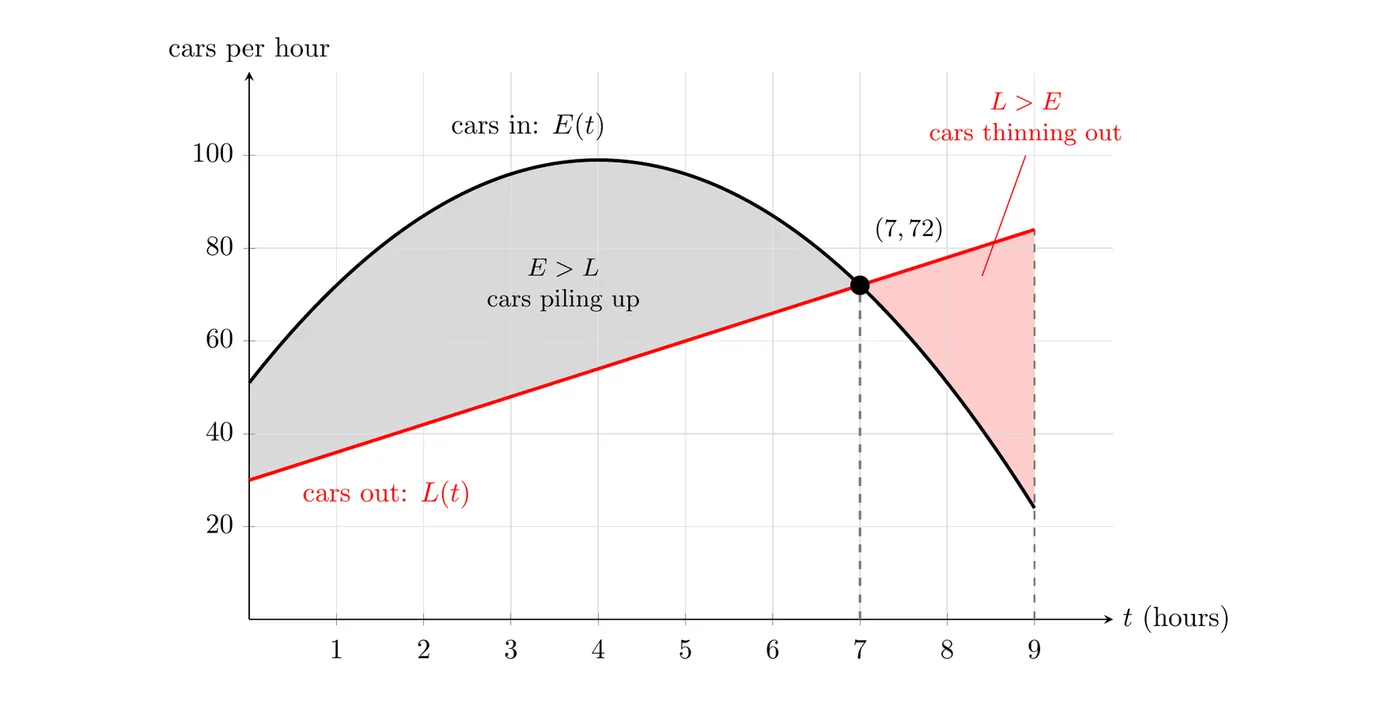
Problem: At 7 AM () a parking garage holds 120 cars. For hours, cars enter at a rate of cars per hour and leave at a rate of cars per hour.
Part (a): Write an expression for the number of cars at time
Part (b): Is the number of cars going up or down at ?
, so the number of cars is decreasing at 3 PM, at a rate of 27 cars per hour.
Part (c): When are there the most cars, and how many?
Set the net rate equal to zero:
( is outside the interval.) Now use the candidates test: check the critical point and both endpoints.
Answer: the garage is fullest at (2 PM), with 365 cars. That matches the graph: cars come in faster than they leave until , and after that the garage starts to empty.
Part (d): What does mean?
153 cars left the garage between 9 AM () and noon (). Integrating a rate out gives the total amount that went out over that time.
Common Question Types
Type 1: “What does this integral represent?” Answer with something like “the net change in [quantity] from [start] to [end]” or “the total amount of [quantity] that accumulated during [time period].”
Type 2: “Write but do not solve…” Identify the initial value, set up Initial rate Target, and use a variable for whatever you’re finding.
Type 3: “Estimate using a left/right/midpoint Riemann sum.” Find the subinterval widths (they may not be uniform), pick the right height for each rectangle, and sum width times height.
Type 4: “How much is in the tank after…” Find the net change with an integral or Riemann sum, add it to (or subtract it from) the initial amount, and check your units.
Type 5: “When is the amount greatest (or least)?” Set rate in minus rate out equal to zero, then use the candidates test: check those times and both endpoints with .
Calculator Tips
Integrals on a TI-84:
- Press
MATH, select9:fnInt(
- Enter
fnInt(function, variable, lower, upper)
- Example:
fnInt(8e^(-0.3X), X, 0, 5)
Tables in lists: put time values in
L₁, rate values in L₂, then compute the Riemann sum with sum(ΔL₁*L₂), adjusting for left or right.Recalling: press
2nd + ENTER to pull up the last entry and edit it.Units Matter
If the rate has units… | The integral has units… |
feet per hour | feet |
liters per minute | liters |
people per day | people |
dollars per year | dollars |
General rule: integrating a rate makes the “per [time]” disappear, leaving just the quantity.
Key Takeaways
- Fundamental principle:
- Setup: Initial value rate Final value
- Add the integral for increasing quantities, subtract for decreasing ones
- “Write but do not solve” means set up the equation with a variable for the unknown
- Tables with rates: use Riemann sums
- Tables with actual values: use the Fundamental Theorem,
- Integrating “per time” removes the time unit
- Always interpret an integral as a total change or accumulated amount
- Distinguish rate functions from quantity functions in tables
- Accumulation function: , and
- Most or least of something: set rate in equal to rate out, then check those times and the endpoints