

8.5 - Finding the Area Between Curves Expressed as Functions of y
Review: Area with Respect to x
Up to now we’ve been finding area between curves with:
That sweeps horizontally, left to right along the -axis.
Area with Respect to y
Sometimes it’s easier (or necessary) to sweep vertically, along the -axis:
Key differences:
- Integrate with respect to , not
- The limits and are -values, not -values
- Subtract left from right, not bottom from top
- Functions have to be written as , not
Converting to Form
Just solve each equation for .
From : square both sides.
From : add 6.
From :
The gives you two branches. The positive square root is the right side of the parabola, and the negative one is the left side.
Example 1: Comparing Both Methods
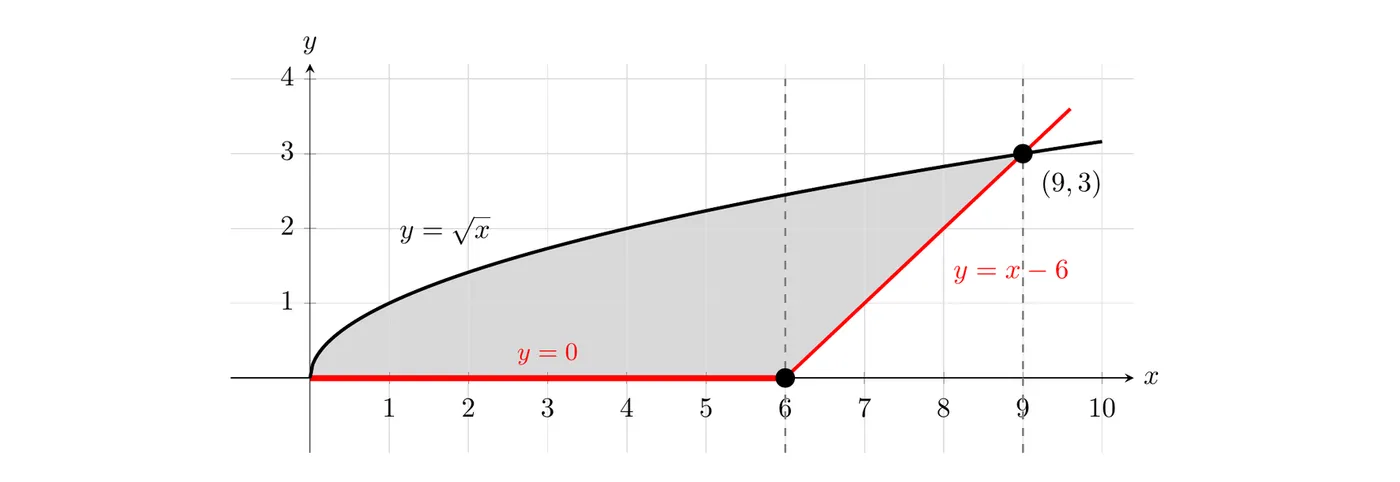
Find the area of the region bounded by , (from to ), (from to ), and .
Method 1: with respect to x
The bottom boundary changes at , so we need two integrals:
Method 2: with respect to y
Step 1: convert to form
Step 2: identify boundaries
- Right boundary: the line (the whole way)
- Left boundary: the curve (the whole way)
- -limits: from to
Step 3: set up the integral
Neither boundary changes, so we only need one integral:
That’s the advantage. With respect to , one integral instead of two.
Check: both methods give the same area.
With respect to , the two integrals come out to and , which also add up to .
Example 2: Single Integral with Respect to y
Find the area bounded by and .
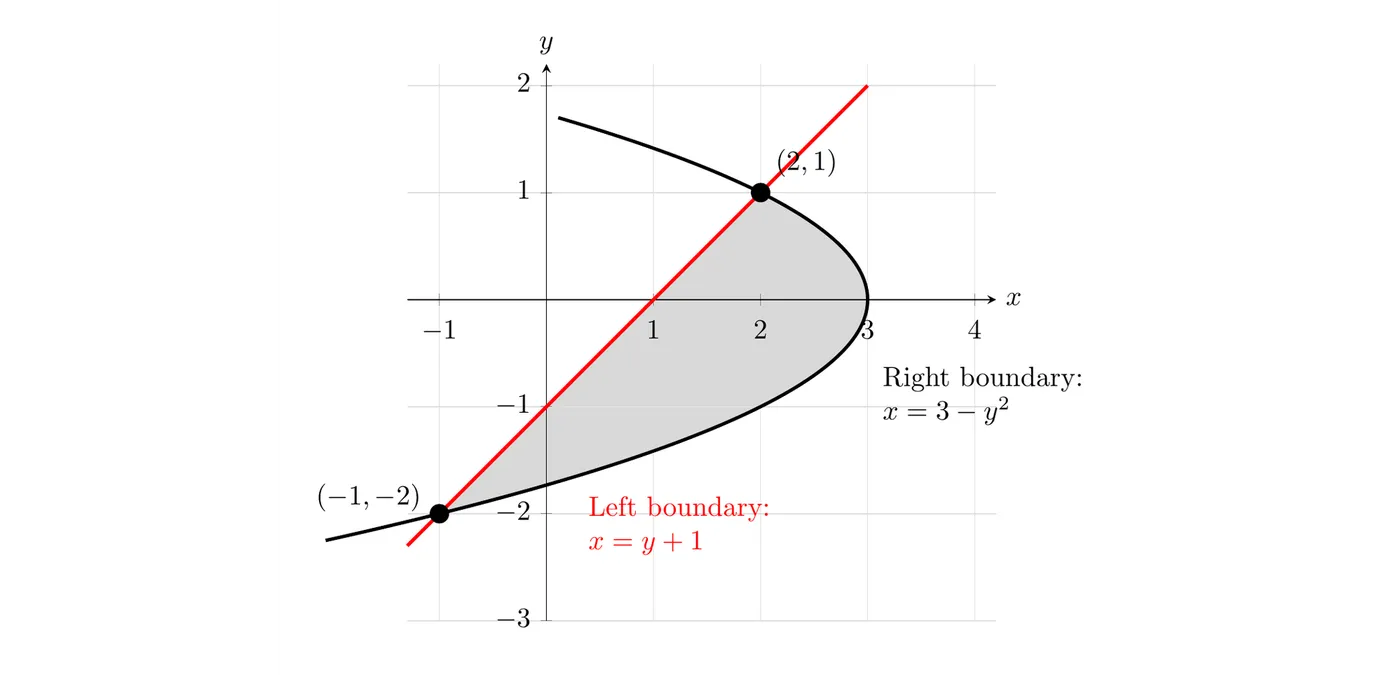
Step 1: which function is on the right?
Test :
- Parabola: (right)
- Line: (left)
Step 2: find the -boundaries
Set them equal:
So and .
Step 3: check whether the boundaries change
- Right side: the whole way ✓
- Left side: the whole way ✓
Only one integral needed.
Step 4: set up
Step 5: evaluate
Area: square units
Example 3: Multiple Integrals Required
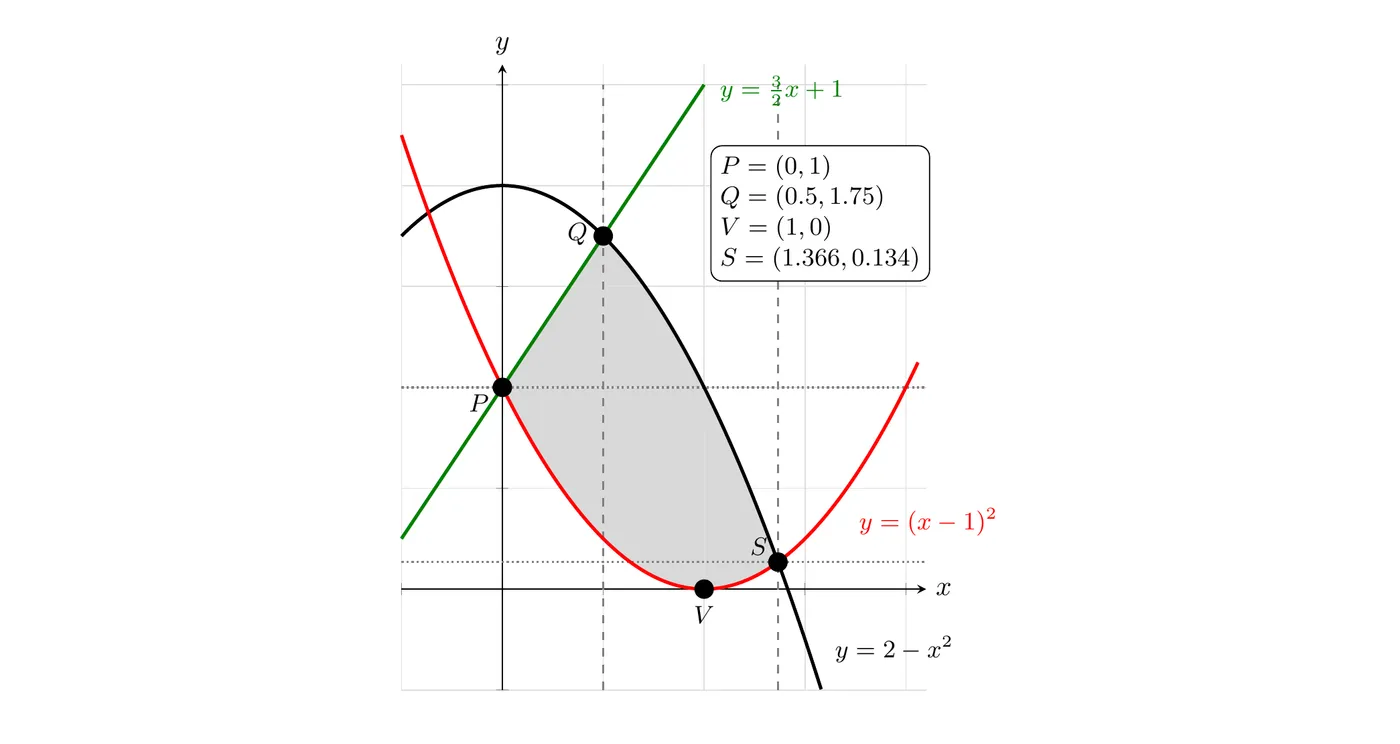
Set up integrals both ways for the region bounded by , , and .
Intersection points:
- , where the line meets the upward parabola
- , where the line meets the downward parabola
- , the vertex of the upward parabola
- , where the two parabolas meet
Setup with respect to x
The top boundary changes at (from the line to the downward parabola). The bottom boundary is the whole way. Two integrals:
Setup with respect to y
Step 1: convert to form
From :
We want the positive root, , which is the right side of the parabola.
From :
So is the right branch and is the left branch.
From :
Step 2: analyze where the boundaries change
Moving bottom to top, from up to :
- to : right is , left is
- to : right is , left is
- to : right is , left is
Three integrals:
This one is deliberately nasty to show the method. Most problems are much simpler.
Choosing Between dx and dy
Use when:
- The boundaries are vertical lines
- The functions are naturally in form
- The top and bottom boundaries are simple
Use when:
- The boundaries are horizontal lines
- The functions are naturally in form
- The left and right boundaries are simpler than the top and bottom
- Using would need many integrals but needs fewer
Example 1 needed two integrals with respect to , but only one with respect to .
Calculator Tips for dy Integrals
On a TI-84, even though the integral is with respect to , you still enter it using X:
fnInt(expression in terms of X, X, lower y-value, upper y-value)
To calculate :
- Press MATH → 9:fnInt(
- Enter
fnInt((X+6) - X^2, X, 0, 3)
- Press ENTER
Why does this work? The calculator’s variable button (X,T,θ,n) just represents a variable. The calculator doesn’t care what you call it.
Decision Tree: Do I Need Multiple Integrals?
With respect to :
1. Does the top boundary change? If yes, split there.
2. Does the bottom boundary change? If yes, split there.
3. You need a new integral at each change point.
With respect to :
1. Does the right boundary change? If yes, split there.
2. Does the left boundary change? If yes, split there.
3. You need a new integral at each change point.
Step-by-Step Process (with respect to y)
Step 1: Convert all equations to form
Step 2: Identify the -boundaries (smallest to largest -value)
Step 3: Determine right and left boundaries, testing a point to see which gives the larger -value
Step 4: Check whether the boundaries change. Trace the right edge from bottom to top, then the left edge, and see if either switches curves
Step 5: Set up the integral(s):
adding a separate integral for each region where the boundaries change.
Common Mistakes to Avoid
- Forgetting to convert to . Always solve for first
- Using -values as limits. For integrals, the limits are -values
- Subtracting top minus bottom instead of right minus left
- Not considering both branches of a square root. gives two curves: is the right side, is the left
- Forgetting to check if the boundaries change. Trace both edges completely
Key Takeaways
- With respect to :
- Convert equations: solve for to get form
- Limits are -values: smallest to largest -coordinate
- Right minus left, not top minus bottom
- Check for multiple integrals: split wherever the right or left boundary changes
- Square roots give two branches: represents both sides of a curve
- Choose wisely: sometimes needs fewer integrals than
- Calculator: still use the X variable button even for integrals
- Both methods work: and give the same area
- Trace the boundaries: follow the edges of the region to spot where they change