

8.2 - Connecting Position, Velocity, and Acceleration of Functions Using Integrals
Review: Derivatives and Motion
Or, in second-derivative terms, .
Working Backwards with Integration
Key principle: to get from acceleration to position, integrate twice.
Example 1: Position from Acceleration
Problem: A particle on the x-axis has acceleration . Its velocity is 18 cm/s at seconds, and its initial position is cm. Find .
Step 1: Integrate acceleration to get velocity.
Step 2: Use the given condition to find . At , :
Step 3: Integrate velocity to get position.
Step 4: Use the initial condition. At , , so .
Displacement vs. Total Distance
Displacement is the net change in position, and it can be positive or negative:
Total distance is how far the object actually traveled, and it’s always positive:
Important Warning
Taking the absolute value of the result just gives you the absolute value of displacement. The absolute value has to go inside the integral.
Speed vs. Velocity
- Velocity: , can be negative
- Speed: , never negative
- So displacement is the integral of velocity, and total distance is the integral of speed,
Example 2: Drive with a Change of Direction
Problem: Someone drives for 30 minutes with velocity miles per minute.
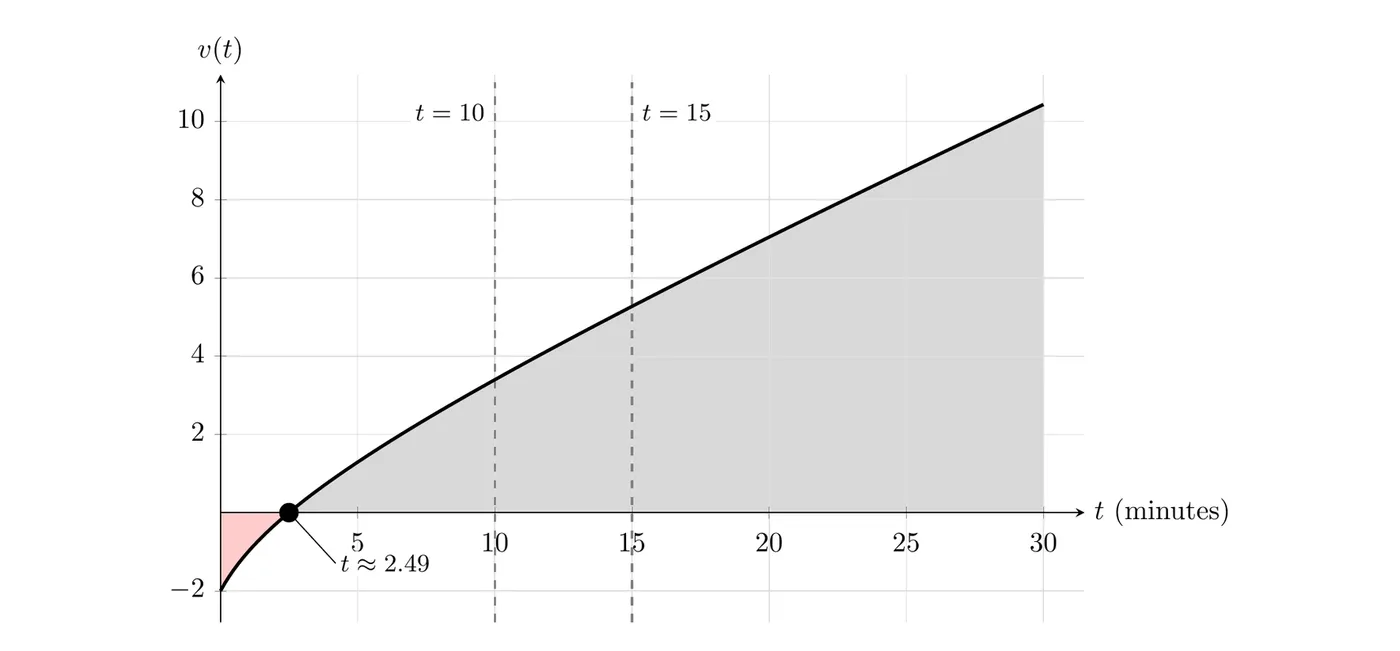
Notice the velocity is negative at first (wrong direction) and crosses zero at about minutes, after which it stays positive.
Part (a): Displacement after 10 minutes
The small negative area from the early backtracking partially cancels the positive area.
Part (b): Displacement after 15 minutes
Part (c): Displacement after 30 minutes
That’s how far the destination is from the starting point.
Part (d): Total distance actually driven
This needs the absolute value, since we want every mile traveled including the backtracking:
Calculator steps (TI-84):
- Press
MATH, then9(for )
- Enter the bounds, 0 to 30
- For the integrand, press
MATH, scroll toNUM, select1:abs(. (Shortcut: press2nd+0for CATALOG, then selectabs(.)
- Enter the velocity function
- Specify the variable
Interpretation: the driver covered about 155.8 miles but ended up only 151.5 miles from home, because of the wrong-direction stretch at the beginning.
Position Using Accumulation
When you know the initial position and the velocity function:
This is an accumulation function: initial position plus the accumulated change.
The same idea works one level up. Acceleration is the rate of change of velocity, so if you know the velocity at one time:
The definite integral of acceleration over an interval is the change in velocity over that interval.
Example: a particle has acceleration , and . Find .
The velocity went up by 14, from to .
Example 3: Using the Accumulation Formula
A particle has velocity .
Part (a): Position at if
Part (b): Position at if
Example 4: Total Distance with a Sign Change
Problem: A particle has velocity for . Find the total distance traveled.
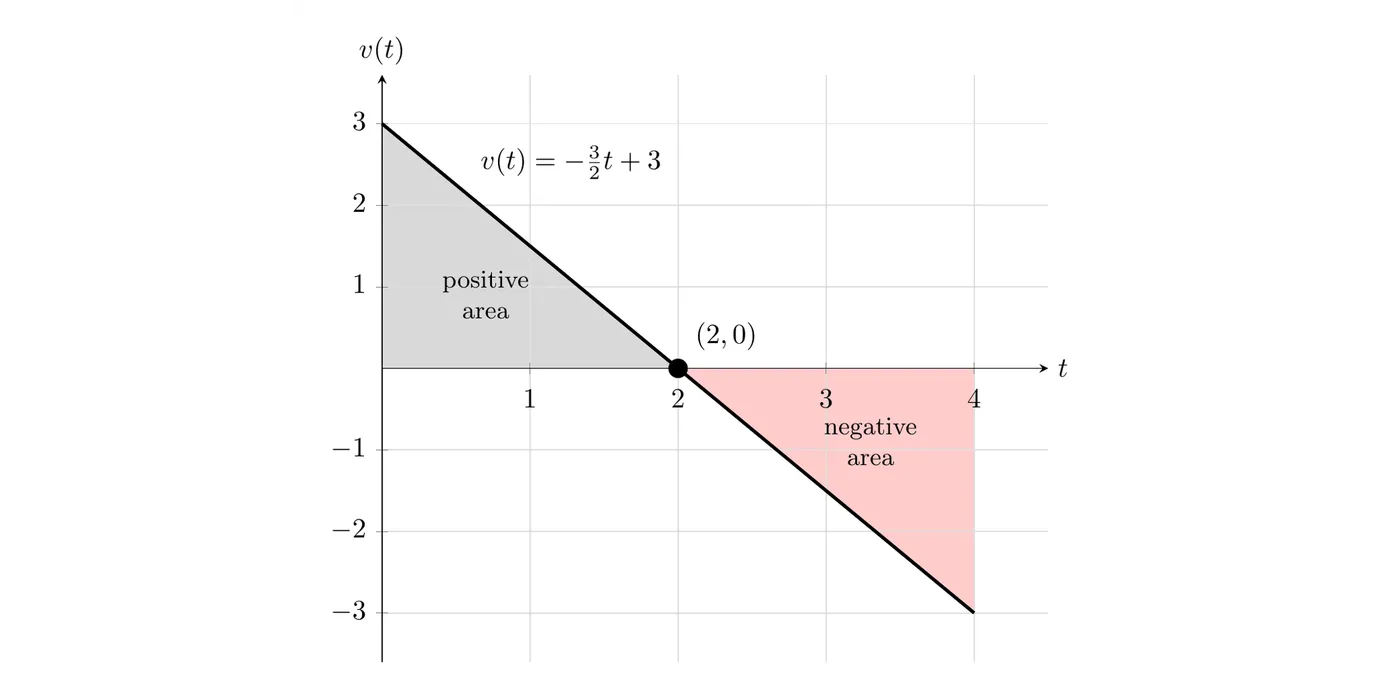
Step 1: Find when velocity is zero.
Step 2: Split the integral at , since velocity changes sign there.
Step 3: Evaluate each piece.
Step 4: Absolute values, then add.
Alternative: just compute directly. It handles the sign change automatically.
Calculator Tips for Absolute Value Integrals
Getting to absolute value on a TI-84:
MATH→ scroll right toNUM→1:abs(
- Or
2nd+0(CATALOG) →A→abs(
Setting up the integral:
∫(abs(function), x, lower, upper)
Using stored functions: store the function in
Y1, then reference it with VARS → Y-VARS → 1:Function → Y1.Recalling a previous entry: press
2nd + ENTER to pull up your last calculation and edit it. Saves a ton of time.Summary of Key Formulas
Given | Find | Formula |
Acceleration | Velocity | |
Velocity | Position |
Quantity | Formula | Notes |
Displacement | Net change, can be negative | |
Total Distance | Actual distance, always positive | |
Speed | Absolute value of velocity |
Position from an initial condition:
Problem-Solving Strategy
Position from acceleration:
- Integrate acceleration to get velocity, with
- Use the given velocity condition to find
- Integrate velocity to get position, with
- Use the initial position to find
Total distance traveled:
- Find where , which is where velocity changes sign
- Split the time interval at those points
- Integrate over each subinterval separately
- Take the absolute value of each result and add
Or just use directly on the calculator.
Common Mistakes
- Taking the absolute value of the final result for total distance. The absolute value goes inside the integral.
- Confusing speed with velocity. Speed is and is never negative.
- Forgetting the constant when integrating. Always include and use initial conditions to pin it down.
- Not checking for sign changes in velocity when finding total distance.
Key Takeaways
- Integration reverses differentiation: acceleration → velocity → position
- Two integrations to get from acceleration to position
- Displacement: , the net change in position
- Total distance: , the actual distance traveled
- Absolute value placement matters: inside the integral, not outside
- Solve to find where to split the integrals
- Accumulation formula:
- Same idea one level up:
- Use for velocity and for position, and find each from its own condition
- Store values on the calculator to avoid rounding errors, and use
2nd+ENTERto recall entries
- Displacement can cancel out, but total distance adds up all the movement