

3.10 - Solubility
Overview
Solubility is the maximum amount of a substance (the solute) that can dissolve in a given amount of another substance (the solvent) at a given temperature. Whether one substance dissolves in another comes down to the forces between their particles: substances with similar intermolecular interactions tend to be soluble in, or miscible with, one another. This one idea explains why salt dissolves in water but not in oil, and why oil and water separate. On the AP exam, every solubility claim needs to be backed up by naming the specific forces involved.
Key terms
- Soluble means a noticeable amount dissolves. Insoluble means so little dissolves that we usually treat it as none (a tiny amount almost always dissolves).
- Miscible liquids mix completely in any proportion, like ethanol and water. Immiscible liquids form separate layers, like hexane and water.
- Aqueous means dissolved in water, written (aq). Nonaqueous solvents are anything else, such as hexane, , or carbon tetrachloride, .
Why similar forces mix
Think of dissolving as a swap of attractions. For a solute to dissolve, three things happen:
- The solute particles are pulled apart from each other (solute-solute attractions are overcome).
- The solvent particles spread apart to make room (solvent-solvent attractions are overcome).
- Solute and solvent particles attract each other (new solute-solvent attractions form).
Steps 1 and 2 take energy, and step 3 gives energy back. When the new solute-solvent attractions are similar in strength to the attractions that were broken, the swap costs little and the particles mix. Particles also tend to spread out and mix on their own (Unit 9 explains this with entropy). When the new attractions are much weaker than the old ones, the solvent particles stay attracted to each other and squeeze the solute out, so little dissolves.
That's the reasoning behind the rule of thumb “like dissolves like”: polar substances mix with polar ones, and nonpolar substances mix with nonpolar ones.
Molecular compounds
Polar solutes in water
Water molecules are held together by hydrogen bonds. A molecular solute that can hydrogen bond with water dissolves well, because new solute-water hydrogen bonds replace the water-water hydrogen bonds that had to break. Ethanol, , mixes with water in any proportion. Glucose, , dissolves well because each molecule has several groups.
A polar molecule doesn't need its own O-H or N-H bond to dissolve. Acetone, , has a polar C=O bond, and water's hydrogen atoms can hydrogen bond to acetone's oxygen atom. Acetone is miscible with water.
Nonpolar solutes in nonpolar solvents
Nonpolar molecules attract each other only through London dispersion forces. Hexane and octane, , mix in any proportion (gasoline is a mixture of hydrocarbons like these). Iodine, , is nonpolar, so it dissolves well in hexane but only slightly in water.
Polar and nonpolar liquids don't mix
Shake hexane with water and the two separate into layers. It's not that hexane and water repel each other: every pair of molecules attracts at least a little through dispersion forces. The problem is that water attracts water much more strongly, through hydrogen bonds. To mix with hexane, water would have to give up many hydrogen bonds and get only weak dispersion attractions in return. So the water molecules stay together, and the hexane ends up in its own layer. Hexane is less dense than water (about 0.66 g/mL), so it floats on top.
Molecules with polar and nonpolar parts
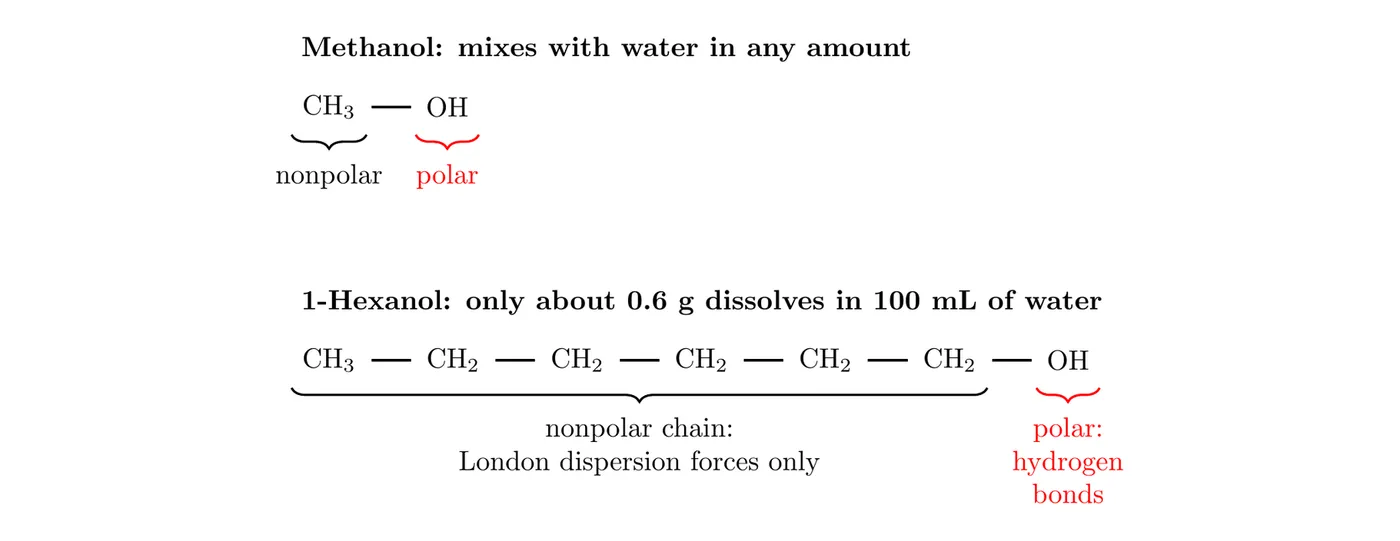
Many molecules have a polar group at one end and a nonpolar hydrocarbon chain at the other. Alcohols are the classic example. The group can hydrogen bond with water, but the and groups can only form dispersion attractions.
Alcohol | Formula | Solubility in water near room temperature |
Methanol | miscible | |
Ethanol | miscible | |
1-Propanol | miscible | |
1-Butanol | about 7 g per 100 mL | |
1-Pentanol | about 2 g per 100 mL | |
1-Hexanol | about 0.6 g per 100 mL |
As the chain gets longer, more of the molecule is nonpolar. A long chain has to push in between water molecules, breaking water-water hydrogen bonds, and it offers only dispersion attractions in return. So solubility in water drops. The same change makes the alcohol mix more easily with hexane, because a longer chain has stronger dispersion attractions with hexane's chains.
Ionic compounds
In water: ion-dipole attractions
When an ionic compound like sodium chloride dissolves in water, the ions separate and spread through the solution:
Each ion gets surrounded by water molecules, a process called hydration. These are ion-dipole attractions: water's partially negative O end points toward cations, and a partially positive H end points toward anions (Topic 3.8 shows how to draw them). Many ion-dipole attractions around each ion can make up for the strong ion-ion attractions that held the crystal together.
In nonpolar solvents: almost none dissolves
Hexane molecules have no dipole, so the only attraction they can offer an ion is weak dispersion forces. That's nowhere near enough to make up for the ion-ion attractions in the crystal. Ionic compounds like NaCl are essentially insoluble in hexane and other nonpolar solvents.
Not every ionic compound dissolves in water
Some ionic compounds, like silver chloride, , calcium carbonate, , and barium sulfate, , dissolve only very slightly in water. In these solids, the attractions holding the crystal together win out over hydration. Ions with larger charges attract each other more strongly (Coulomb's law), which is one reason many compounds of 2+ and 2- ions barely dissolve.
The one solubility rule the AP exam expects you to know (Topic 4.7): all sodium, potassium, ammonium, and nitrate salts are soluble in water. Unit 7 shows how to calculate how much of a slightly soluble salt dissolves.
How far does “like dissolves like” go?
“Like dissolves like” is a model, and AP questions can ask how well a model explains what we observe. It works well for:
- predicting which of two solvents a substance prefers
- ranking similar molecules, like the alcohols above
- explaining why some liquids form layers
It falls short in a few places:
- It can't tell you how much will dissolve, only which way the trend goes.
- Water is the best solvent for ionic compounds in general, yet and barely dissolve in it. The balance between ion-ion attractions and hydration decides, and the rule of thumb doesn't capture that.
- It ignores temperature. Most solids dissolve better in hot water, while gases dissolve better in cold water.
So use it as a starting point, then justify your answer with the actual forces: which attractions break, which form, and how their strengths compare.
Explaining solubility with forces
Example 1: Predicting which solvent wins
For each substance, predict whether it is more soluble in water or in hexane, . Justify each answer with intermolecular forces.
- Ammonia, : water. Ammonia is polar and has N-H bonds, so it forms hydrogen bonds with water. Hexane can offer it only dispersion forces.
- Iodine, : hexane. Iodine is nonpolar, so its only attractions are London dispersion forces, which match hexane's. To dissolve in water, it would have to break water-water hydrogen bonds and would get only weak attractions in return.
- Potassium bromide, : water. The and ions form strong ion-dipole attractions with polar water molecules. Hexane has no dipole, so it can't make up for the ion-ion attractions in the crystal.
Example 2: Pulling iodine out of water
A student has a brownish solution of a small amount of in water. She pours it into a separatory funnel, adds hexane, shakes, and lets the layers settle. (a) Which layer is on top? (b) Where does most of the end up, and why?
(a) Hexane and water are immiscible, so they form two layers. Hexane (about 0.66 g/mL) is less dense than water (1.00 g/mL), so the hexane layer is on top.
(b) Most of the moves into the hexane layer, which turns violet. and hexane are both nonpolar, so the dispersion attractions between them are similar to the attractions each has for itself. In water, disrupts water's hydrogen bonding and gets only weak attractions back. Moving a solute from one solvent into another like this is called extraction. Like chromatography and distillation (Topic 3.9), it separates substances by taking advantage of differences in intermolecular interactions.
Example 3: Comparing two vitamins (AP-style)
Vitamin C, , has four groups on a small six-carbon framework. Vitamin A (retinol), , has a single group attached to a large, mostly hydrocarbon structure with 20 carbon atoms. Vitamin C dissolves in water, while vitamin A dissolves in fats and oils instead. Explain this difference in terms of intermolecular forces.
- Vitamin C in water: its four groups make up a large part of a small molecule, and each one can hydrogen bond with water. These solute-water hydrogen bonds are similar in strength to the water-water hydrogen bonds that have to break, so vitamin C dissolves.
- Vitamin A in water: almost the whole molecule is nonpolar and can form only London dispersion forces. Fitting it between water molecules would break many water-water hydrogen bonds and replace them with much weaker attractions, so very little dissolves. One group isn't enough to make up for this.
- Vitamin A in fat: fats are made mostly of long hydrocarbon chains. Vitamin A's large nonpolar region forms dispersion attractions with those chains that are similar to the attractions fat molecules have for each other, so it dissolves.
Notice that the answer names the forces on both sides (what breaks and what forms) and compares their strengths. That's what a full-credit explanation looks like.
Common mistakes
- Stopping at “like dissolves like.” Name the forces (hydrogen bonding, dipole-dipole, ion-dipole, or London dispersion), then compare the attractions that break with the ones that form.
- Saying covalent bonds break when a molecular compound dissolves. When sugar dissolves, the sugar molecules stay whole. Only the attractions between molecules are overcome. Ionic compounds are different: they separate into ions.
- Saying polar and nonpolar molecules repel. They attract weakly. Water just attracts other water molecules much more.
- Assuming every ionic compound dissolves in water. Many, like and , barely dissolve.
- Drawing water backward around ions. Oxygen () faces cations, and hydrogen () faces anions. This is one of the most common errors in AP particle diagrams.
- Ignoring the size of the nonpolar part. One group can't make a long hydrocarbon chain dissolve in water.
- Using “strong” and “weak” without a comparison. Say which force is stronger than which, not just that a force is strong.