

3.7 - Solutions and Mixtures
Overview
Most of the matter around you is a mixture, and most chemistry in a lab happens in solutions. This topic sets up the vocabulary (solution, solute, solvent, homogeneous, heterogeneous) and the most important way to describe a solution's makeup: molarity. You'll use molarity in almost every unit from here on, in stoichiometry, titrations, kinetics, equilibrium, and acid-base chemistry, so the calculations here need to become automatic.
Solutions and heterogeneous mixtures
A mixture contains two or more substances that are physically combined, not chemically bonded, so its composition can vary. Mixtures come in two types.
- Solution (homogeneous mixture): the components are mixed down to the level of individual particles (molecules, atoms, or ions). The macroscopic properties, such as color, density, and concentration, are the same everywhere in the sample. A sip from the top of a glass of salt water tastes the same as a sip from the bottom.
- Heterogeneous mixture: the components stay in separate regions. The macroscopic properties depend on where you sample. Oil and water, sand in water, and granite are all heterogeneous.
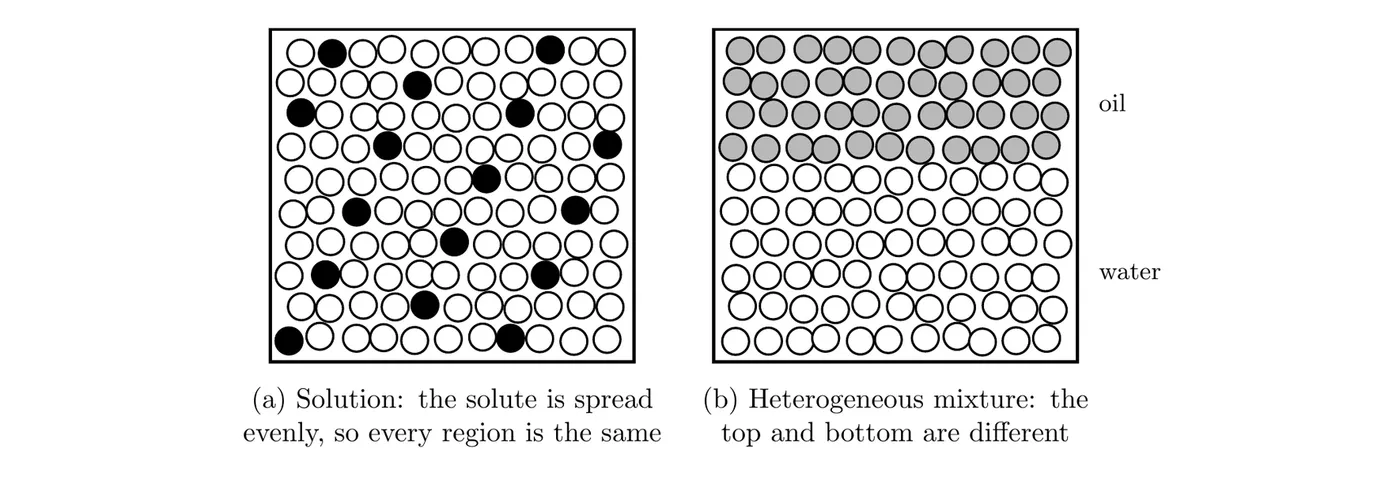
In a solution, the substance present in the largest amount is usually called the solvent, and anything dissolved in it is a solute. Water is the most common solvent in AP Chemistry, and a solution in water is labeled , for aqueous.
Solutions aren't only liquids. They can be solids, liquids, or gases:
Solution | Phase | What's dissolved in what |
Air | Gas | , , and other gases in |
Salt water | Liquid | (a solid) in water |
Vinegar | Liquid | Acetic acid (a liquid) in water |
Soda water | Liquid | (a gas) in water |
Brass | Solid | Zinc in copper (a substitutional alloy from Topic 2.4) |
Molarity
Solution composition can be described in several ways, but the most common in the lab is molarity (): the number of moles of solute per liter of solution. This equation is on the AP reference sheet:
The unit is mol/L, written and read "molar." A solution of glucose has 0.25 mol of glucose in every liter of solution.
Two things to watch:
- Liters of solution, not liters of solvent. Dissolving 1 mol of solute in 1.00 L of water does not make a solution, because the final volume isn't exactly 1.00 L. That's why chemists dissolve the solute first and then add water up to a measured total volume.
- Volumes in mL must be converted to L. Divide by 1000: 250.0 mL is 0.2500 L.
Molarity is a conversion factor between moles of solute and volume of solution, so you can solve for any one of the three quantities:
You want | Use | Units check |
Molarity | ||
Moles of solute | ||
Volume of solution |
If the problem gives a mass, convert it to moles first: , where is the mass in grams and is the molar mass in g/mol. This relationship is on the reference sheet too. (We write molar mass as here so it doesn't get mixed up with molarity, .)
Other ways of expressing composition exist, such as mole fraction (used with gases in Topic 3.4), percent by mass, and molality. Calculations of molality, percent by mass, and percent by volume are not assessed on the AP exam.
Counting solute particles
This topic asks you to calculate the number of solute particles, not just moles. Two ideas make that work.
1. Moles to particles. Multiply by Avogadro's number (, on the reference sheet):
2. Ionic compounds break into ions. A soluble ionic compound separates into its ions when it dissolves, so the concentration of each ion depends on the formula. Molecular solutes like glucose or ethanol stay as whole molecules. Polyatomic ions like and stay together as one ion.
So is in and in , for of dissolved particles in total.
Solution | Ions per formula unit | Concentrations of ions |
1 + 1 | , | |
1 + 2 | , | |
2 + 1 | , | |
Doesn't break apart | glucose molecules |
Square brackets, as in , mean "the molar concentration of."
Making a solution in the lab
To make a solution of a known molarity from a solid, use a volumetric flask. It has a single etched line on its neck and holds a precise volume (for example, 250.0 mL) when filled to that line.
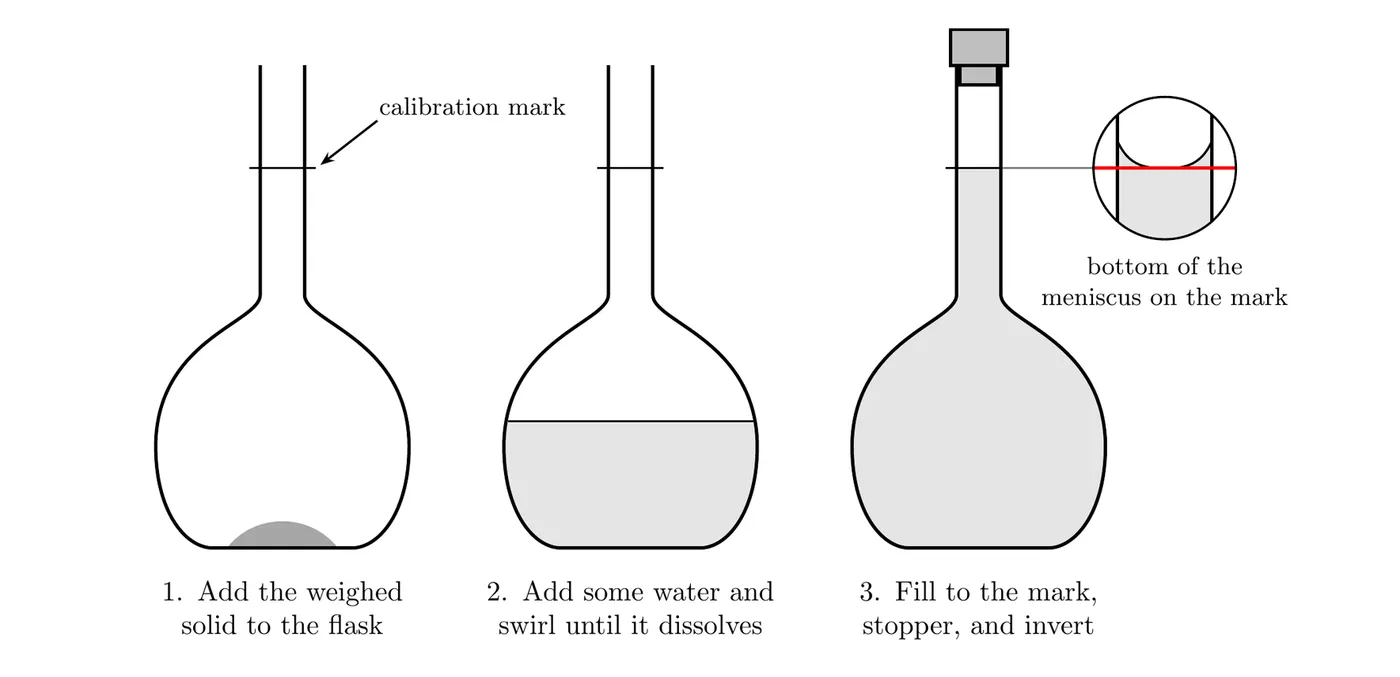
- Calculate the mass of solute you need, and measure it on an analytical balance.
- Transfer the solid into the volumetric flask (rinse the weighing container into the flask with distilled water so nothing is left behind).
- Add distilled water until the flask is about half full, and swirl until the solid has completely dissolved.
- Add more water until the bottom of the meniscus sits on the calibration mark. Read it at eye level. Use a dropper for the last few drops.
- Stopper the flask and invert it several times so the solution is the same throughout.
A beaker or Erlenmeyer flask is not precise enough for this. Their volume markings are only rough estimates.
Dilution
Labs often keep a concentrated stock solution and dilute it as needed. When you add water, the moles of solute don't change. Only the volume does. Since before and after:
and describe the concentrated solution you measure out, and and describe the final diluted solution. This equation isn't on the reference sheet, but it comes straight from . Any volume unit works as long as and use the same one. To do it in the lab, measure with a volumetric pipet or buret, put it in a volumetric flask of volume , and fill to the mark with water.
Example 1: Molarity from a mass
A student dissolves 4.25 g of potassium nitrate, , in water and dilutes it to a total volume of 250.0 mL in a volumetric flask. What is the molarity?
Molar mass: g/mol.
The mass has 3 significant figures, so the answer has 3. Answer: .
Example 2: Mass needed to make a solution
How many grams of sodium carbonate, , are needed to make 500.0 mL of a solution?
Molar mass: g/mol.
Answer: 7.95 g. Weigh 7.95 g of , dissolve it in a 500.0 mL volumetric flask, and fill to the mark.
Example 3: Counting ions
A beaker holds 25.0 mL of aluminum nitrate, . (a) What is ? (b) How many nitrate ions are in the beaker? (c) How many ions are there in total?
(a) Each formula unit gives 3 nitrate ions: .
(b) Find moles of , then nitrate, then ions:
(c) Each formula unit gives 4 ions (1 and 3 ):
Answer: ; nitrate ions; ions in total. The nitrate ion counts as one particle, not four.
Example 4: Diluting a stock solution
What volume of is needed to make 500. mL of ?
Answer: 20.8 mL. Measure 20.8 mL of the stock acid, add it to a 500. mL volumetric flask that already has some water in it, and then fill to the mark. You don't add 500. mL of water. You dilute to a total of 500. mL. (Adding acid to water, not water to acid, is the safe order.)
Example 5: Mixing two solutions (AP-style)
A student mixes 50.0 mL of with 25.0 mL of . No reaction occurs, and the volumes add. Calculate , , and in the mixture.
Track moles of each ion, then divide by the total volume, 0.0750 L.
Answer: , , . A quick check: total positive charge is mol/L, which matches the negative charge from , so the solution is neutral. A common wrong answer is to average the two chloride concentrations; averaging ignores that the volumes are different and that each gives two .
Common mistakes
- Using the volume of solvent. Molarity uses the total volume of solution.
- Forgetting to convert mL to L before dividing moles by volume.
- Ignoring the formula. has . Use the subscripts to get each ion's concentration.
- Breaking up polyatomic ions or molecules. is one ion. Glucose stays as glucose molecules.
- "Adding" the final volume of water in a dilution. Dilute to the final volume, don't add that much water.
- Using a beaker to make a solution of exact molarity. Use a volumetric flask, and read the bottom of the meniscus at the line.