

3.12 - Properties of Photons
Overview
Light behaves like a wave, but it also comes in tiny packets of energy called photons. Two equations from the AP reference sheet connect a photon's wavelength, frequency, and energy: and . When an atom or molecule absorbs or emits a photon, its energy changes by exactly the energy of that photon. This topic is mostly calculation, so watch your units and significant figures.
Wavelength and frequency
Every electromagnetic wave has a wavelength, (lambda), and a frequency, (nu). Wavelength is the distance from one crest to the next, measured in meters or nanometers (). Frequency is the number of waves that pass a point each second, measured in , also called hertz (Hz).
All electromagnetic waves travel through a vacuum at the same speed, the speed of light:
Since is a constant, wavelength and frequency are inversely proportional. Double the wavelength and the frequency is cut in half. Short waves have high frequencies, and long waves have low frequencies.
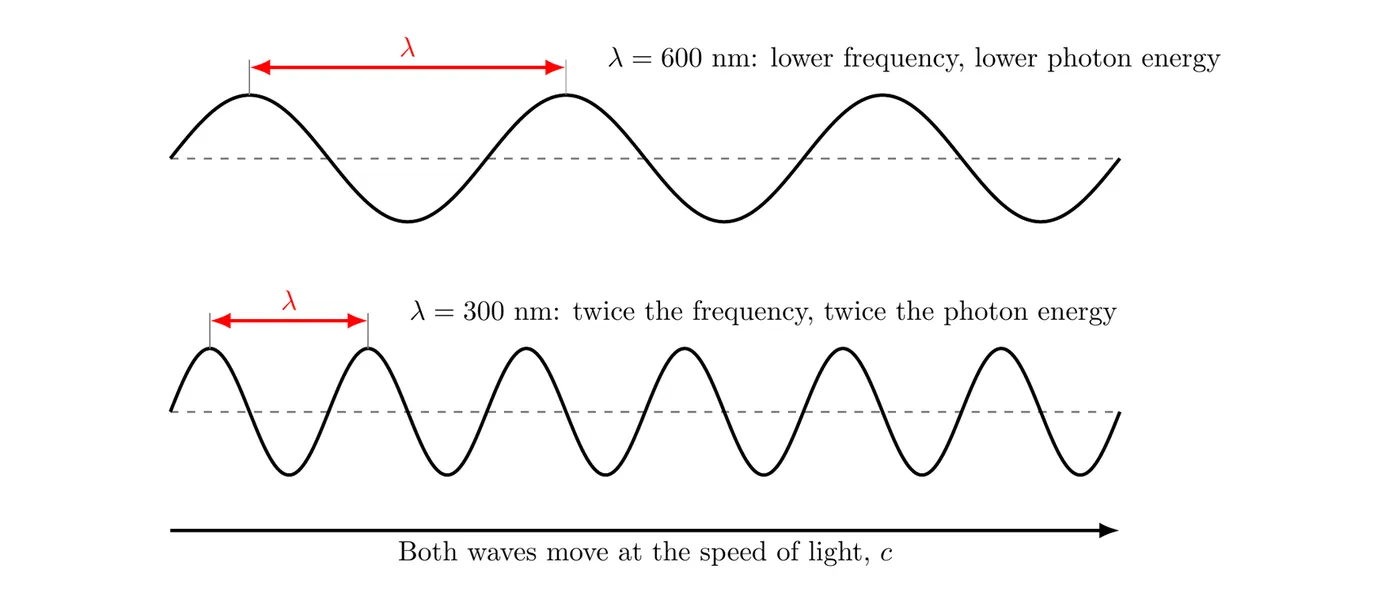
Both waves in the figure move at the same speed. The bottom wave has half the wavelength of the top one, so twice as many crests pass a point each second: it has twice the frequency.
Photon energy
A photon is a single packet (a quantum) of electromagnetic energy. Planck's equation gives the energy of one photon from its frequency:
Here is Planck's constant. Energy and frequency are directly proportional: double the frequency and you double the energy of each photon.
Often you'll know the wavelength instead of the frequency. Substituting into Planck's equation gives a shortcut:
This form isn't written on the reference sheet, but it comes straight from the two equations that are. It shows that photon energy is inversely proportional to wavelength: the shorter the wavelength, the more energy each photon carries.
Per photon or per mole?
gives the energy of one photon, a tiny number of joules. Chemists usually talk about energy per mole (bond energies are in kJ/mol, for example). To convert, multiply the energy of one photon by Avogadro's number, . To go from per mole to per photon, divide by it.
If you know | Use | To find |
wavelength, | frequency, | |
frequency, | energy of one photon | |
wavelength, | energy of one photon | |
energy of one photon | multiply by | energy of one mole of photons |
Example 1: Frequency and energy of a laser photon
A green laser pointer gives off light with a wavelength of 532 nm. Find (a) the frequency of the light, (b) the energy of one photon, and (c) the energy of one mole of these photons, in kJ/mol.
(a) Frequency. Convert the wavelength to meters first, since is in meters per second:
The wavelength has three significant figures, so . Keep the extra digit for the next step.
(b) Energy of one photon.
(c) Energy per mole.
Answer: the frequency is , one photon carries J, and one mole of photons carries 225 kJ.
Example 2: Comparing two photons
Photon A has a wavelength of 300 nm (ultraviolet), and photon B has a wavelength of 600 nm (orange). How do their frequencies and energies compare?
Frequency is inversely proportional to wavelength, and energy is directly proportional to frequency. Photon A has half the wavelength, so it has twice the frequency and twice the energy of photon B. This is the pair of waves in the figure above.
Checking with numbers:
, as predicted. On the AP exam, proportional reasoning like this is often faster than plugging in numbers.
Photons and energy levels
Energy is conserved when light interacts with matter. When an atom or molecule absorbs a photon, its energy goes up by exactly the energy of the photon. When it emits a photon, its energy goes down by exactly the energy of that photon.
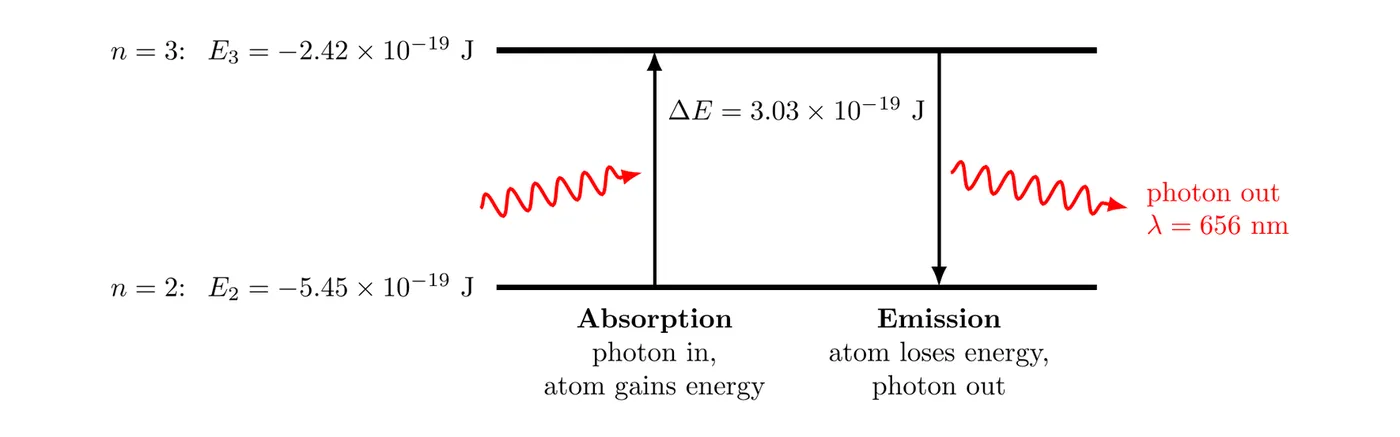
- Only matching photons are absorbed. Energy levels are quantized, so an atom moves from one level to another only by absorbing a photon whose energy equals the gap between them. (A photon with enough energy to remove the electron completely is the exception, and that's the idea behind photoelectron spectroscopy in Topic 1.6.)
- Bigger gap, shorter wavelength. A transition across a large gap involves a high-energy, short-wavelength photon. A small gap means a low-energy, long-wavelength photon.
- The same two levels give the same wavelength both ways. That's why a gas emits light at the same wavelengths it can absorb.
- The photon's energy is always positive. The sign shows up in the atom's energy, which increases on absorption and decreases on emission.
Example 3: The red line in hydrogen's spectrum
In a hydrogen atom, the energy of the level is J, and the energy of the level is J. An electron drops from to . (a) Does the atom absorb or emit a photon? (b) Find the photon's wavelength in nanometers. (c) Which region of the spectrum is it in?
(a) The electron moves to a lower energy level, so the atom loses energy. It emits a photon.
(b) The photon carries away the energy difference between the two levels:
(c) 656 nm is between 400 and 700 nm, so the photon is visible light (red). It's the bright red line in hydrogen's emission spectrum.
Running the process in reverse: a hydrogen atom in the level can absorb a photon of exactly J, moving the electron up to . A photon of J would not be absorbed by that atom, because it's too small to reach even , the next level up.
Putting it together
Example 4: Light that breaks a bond (AP-style)
The bond energy of the O=O double bond in is 498 kJ/mol. High in the atmosphere, sunlight can break this bond:
(a) Calculate the minimum energy, in joules, needed to break the bond in one molecule. (b) Calculate the frequency and wavelength of a photon with exactly this energy. (c) Could a photon with a longer wavelength break the bond? Justify your answer.
(a) The bond energy is given per mole, so convert kilojoules to joules and divide by Avogadro's number:
(b) Use Planck's equation for the frequency, then for the wavelength:
That wavelength is in the ultraviolet region.
(c) No. A longer wavelength means a lower frequency, and by , less energy per photon. That photon would carry less than the J needed to break one O=O bond, so only photons of 240 nm or shorter can do it. A brighter beam of longer-wavelength light doesn't help either: it has more photons, but each one still has too little energy.
Common mistakes
- Forgetting to convert nanometers to meters. The speed of light is in m/s, so the wavelength must be in meters: m.
- Using wavelength where frequency belongs. In , is frequency. If you have a wavelength, find first, or use .
- Mixing up per photon and per mole. is for one photon. Bond energies are per mole, so multiply or divide by to switch.
- Rounding too early. Keep an extra digit in middle steps and round only the final answer. The reference sheet constants have four significant figures, so the given data usually set the limit.
- Thinking a brighter beam has more energetic photons. Brightness is the number of photons. The energy of each photon depends only on its frequency.
- Getting the direction of the energy change backward. Absorbing a photon raises the energy of the atom or molecule, and emitting one lowers it.