

3.2 - Properties of Solids
Overview
This topic connects what you can measure (melting point, boiling point, vapor pressure, hardness, conductivity) to what the particles are doing. The big idea: a substance's properties depend on what particles it's made of and how strongly those particles attract each other. Learn the four kinds of solids and you can explain almost any property question the AP exam asks.
Intermolecular forces and physical properties
Vaporizing a liquid pulls its particles completely apart, so it overcomes essentially all of the attractions between them. That makes two properties a direct measure of how strong those attractions are:
- Boiling point: stronger attractions take more energy to overcome, so the boiling point is higher.
- Vapor pressure: the pressure of the vapor above a liquid in a closed container once evaporation and condensation balance. Stronger attractions let fewer particles escape, so the vapor pressure is lower. A liquid boils when its vapor pressure equals the outside pressure; its normal boiling point is where the vapor pressure reaches 1 atm (760 torr).
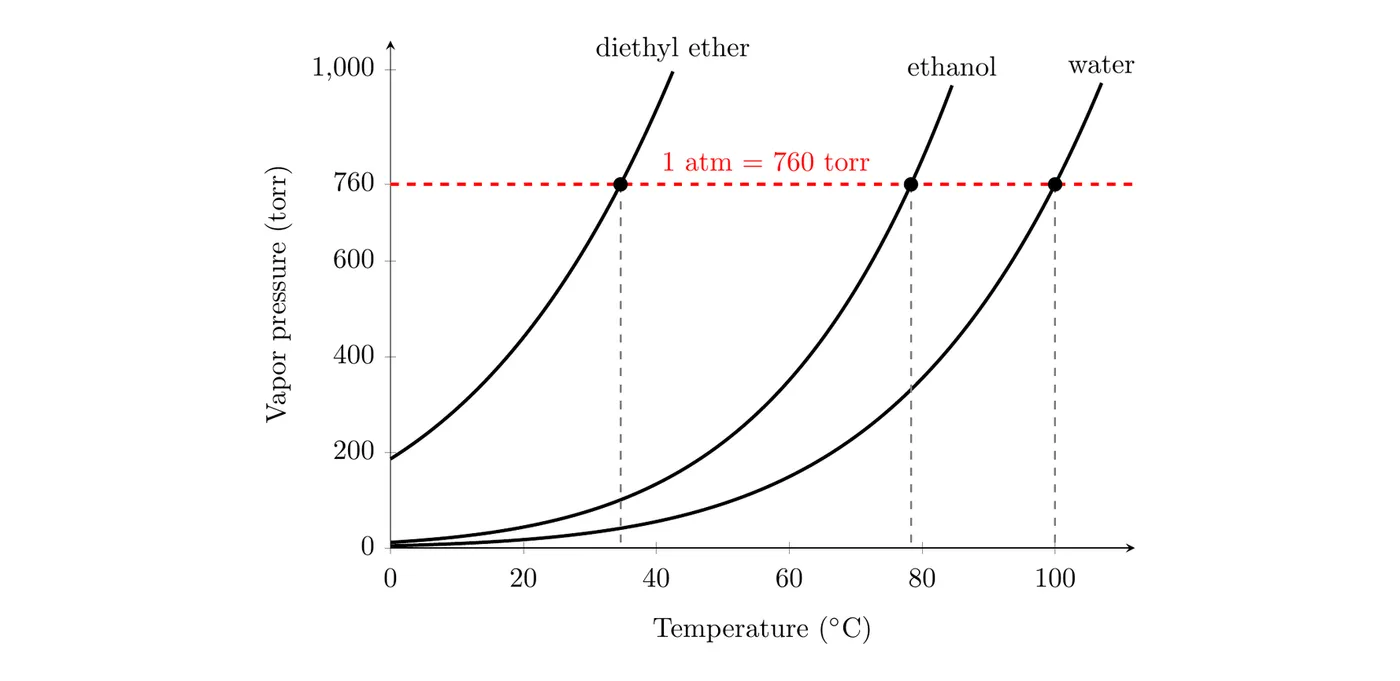
Read across at 760 torr to get each normal boiling point: about 35 °C for diethyl ether, 78 °C for ethanol, and 100 °C for water. Read up at any one temperature, and the liquid with the lowest vapor pressure has the strongest intermolecular forces.
Melting is subtler. When a solid melts, the particles stay in contact; the attractions are rearranged rather than overcome. Melting points usually follow the strength of the attractions too, but how well the particles pack in the solid also matters. Pentane has the higher boiling point (36.1 °C vs. 9.5 °C for neopentane) because of its larger contact area (Topic 3.1). But neopentane has the much higher melting point (−16.6 °C vs. −129.8 °C), because its compact, ball-shaped molecules pack neatly into a crystal.
Particle diagrams of solids
Particle-level drawings that show many particles at once are how the AP exam connects structure to properties. A good drawing shows which particles are present (ions, atoms, or molecules), how they're arranged, and what holds them together. Here are the four main kinds of solids:
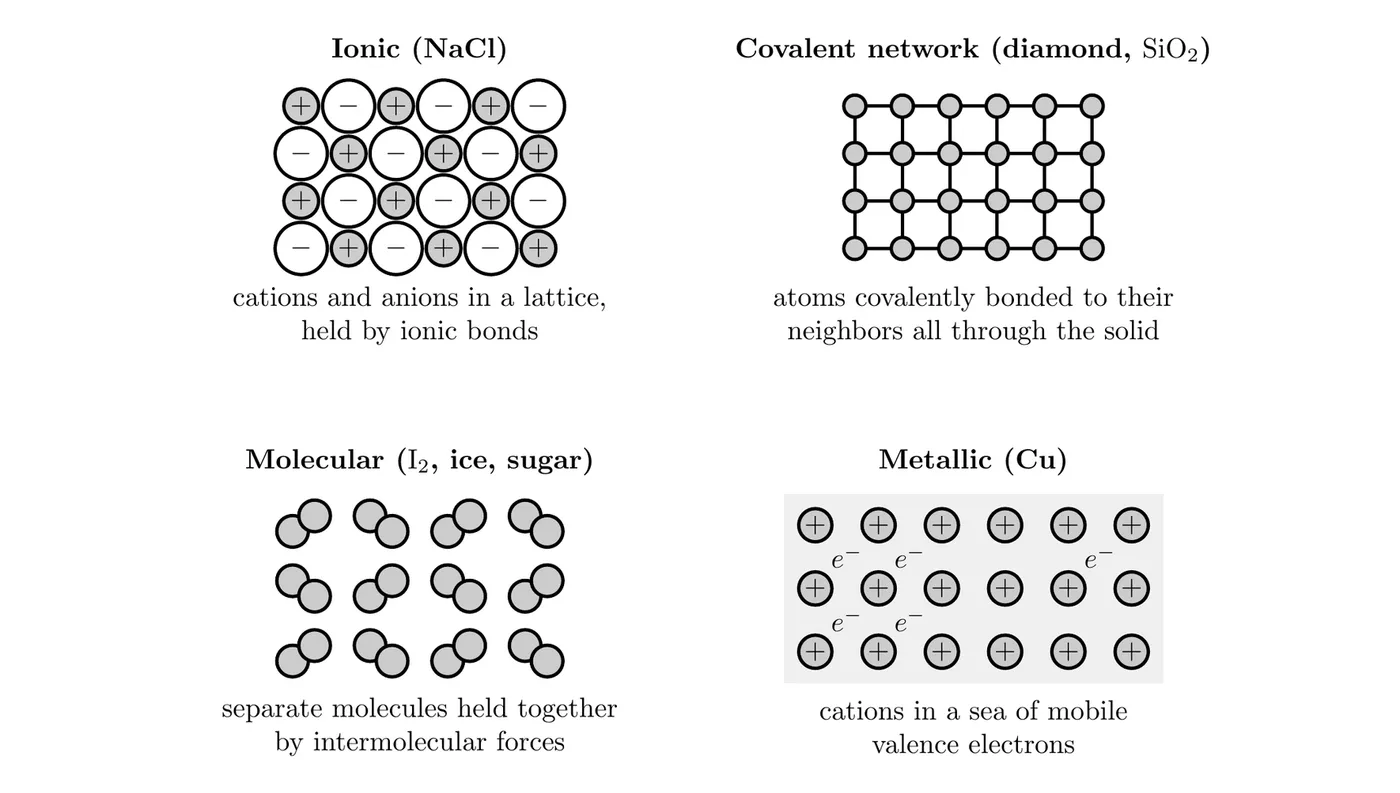
Type | Particles | Held together by | Melting point | Conducts electricity? | Examples |
Ionic | cations and anions | ionic bonds | high | only when melted or dissolved | , |
Covalent network | nonmetal or metalloid atoms | covalent bonds throughout | very high | no (graphite is the exception) | diamond, , |
Molecular | molecules | intermolecular forces | low | no | , ice, sugar, dry ice |
Metallic | metal cations in a sea of electrons | metallic bonding | usually high | yes, as a solid or liquid | Cu, Fe, steel |
Ionic solids
Ionic solids are held together by strong Coulombic attractions between cations and anions in every direction (Topic 2.3). Overcoming them takes a lot of energy, so ionic solids have high melting and boiling points and very low vapor pressures: melts at 801 °C. Larger ion charges and smaller ions make the attractions stronger still, which is why melts at 2,852 °C (Topic 2.2 works through the Coulomb's law comparison).
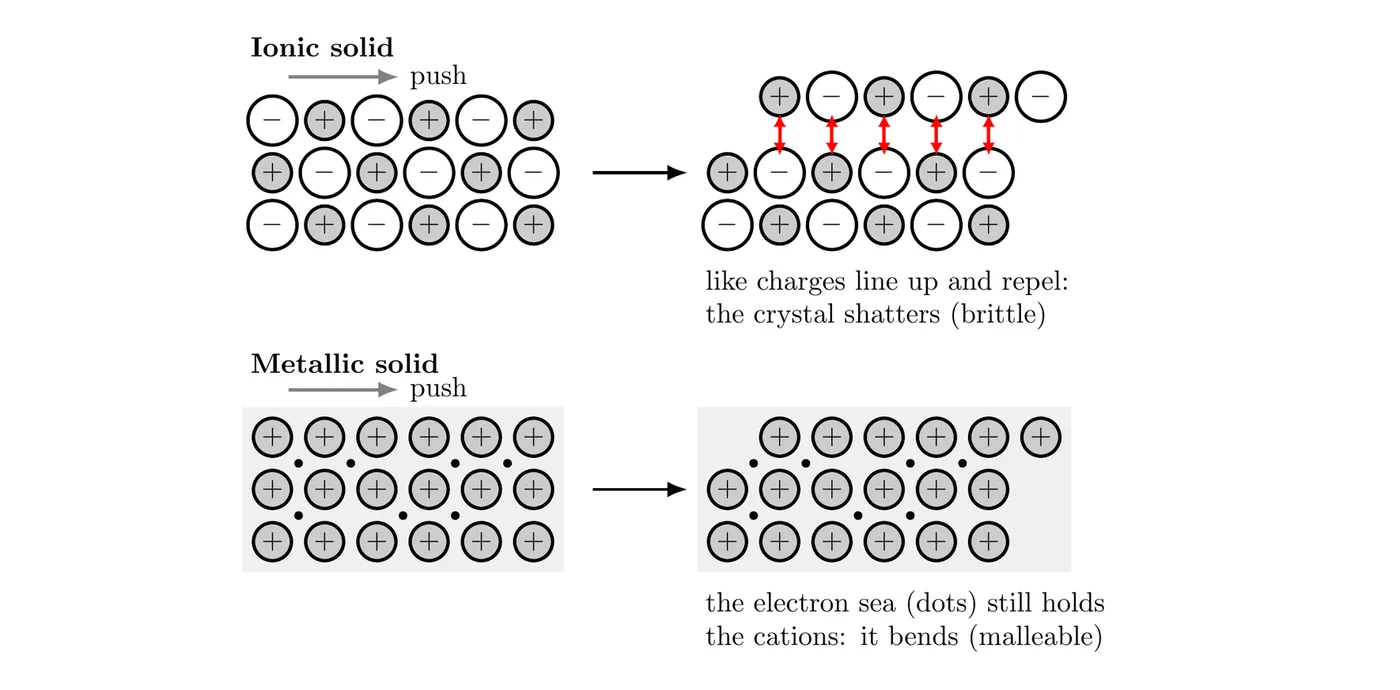
They're brittle. Push one layer of ions over by one position, and suddenly cations sit next to cations and anions next to anions. The like charges repel, and the crystal cracks.
They conduct electricity only when the ions can move: when the solid is melted (molten) or dissolved in water or another solvent. In the solid, the ions are locked in place, so no charge can flow. The charge carriers are the ions themselves, not electrons.
Covalent network solids
In a covalent network solid, every atom is covalently bonded to its neighbors throughout the whole sample, with no separate molecules. These form only from nonmetals and metalloids: elements like diamond and graphite (both pure carbon) and binary compounds like silicon dioxide (, quartz) and silicon carbide ().
Melting one means breaking covalent bonds, so covalent network solids have very high melting points. A three-dimensional network like diamond is also rigid and very hard, because the bond angles are fixed. Graphite is different: it's made of flat sheets that are strong within each sheet, but the sheets are held to each other only by dispersion forces and slide past each other easily. That's why graphite is soft enough to use as pencil "lead."
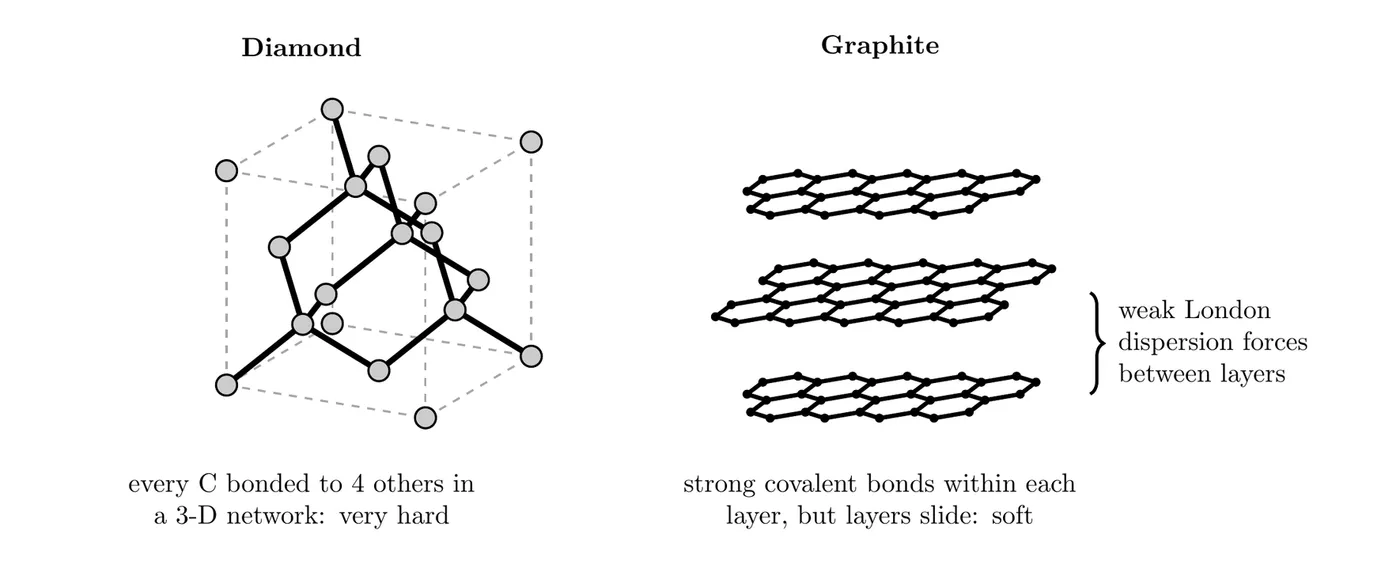
Graphite also conducts electricity along its sheets, because each carbon bonds to only three neighbors and its fourth valence electron is spread over the whole sheet. Diamond, where every valence electron is in a bond, does not conduct.
Molecular solids
Molecular solids are separate molecules held together by intermolecular forces (Topic 3.1), which are much weaker than covalent or ionic bonds. So molecular solids generally have low melting points: ice melts at 0 °C, and dry ice (solid ) turns straight to gas at −78 °C. They don't conduct electricity, because their valence electrons are held tightly in covalent bonds and lone pairs, and there are no ions.
Some molecular solids are made of very large molecules or polymers, like waxes and many plastics. Longer chains mean stronger dispersion forces, so these melt higher than small molecules, but still far below ionic or network solids.
Metallic solids
A metal is a lattice of cations surrounded by a "sea" of valence electrons that move freely through the whole sample (Topic 2.4).
- Good conductors of electricity and heat: the mobile electrons carry charge and energy through the metal.
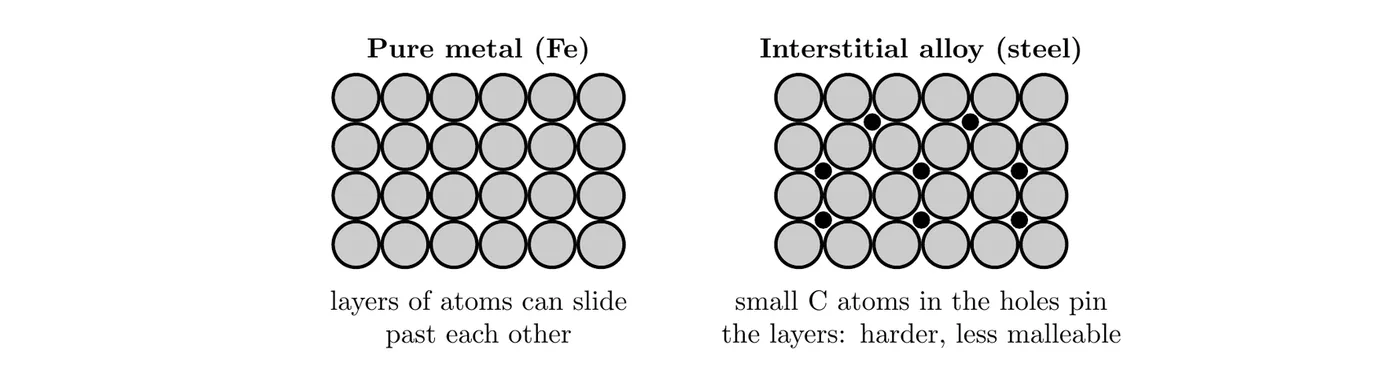
- Malleable and ductile: when layers of cations shift, the electron sea shifts with them and keeps holding them together, so the metal bends instead of shattering (compare the two rows of the figure above).
Alloys. In an interstitial alloy, small atoms fill the holes between the larger metal atoms, like carbon in iron (steel). The small atoms get in the way when layers try to slide, so the lattice is more rigid: steel is harder and less malleable and ductile than pure iron. Alloys keep their sea of mobile electrons, so they still conduct.
Polymers and biomolecules
In large molecules, noncovalent interactions (hydrogen bonds, dipole forces, dispersion forces, and ionic attractions) act between different molecules and between different parts of the same molecule (see the folded-chain figure in Topic 3.1). These interactions fold the molecule into a particular shape, and the shape largely decides how the molecule behaves. A protein's shape decides which molecules it can bind. Heat it enough and those interactions are overcome, the protein unfolds, and it stops working, even though no covalent bonds broke.
Identifying a solid from its properties
This is the logic of the AP lab "What's in That Bottle?": measure a few properties, then match them to a type of solid.
- Conducts electricity as a solid: metallic (or graphite).
- Doesn't conduct as a solid, but conducts when melted or dissolved in water: ionic.
- Never conducts, very high melting point, very hard: covalent network.
- Never conducts, low melting point, often soft: molecular.
Example 1: Identifying unknown solids (AP-style)
A student tests four white or gray solids. Identify the type of each and justify your answer.
Solid | Melting point | Conducts as a solid? | Conducts when melted? | Other observations |
A | 801 °C | no | yes | brittle; dissolves in water, and the solution conducts |
B | 1,085 °C | yes | yes | flattens when hammered |
C | 186 °C | no | no | dissolves in water, but the solution doesn't conduct |
D | about 1,700 °C | no | no | very hard; doesn't dissolve in water |
- A is ionic. It conducts only when the ions are free to move (melted or dissolved), it has a high melting point, and it's brittle. (These are the properties of .)
- B is metallic. It conducts as a solid, so it has mobile electrons, and it's malleable. (Copper.)
- C is molecular. It never conducts, even dissolved, so it has no ions and no mobile electrons, and its low melting point means only intermolecular forces hold it together. (Sucrose.)
- D is a covalent network solid. Its very high melting point and hardness mean covalent bonds must break for it to melt, and it has no ions or mobile electrons to conduct. (Quartz, .)
Melting point alone can't separate B from D. Conductivity does.
Example 2: Reading vapor pressure curves
Use the vapor pressure graph near the top of this page. (a) Which liquid has the strongest intermolecular forces? (b) Diethyl ether, , has more electrons than ethanol (42 vs. 26). Explain why ethanol still has the lower vapor pressure.
- (a) Water. At every temperature its vapor pressure is the lowest (at 20 °C, about 17.5 torr, compared with about 44 torr for ethanol and 440 torr for diethyl ether), and it has the highest normal boiling point. The fewest molecules escape, so the attractions are strongest. Each water molecule has two bonds and two lone pairs, so it can form more hydrogen bonds than an ethanol molecule.
- (b) Diethyl ether's extra electrons do give it stronger dispersion forces. But all of its H atoms are bonded to C, so ether molecules have only dipole-dipole and dispersion forces between them. Ethanol's lets its molecules hydrogen bond with each other, and that stronger attraction outweighs ether's advantage in dispersion forces. Fewer ethanol molecules escape the liquid, so ethanol's vapor pressure is lower.
Common mistakes
- Saying a molecular solid melts by breaking covalent bonds. Melting ice separates whole molecules.
- Saying ionic solids conduct because electrons move. Ionic compounds conduct only when melted or dissolved, and the ions carry the charge.
- Calling graphite a molecular solid because it's soft. It's a covalent network; it's soft because its layers slide.
- Mixing up directions: a high vapor pressure means weak attractions and a low boiling point.
- Writing " molecules." Ionic solids are lattices of ions, not molecules.