

3.9 - Separation of Solutions and Mixtures
Overview
If you can't pick a solution apart with a filter, how do chemists separate its components? They use differences in intermolecular forces. Chromatography separates substances by how strongly each one is attracted to two different phases, and distillation separates them by how easily each one evaporates. This topic matches the AP lab on separating dyes, and the exam asks you to explain separation results, choose a method, and recognize a correct lab setup.
Why filtration doesn't work on solutions
Filtration separates a solid from a liquid by size: the liquid passes through the filter paper's pores, and the solid particles are too big to fit. That works for a heterogeneous mixture like sand in water.
In a solution, the solute is dispersed as individual molecules or ions, which are far smaller than the pores. Everything passes through together, so the filtrate is the same solution you started with. To separate the components of a liquid solution, you have to take advantage of differences in their intermolecular interactions instead.
Chromatography
Every type of chromatography has two phases:
- Stationary phase: a solid (or a liquid coated on a solid) that stays put. Examples are paper, a thin layer of silica gel on a plate, or a column packed with silica or alumina.
- Mobile phase: the solvent that moves through or across the stationary phase and carries the mixture with it.
As the mobile phase moves, each component of the mixture is constantly attracted to both phases. It spends part of its time stuck to the stationary phase and part of its time dissolved in the moving solvent. The balance between those two attractions decides how fast it travels:
- A component with stronger interactions with the stationary phase spends more time stuck and travels a shorter distance.
- A component with stronger interactions with the mobile phase spends more time moving and travels farther.
Because different substances have different polarities, they have different intermolecular forces with each phase, so they spread out into separate spots or bands.
Paper and thin-layer chromatography
In paper chromatography, the stationary phase is paper, which is made of cellulose. Cellulose is covered with -OH groups, so it is very polar and can hydrogen bond. Thin-layer chromatography (TLC) works the same way on a plate coated with silica gel, which also has polar -OH groups on its surface.
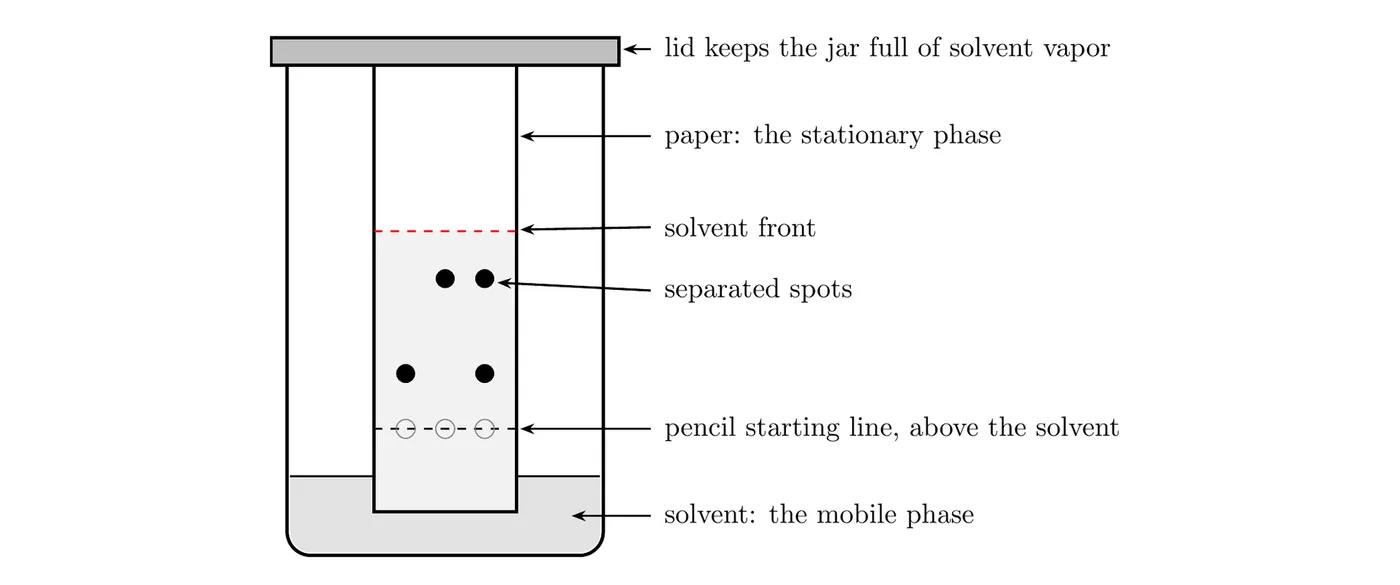
Small spots of each sample go on a starting line drawn in pencil, a little above the bottom. The paper or plate stands in a shallow layer of solvent in a covered jar. Solvent climbs up the paper by capillary action, carrying the components with it. When the solvent front is near the top, you remove the paper, mark the solvent front right away (it evaporates fast), and let it dry. The result is a chromatogram.
Column chromatography
In column chromatography, the stationary phase (often silica gel) is packed into a vertical tube. The mixture goes on top, and solvent is poured through. The components move down at different speeds and come out the bottom one at a time. The component with the weakest attraction to the stationary phase comes out first. The idea is the same as on paper, just turned on its side: "travels farther" on a plate becomes "comes out sooner" from a column.
Reading a chromatogram
How far a spot travels depends on how long the run lasted, so chemists compare spots using the retention factor, :
Measure both distances from the starting line, and measure to the center of each spot. has no units and is always between 0 and 1. A substance has the same whenever the stationary phase, solvent, and temperature are the same, so matching values (on the same plate) is a way to identify components.
Inferring polarity. On a polar stationary phase (paper or silica) with a less polar solvent:
Spot | Attractions | Polarity of the component |
Low (stays near the start) | Stronger interactions with the polar stationary phase (hydrogen bonding, dipole-dipole) | More polar |
High (near the solvent front) | Stronger interactions with the mobile phase relative to the stationary phase | Less polar |
Always reason from both phases. If the setup is reversed (a nonpolar stationary phase with a polar solvent like water, as in a C18 cartridge), the more polar components travel farther. The exam rewards an explanation that names which phase a component is more attracted to and why.
Distillation
Distillation separates the components of a liquid mixture by their volatility, which comes from intermolecular forces. A component with weaker intermolecular forces has particles that escape the liquid more easily, so it has a higher vapor pressure and a lower boiling point (Topic 3.1). When the mixture is heated, the vapor is richer in the more volatile component. That vapor is cooled in a condenser, turns back into a liquid, and is collected as the distillate.
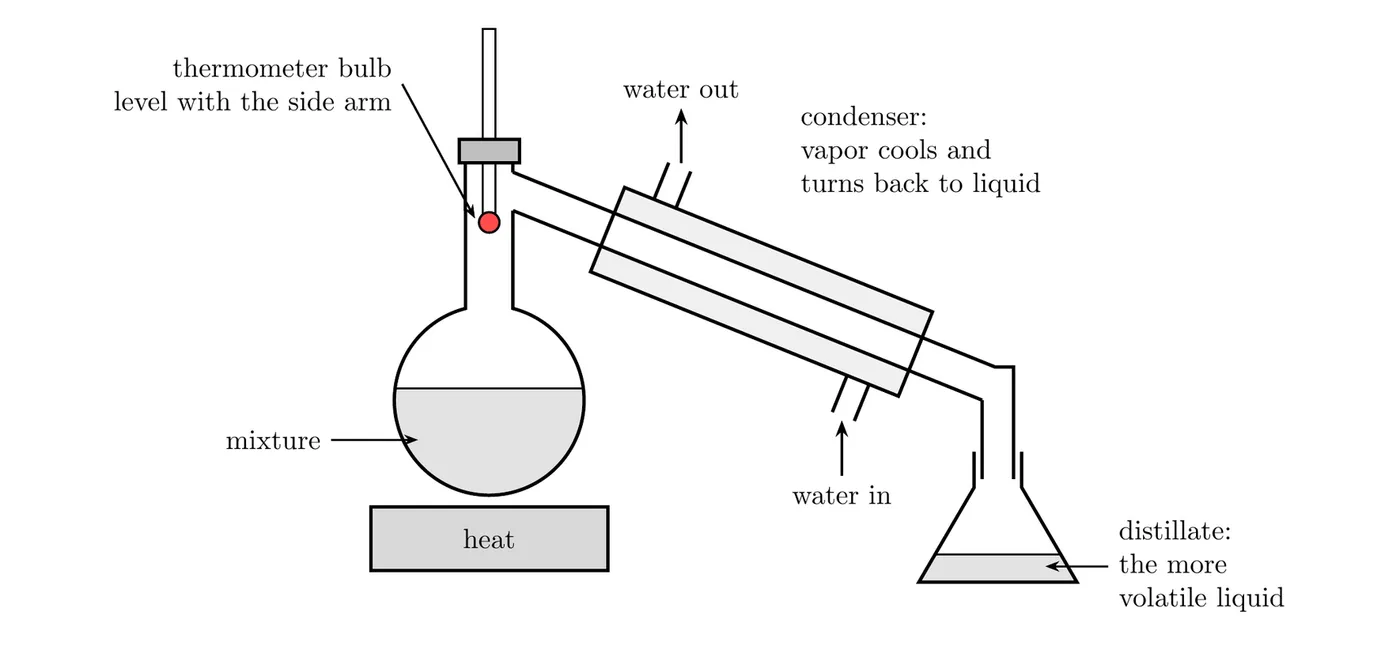
Key parts of the setup:
- Distilling flask: holds the mixture over the heat source. Boiling chips help it boil smoothly. Never heat it to dryness.
- Thermometer: its bulb sits right at the side arm, so it reads the temperature of the vapor that is about to enter the condenser, not the temperature of the liquid.
- Condenser: cold water flows through the outer jacket and cools the vapor inside back into a liquid. Water goes in at the lower end and out at the upper end, so the jacket stays completely full.
- Receiving flask: collects the distillate.
When the boiling points are close, a fractional distillation column between the flask and the condenser gives the vapor many chances to condense and re-evaporate, which separates the components more completely. The graph below shows idealized data for a fractional distillation of a mixture of 50 mL of acetone and 50 mL of water.
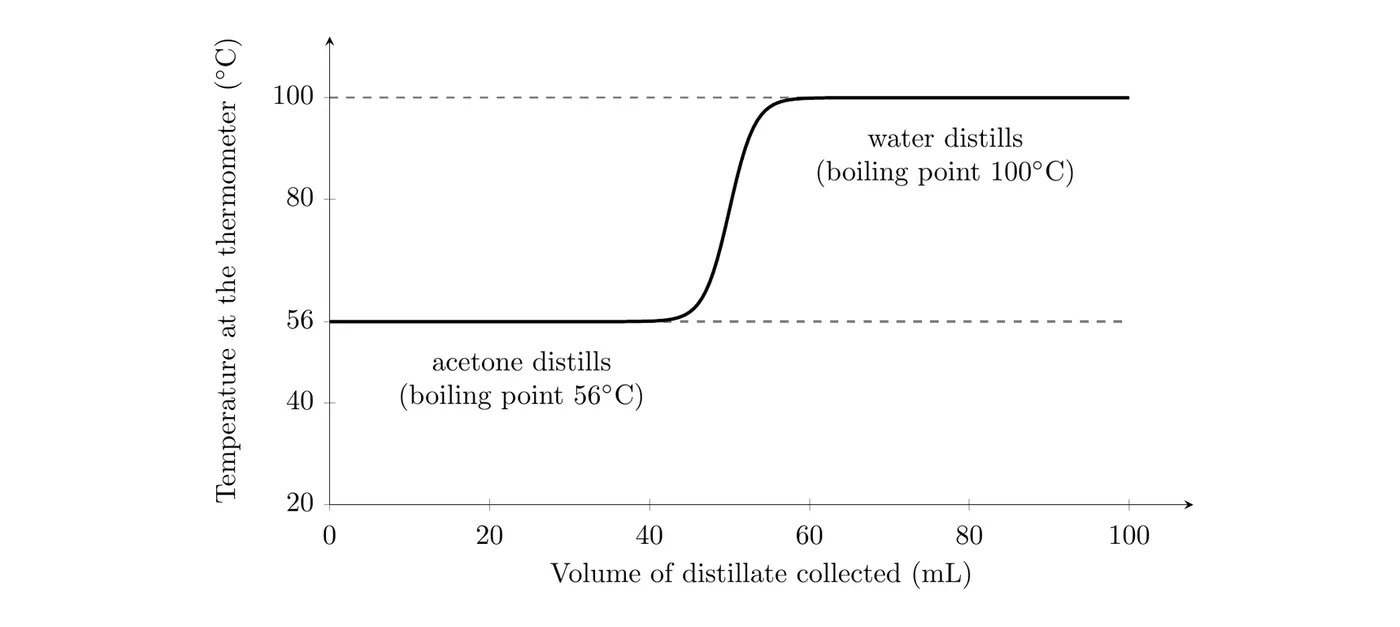
The thermometer reads close to while acetone distills. When the acetone is used up (after about 50 mL), the temperature rises until it levels off at , where water distills. Each flat section tells you a component is distilling, and the boiling point identifies it.
Lab technique and sources of error
The AP exam can ask you to identify a correct procedure, explain why a step matters, or predict how an error changes the results:
- Starting line in pencil, not pen. Ink is a mixture of dyes that would dissolve and separate along with your sample.
- Starting line above the solvent level. If the spots sit below the solvent surface, they dissolve into the solvent pool instead of moving up the paper.
- Covered jar. The lid keeps the air inside saturated with solvent vapor, so the solvent doesn't evaporate off the paper before it climbs.
- Small, concentrated spots. Big spots spread into each other and are hard to measure.
- Mark the solvent front immediately. If it evaporates before you mark it, your measured front is too low and every comes out too high.
- Thermometer bulb at the side arm in distillation. Too high, and it reads low because the vapor hasn't reached it. Down in the liquid, and it reads the liquid's temperature, not the vapor's.
Example 1: Calculating values
A TLC plate was spotted with three dyes, A, B, and C, and with an unknown mixture, U. Distances are in centimeters from the starting line.
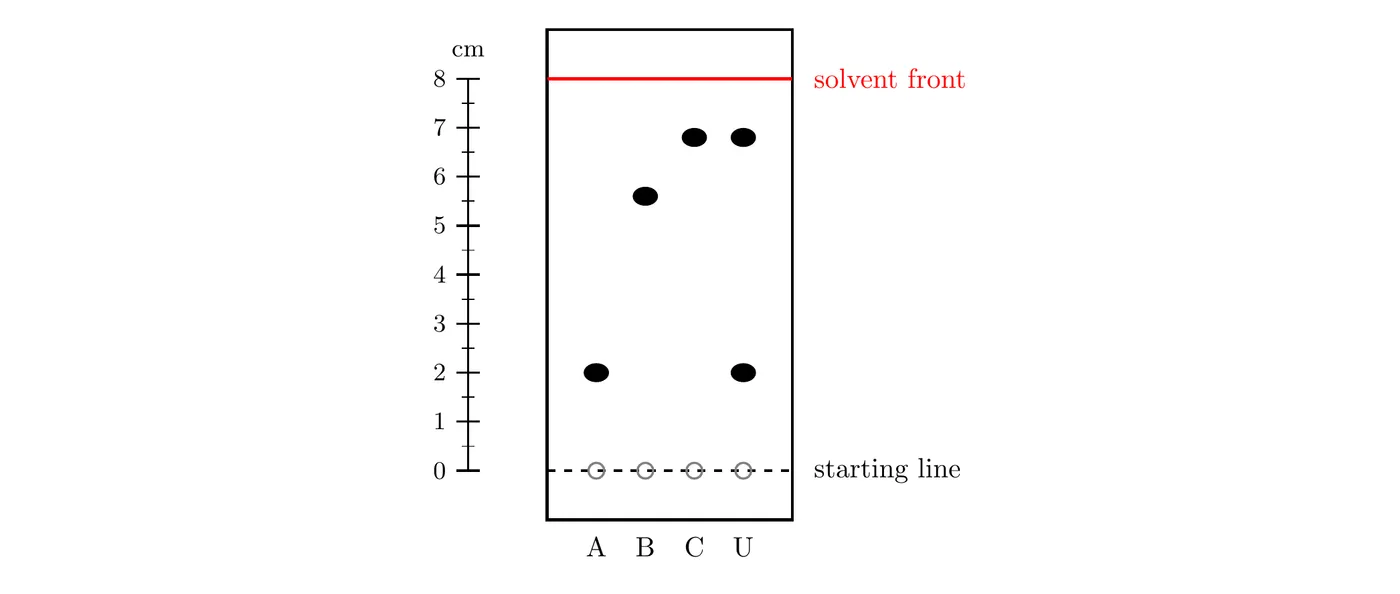
Calculate the of each dye, and identify the components of U.
The solvent front traveled 8.0 cm. Read each spot's center from the ruler:
The unknown has two spots, at 2.0 cm and 6.8 cm, so values of 0.25 and 0.85. Answer: values are 0.25 (A), 0.70 (B), and 0.85 (C). U contains dyes A and C, and it does not contain B, because it has no spot at .
Example 2: Explaining the separation (AP-style)
The plate in Example 1 is silica gel, whose surface is covered with polar -OH groups. The solvent is mostly hexane, which is nonpolar. (a) Which dye is the most polar? Justify your answer in terms of intermolecular interactions. (b) The experiment is repeated with a more polar solvent. Predict how the values change.
(a) Dye A is the most polar. A traveled the shortest distance (), so it spent the most time attached to the stationary phase. The polar -OH groups on the silica interact strongly with polar molecules through dipole-dipole interactions and hydrogen bonding. A nonpolar solvent like hexane interacts with the dyes only through London dispersion forces, so it can't compete well for a polar dye. Dye C, with the highest , is the least polar: its interactions with the silica are the weakest compared with its interactions with the solvent.
(b) All of the values increase. A more polar mobile phase can form stronger dipole-dipole interactions (or hydrogen bonds) with the dyes, so it competes better with the silica for them. The dyes spend more time in the moving solvent and travel farther. Their order usually stays the same, with A lowest and C highest.
Example 3: Interpreting a distillation (AP-style)
A student distills a mixture of acetone, , and water using a fractionating column, recording the temperature at the thermometer as distillate is collected (see the graph above). (a) Which liquid is collected first? Explain using intermolecular forces. (b) A classmate puts the thermometer bulb down in the boiling liquid. How would that change the temperature readings?
(a) Acetone is collected first. Acetone is polar, so its molecules attract each other with dipole-dipole forces and London dispersion forces. It can't hydrogen bond with itself, because none of its H atoms is bonded to an O atom. Water molecules form hydrogen bonds with each other, which are stronger than the dipole-dipole attractions between acetone molecules. Weaker intermolecular forces mean acetone molecules escape the liquid more easily, so acetone has the higher vapor pressure and the lower boiling point ( vs. ). The vapor reaching the condenser at first is mostly acetone.
(b) The thermometer would read the temperature of the boiling mixture instead of the vapor. The mixture boils above , and its boiling point climbs steadily as the acetone boils away, so the readings would start too high and keep rising. The graph would lose its clear plateau at acetone's boiling point, so the data could no longer identify the first component.
Common mistakes
- Filtering a solution. Dissolved particles pass through the filter. Filtration only separates undissolved solids.
- Saying a spot "moved farther because it's polar" without naming the phases. Whether a polar component travels farther depends on whether the stationary or mobile phase is more polar. Say which phase it's more attracted to, and name the forces.
- Measuring from the bottom of the paper. Measure both distances from the starting line.
- Getting an greater than 1. A spot can't travel farther than the solvent front. Check that you put the solvent distance in the denominator.
- Mixing up volatility and boiling point. The component with weaker intermolecular forces has the higher vapor pressure and the lower boiling point, so it distills first.
- Starting line drawn in ink or below the solvent level. Both ruin the run.