

3.3 - Solids, Liquids, and Gases
Overview
Solids, liquids, and gases can be made of exactly the same particles. What changes is how close together the particles are, how orderly they are, and how freely they move. The AP exam asks you to draw these differences at the particle level and explain them, so this topic is about building an accurate picture of each phase.
Solids
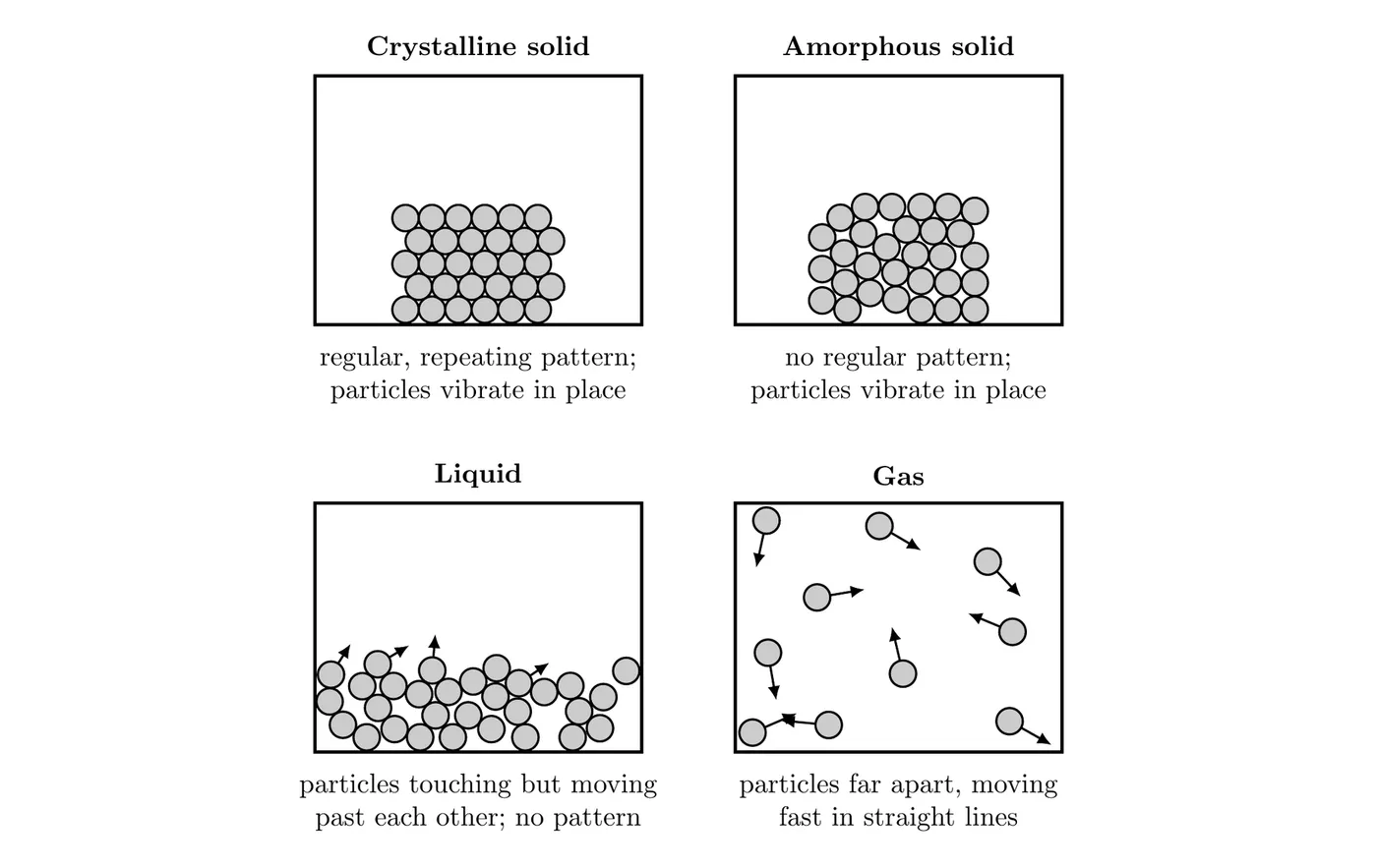
In a solid, the particles are in close contact. They vibrate in place but don't move past each other, which is why a solid keeps its own shape.
- Crystalline solids have particles arranged in a regular, repeating three-dimensional pattern. Examples: table salt, ice, quartz, metals.
- Amorphous solids have no regular pattern; the particles are frozen in a jumbled arrangement, a bit like a snapshot of a liquid. Examples: glass, many plastics, rubber.
You can see the difference when they melt. A crystalline solid melts at one sharp temperature (ice at 0 °C), because every particle sits in the same kind of environment. An amorphous solid softens gradually over a range of temperatures, which is why hot glass can be bent and blown.
The structure of a solid depends on two things: the attractions between the particles, and how well the particles can pack together. Neopentane's unusually high melting point (Topic 3.2) is a packing effect.
Liquids
In a liquid, the particles are still in close contact, but they're continually moving, colliding, and sliding past each other. That's why a liquid flows and takes the shape of its container while keeping a fixed volume. There's no long-range pattern. How the particles arrange and move depends on the forces between them (polarity, hydrogen bonding) and on temperature: stronger attractions hold neighbors together more tightly, and a higher temperature means faster motion.
Solids and liquids have similar molar volumes
The molar volume is the volume of one mole of a substance. Because the particles are touching in both phases, a substance's solid and liquid molar volumes are usually close. Melting doesn't spread the particles apart much; it lets them move past each other.
Water is a famous exception in direction, though not in size: ice takes up about 9% more volume than the liquid, so ice floats. Hydrogen bonds lock the molecules in ice into an open, hexagonal pattern with empty space in it; when ice melts, that pattern partly collapses and the molecules crowd closer.
Example 1: Molar volumes of water in all three phases
Ice at 0 °C has a density of 0.917 g/mL. Liquid water has a density of 1.00 g/mL at 0 °C and 0.958 g/mL at 100 °C. Water vapor at 100 °C and 1.00 atm has a density of 0.598 g/L. The molar mass of water is 18.02 g/mol. Find each molar volume and compare them.
Step 1: Combine and (both on the reference sheet). The volume per mole is
where is the molar mass (script , so it isn't confused with molarity, ).
Step 2: Calculate each one.
\text{ice, } 0\,^\circ\mathrm{C}: \ \frac{18.02\ \mathrm{g/mol}}{0.917\ \mathrm{g/mL}} = 19.7\ \mathrm{mL/mol}\text{liquid, } 0\,^\circ\mathrm{C}: \ \frac{18.02\ \mathrm{g/mol}}{1.00\ \mathrm{g/mL}} = 18.0\ \mathrm{mL/mol}\text{liquid, } 100\,^\circ\mathrm{C}: \ \frac{18.02\ \mathrm{g/mol}}{0.958\ \mathrm{g/mL}} = 18.8\ \mathrm{mL/mol}\text{vapor, } 100\,^\circ\mathrm{C}: \ \frac{18.02\ \mathrm{g/mol}}{0.598\ \mathrm{g/L}} = 30.1\ \mathrm{L/mol} = 30{,}100\ \mathrm{mL/mol}Step 3: Compare. Ice and liquid water differ by less than 10%. The vapor at 100 °C takes up times the volume of the liquid at the same temperature.
Answer: Solid and liquid water have nearly the same molar volume, but one mole of steam fills about 1,600 times as much space as one mole of liquid water. In the gas, the molecules themselves fill only a tiny fraction of the space; the rest is empty.
Gases
Gas particles are far apart and in constant, fast motion, traveling in straight lines until they hit another particle or the container wall. Because the particles move constantly and the forces between them have little effect, a gas has neither a definite shape nor a definite volume: it spreads out to fill whatever container it's in.
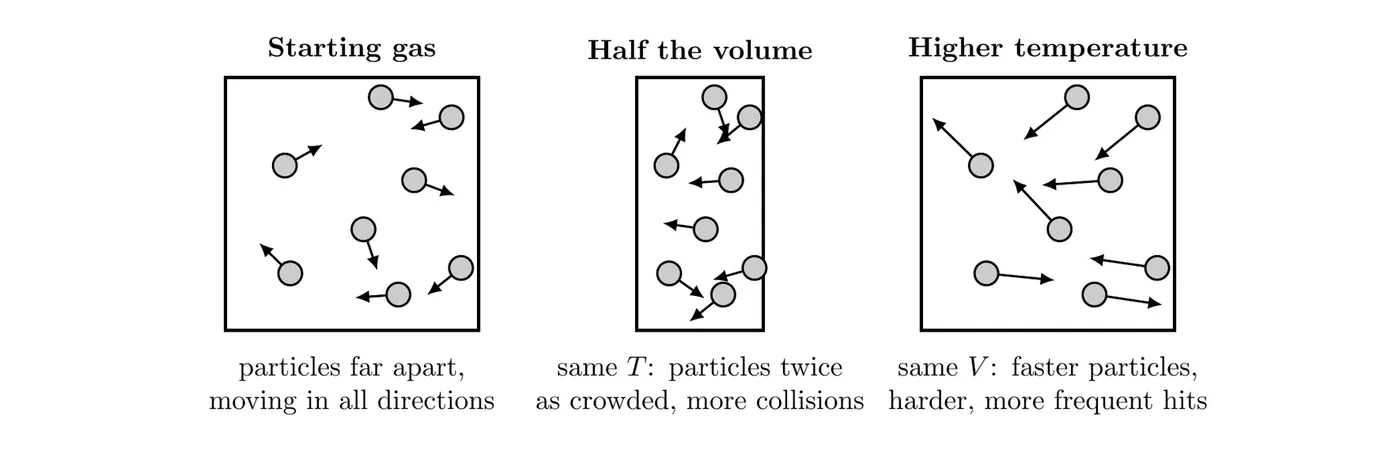
How often the particles collide, and how far apart they are on average, depends on the conditions:
- Higher temperature: the particles move faster, so they collide more often and harder.
- Smaller volume (higher pressure): the same particles are crowded closer together, so they collide more often.
- More particles in the same volume: closer spacing and more collisions.
Topics 3.4 and 3.5 put numbers on these ideas.
Comparing the three phases
Solid | Liquid | Gas | |
Spacing | particles touching | particles touching | far apart |
Order | regular (crystalline) or none (amorphous) | no long-range order | none |
Motion | vibrate in place | move past each other | fast, random, straight lines |
Shape | definite | takes the container's shape | fills the container |
Volume | definite | definite | fills the container |
Compressible? | barely | barely | very |
Drawing particle diagrams
- Solid: particles touching, in a regular pattern (crystalline) or a jumbled one (amorphous).
- Liquid: particles still touching, packed about as closely as in the solid, but disordered and filling the bottom of the container.
- Gas: particles spread through the whole container with lots of empty space between them. At room conditions, gas molecules are about ten molecule-widths apart on average, so you can't draw a gas to scale; just make the spacing obviously much larger than in the liquid.
- Draw the particles the same size in every phase: particles don't grow or shrink when they change phase. If the question follows one sample through a change, keep the number of particles the same.
Phase diagrams (graphs of pressure vs. temperature that show which phase is stable) are not assessed on the AP exam.
Example 2: Changing conditions for a gas (AP-style)
A sample of neon gas is in a sealed, rigid container. (a) The container is heated from 300 K to 450 K. What happens to the average distance between atoms, and to how often atoms hit the walls? (b) The same sample, still at 450 K, is then moved into a container with half the volume. What happens to the spacing and the collision frequency now?
- (a) The average spacing doesn't change: the same number of atoms is in the same volume. The atoms move faster, so they reach the walls more often and hit them harder. Collisions with the walls become more frequent, and the pressure rises.
- (b) Now there are twice as many atoms per unit volume, so the atoms are closer together on average. They collide with each other and with the walls more often, so the pressure rises again.
Common mistakes
- Drawing liquid particles far apart. They touch, nearly as close as in the solid.
- Drawing particles that change size between phases.
- Saying the particles in a solid don't move. They vibrate; they just don't move past each other.
- Saying gas particles have no attractions at all. The attractions exist, but they have little effect because the particles are far apart and moving fast (Topic 3.6 covers when they matter).
- Assuming every solid is crystalline. Glass and many plastics are amorphous.