

3.4 - Ideal Gas Law
Overview
Gases are the one phase with a simple equation that connects their properties. The ideal gas law ties together pressure, volume, temperature, and moles, and every other gas relationship comes out of it. On the AP exam you'll calculate with it, and just as often you'll explain what happens to one variable when another one changes.
The ideal gas law
- = pressure, usually in atm ()
- = volume, in liters
- = moles of gas
- = temperature in kelvins:
- = the gas constant, (or when energy is involved, as in Topic 3.5)
The units of set your units: with , pressure must be in atm and volume in liters, so convert torr and mL first.
At STP (273.15 K and 1.0 atm), one mole of any ideal gas fills 22.4 L. That value is on the reference sheet, and it comes straight from the ideal gas law:
An ideal gas is a model: its particles take up no space and don't attract each other (Topic 3.5 explains the model). Real gases follow it closely at ordinary conditions; Topic 3.6 covers when they don't.
Example 1: Using the ideal gas law
A 2.50 L flask holds 0.105 mol of at 25.0 °C. What is the pressure in atm and in torr?
Step 1: Convert the temperature: .
Step 2: Solve for .
Step 3: Convert to torr.
Answer: atm, or 781 torr. (Keep an extra digit, 1.028, until the last step.)
How the variables are related
Hold some variables constant in , and the classic gas laws fall out:
Held constant | Relationship | In words |
, | and are inversely proportional (Boyle's law) | |
, | is directly proportional to Kelvin (Charles's law) | |
, | is directly proportional to Kelvin (Gay-Lussac's law) | |
, | is directly proportional to (Avogadro's law) |
For a fixed amount of gas, they combine into one equation on the reference sheet:
You don't need the names. You need the reasoning: figure out what's constant, then decide whether the two changing variables go up together (direct) or move in opposite directions (inverse).
Graphs of gas behavior
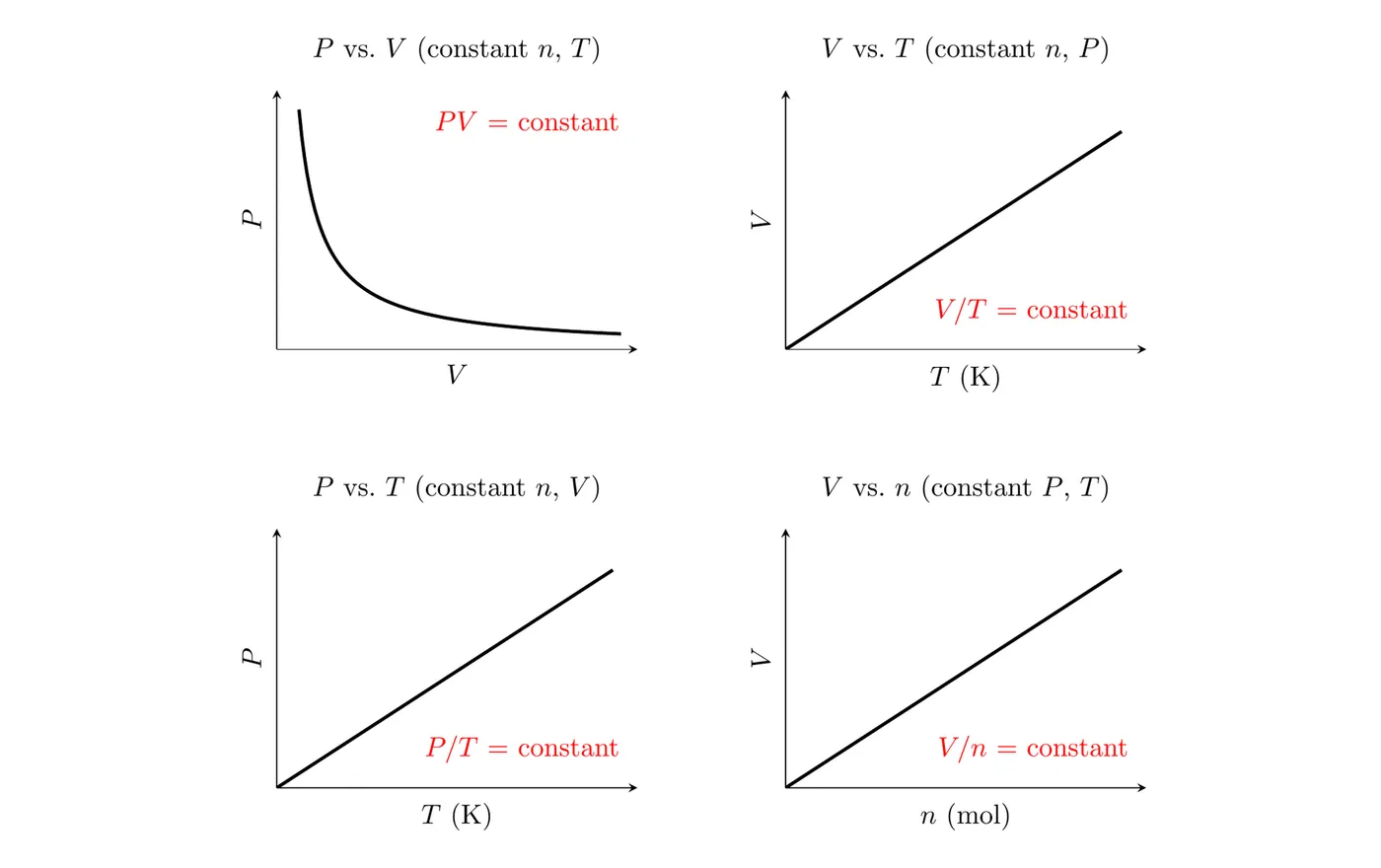
An inverse relationship gives a curve that drops toward the axis. A direct relationship gives a straight line through the origin, but only if temperature is in kelvins.
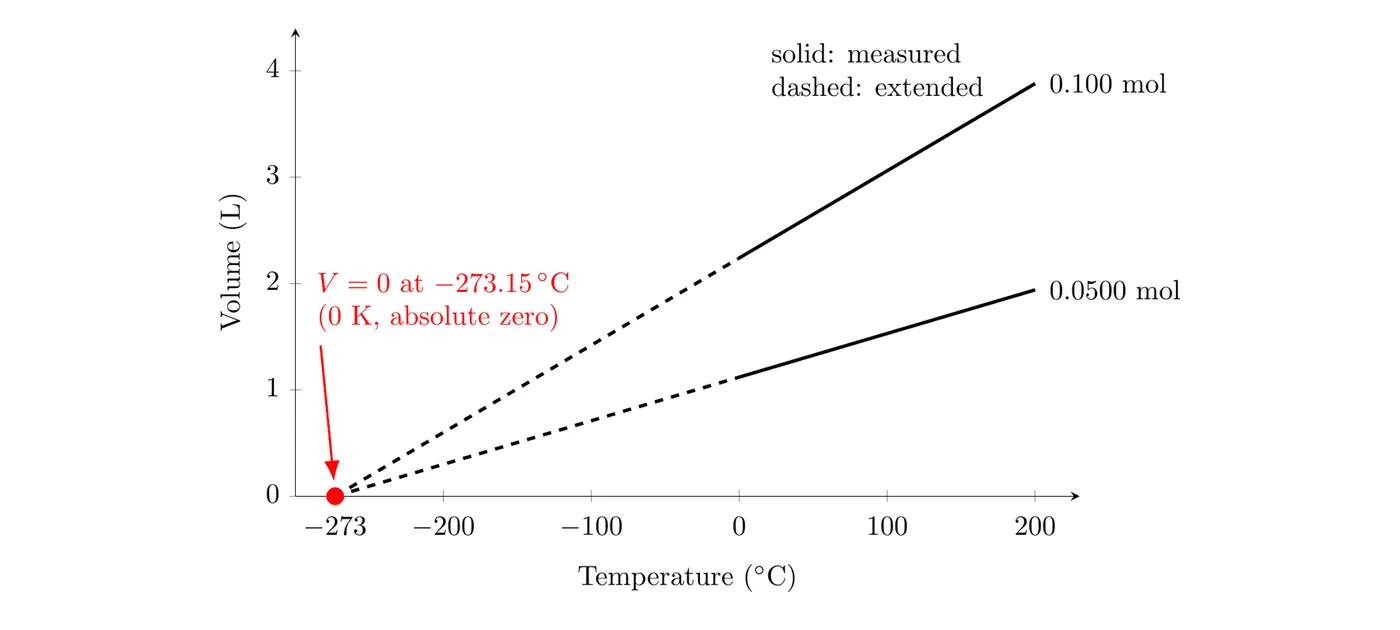
Why kelvins? Measure the volume of a gas at several Celsius temperatures, extend the line backward, and every sample reaches zero volume at the same point: −273.15 °C, which is 0 K (absolute zero). The Kelvin scale starts there, so on it, volume and temperature are truly proportional.
Example 2: Predicting a change
A sealed, rigid steel tank holds a gas at 1.20 atm and 27 °C. It's heated to 327 °C. What is the new pressure?
Step 1: The tank is sealed and rigid, so and are constant, and is directly proportional to in kelvins: , .
Step 2:
Answer: 2.40 atm. The Kelvin temperature doubled, so the pressure doubled. With Celsius you'd have multiplied by 327/27, about 12, which is badly wrong.
Quick checks like this are a big part of the exam. Halve the volume at constant and , and doubles. Double at constant and , and doubles. Double the Kelvin temperature and halve the volume, and becomes 4 times as large.
Example 3: Molar mass from gas data (AP-style)
A student puts a few mL of an unknown volatile liquid in a 250.0 mL flask, covers it with foil that has a pinhole, and heats it in boiling water at 100.0 °C. The liquid vaporizes, the extra vapor escapes through the pinhole, and the flask is left full of vapor at the air pressure, 750. torr. The student cools the flask and finds 0.695 g of condensed liquid. (a) Find the molar mass. (b) The liquid is pentane (72.15 g/mol), hexane (86.17 g/mol), or heptane (100.20 g/mol). Which one? (c) The outside of the flask was still wet when it was weighed. How does that affect the calculated molar mass?
(a) Step 1: Combine with :
Step 2: Convert: , , .
Step 3:
(b) 86.3 g/mol is closest to hexane, (86.17 g/mol).
(c) Water on the outside adds mass, so the measured is too large. Since is directly proportional to , the calculated molar mass is too high. (Leftover liquid that never vaporized would cause the same error.)
Mixtures of gases: partial pressures
In a mixture of ideal gases, each gas behaves as if the others weren't there. The pressure each gas would exert by itself in the container is its partial pressure, and the total pressure is the sum:
All the gases share the same and , so each gas's partial pressure is proportional to its moles. That makes the partial pressure proportional to the mole fraction, :
Mole fractions have no units and add up to 1. A gas's partial pressure is independent of the other gases because, in the ideal model, particles don't attract each other and take up no space: adding Ar atoms doesn't change how often the He atoms hit the walls.
Example 4: Partial pressures from a particle diagram (AP-style)
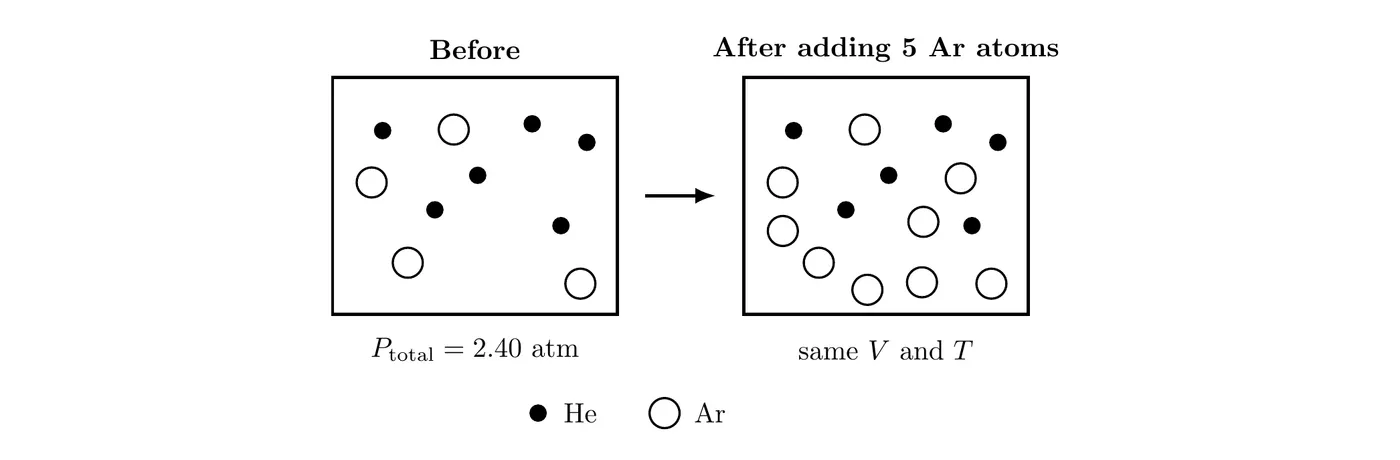
The container on the left holds a mixture of He and Ar at a total pressure of 2.40 atm. (a) Find the partial pressure of each gas. (b) Five more Ar atoms are added at the same volume and temperature, as shown on the right. Find the new partial pressures and the new total pressure.
(a) Count the particles: 6 He and 4 Ar, 10 in all.
(b) The number of He atoms, the volume, and the temperature haven't changed, so stays 1.44 atm. Each atom contributes , so the 9 Ar atoms give
Check with the mole fraction: , and . The mole fraction of He went down, but its partial pressure didn't change: partial pressure depends on how much of that gas is present, not on what else is in the container.
Example 5: Collecting a gas over water
Hydrogen gas from a reaction is collected over water at 22.0 °C. The collected gas fills 125 mL at a total pressure of 755 torr. The vapor pressure of water at 22.0 °C is 19.8 torr. How many moles of were collected?
Step 1: The gas in the tube is a mixture of and water vapor, so subtract the water's share:
Step 2: Use and :
Answer: mol of .
Common mistakes
- Using Celsius in a gas law calculation. Always convert to kelvins.
- Mixing units with . With , pressure must be in atm and volume in liters.
- Thinking a gas's partial pressure changes when another gas is added at constant and . Only the total and the mole fractions change.
- Forgetting to subtract water's vapor pressure when a gas is collected over water.
- Calling a vs. graph in °C proportional. It's a straight line, but it passes through the origin only when is in kelvins.