

3.5 - Kinetic Molecular Theory
Overview
The kinetic molecular theory (KMT) is the particle-level model behind the gas laws. It explains pressure, temperature, and every relationship from Topic 3.4 in terms of tiny particles flying around and colliding. It also introduces the Maxwell-Boltzmann distribution, a graph you'll use again in kinetics (Unit 5).
The kinetic molecular theory
KMT describes an ideal gas with a few assumptions:
- Gas particles are in constant, random, straight-line motion.
- The particles are tiny compared with the distances between them, so their own volume is negligible. A gas is mostly empty space.
- The particles don't attract or repel each other except when they collide.
- Collisions with each other and with the walls are elastic: particles trade kinetic energy, but none is lost overall.
- The average kinetic energy of the particles is proportional to the Kelvin temperature.
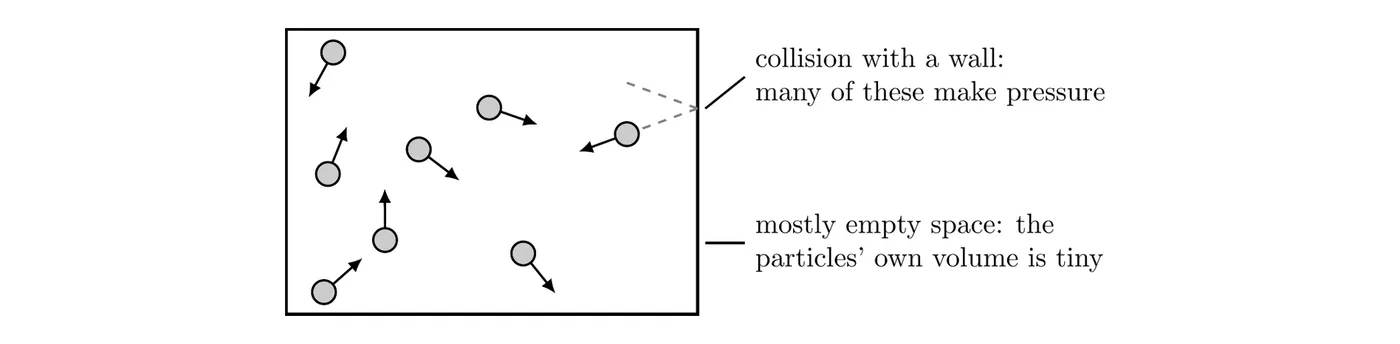
Pressure comes from collisions. Each time a particle bounces off a wall, it pushes on the wall. An enormous number of these hits every second adds up to a steady force on each area of wall, and force per area is pressure.
KMT explains the gas laws
Change | What the particles do | Result |
Decrease (constant , ) | same speeds, but more crowded, so they hit the walls more often | increases |
Increase (constant , ) | move faster, so they hit the walls more often and harder | increases |
Increase (constant , ) | faster particles push the walls out until the hits per area drop back | increases |
Add gas (constant , ) | more particles, so more hits on the walls | increases |
Kinetic energy and speed
Kinetic energy is energy of motion. For one particle, is its mass in kilograms and its speed in m/s, which gives in joules (). All the particles in a sample are in continuous, random motion, but not at the same speed. At any instant some are slow and some are fast, and they keep trading energy in collisions, so for a whole sample we talk about the average kinetic energy.
Example 1: Kinetic energy of one molecule
An molecule (molar mass 28.02 g/mol) is moving at 515 m/s. What is its kinetic energy?
Step 1: Find the mass of one molecule, in kilograms.
Step 2: Apply the equation.
Answer: J. It's a tiny number because one molecule is tiny. The most common slip here is leaving the mass in grams.
Temperature and average kinetic energy
The Kelvin temperature of a sample is proportional to the average kinetic energy of its particles. Double the Kelvin temperature, and the average kinetic energy doubles. Two big consequences:
- Same temperature, same average kinetic energy, for any gas. At 25 °C, He atoms and molecules have the same average kinetic energy.
- Lighter particles move faster. If is the same, a smaller means a larger . At the same temperature, He atoms move much faster on average than Ar atoms.
Example 2: Comparing speeds and temperatures
(a) At the same temperature, how many times faster than an molecule does a He atom move, on average? (b) A gas is heated from 25 °C to 125 °C. By what factor does its average kinetic energy increase?
(a) The same temperature means the same average kinetic energy:
The ratio of particle masses equals the ratio of molar masses, so molar masses work directly. A He atom moves about 2.83 times as fast. (Here means a typical speed; technically it's the root-mean-square speed.)
(b) Only Kelvin temperatures are proportional to kinetic energy:
The average kinetic energy goes up by a factor of 1.34, not 5. The typical speed goes up by , about 16%.
The Maxwell-Boltzmann distribution
The Maxwell-Boltzmann distribution is a graph of how the particles in a sample are spread over different speeds (or kinetic energies) at a given temperature. The x-axis is speed or energy; the y-axis is the fraction of particles. The area under the whole curve stands for all of the particles, so it's the same for every curve drawn for the same sample.
- It starts at zero: almost no particles are nearly at rest.
- It rises to a peak, the most probable speed.
- It has a long tail to the right: a few particles move much faster than average.
Effect of temperature
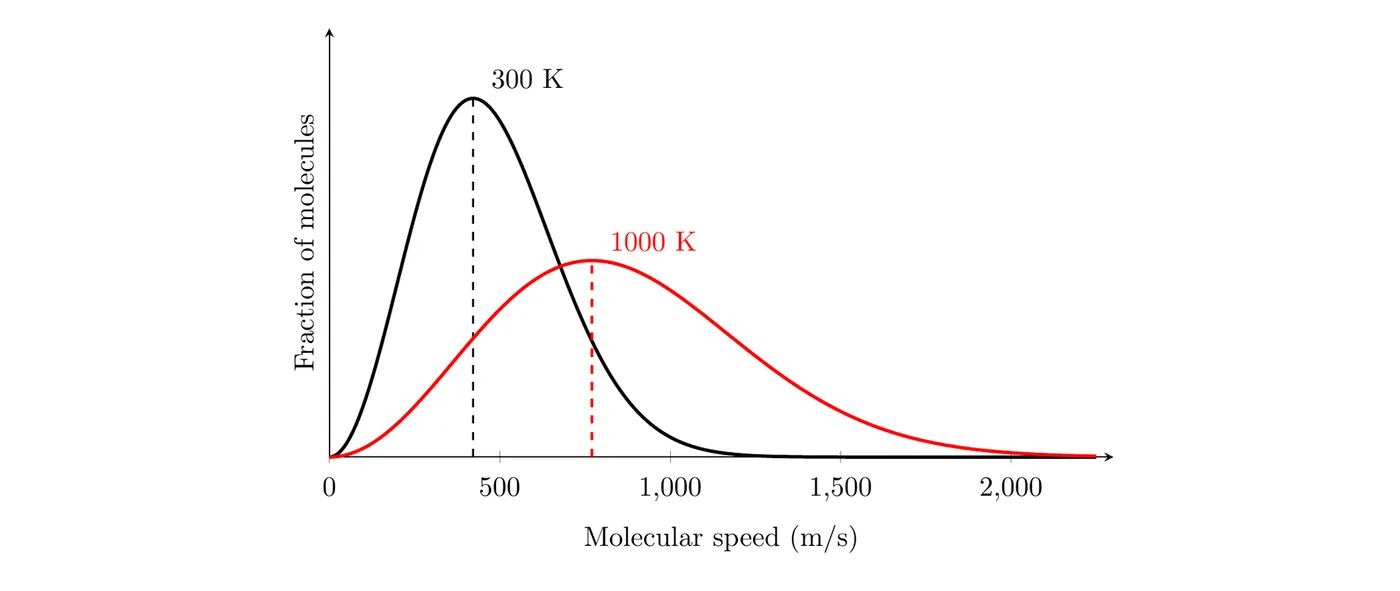
For , the most probable speed is about 420 m/s at 300 K and about 770 m/s at 1000 K. At the higher temperature, the peak moves right (faster on average), the curve spreads out and gets lower (the speeds are more varied), and the area stays the same (the same number of molecules). The hot curve has many more molecules in the high-speed tail. In Unit 5, that tail is why reactions speed up when they're heated: more particles have enough energy to react.
Effect of mass
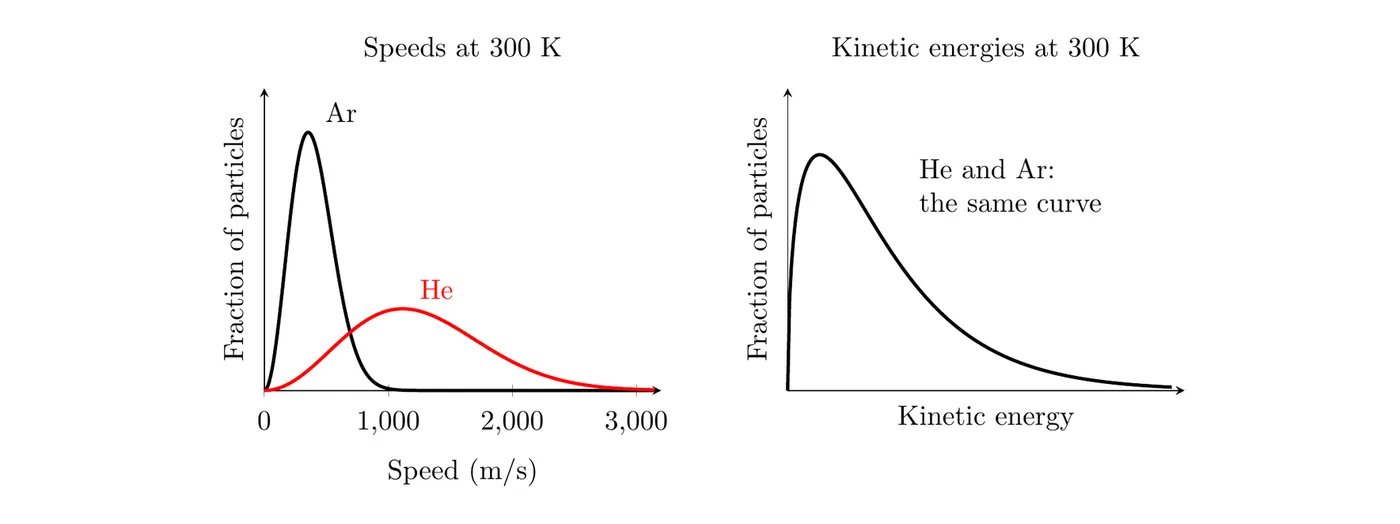
At the same temperature, a light gas like He has a speed distribution that's shifted right and spread out, while a heavy gas like Ar has a tall, narrow peak at low speeds. But plot kinetic energy instead of speed, and every gas at the same temperature gives the same curve, because the temperature sets the kinetic energies, whatever the mass.
Example 3: Interpreting distributions (AP-style)
A sealed, rigid container holds . The temperature graph above shows its speed distribution at 300 K (black) and after it was heated (red). (a) Explain how the graph shows the gas was heated. (b) Use KMT to explain why the pressure in the container increased. (c) A student says heating made every molecule move faster. Is the student right?
- (a) The red curve's peak is at a higher speed, and more molecules are in the high-speed tail, so the average speed and the average kinetic energy are higher. Average kinetic energy is proportional to Kelvin temperature, so the temperature went up. The red curve is lower and wider, with the same area, because it describes the same molecules.
- (b) The volume and the number of molecules didn't change. The molecules move faster on average, so they hit the walls more often and with more force per hit. More force on each area of wall means a higher pressure.
- (c) No. The distribution describes the whole sample. Heating raises the average, but at any instant some molecules are still slow (the red curve still starts at zero), and each molecule's speed keeps changing as it collides with others.
Common mistakes
- Saying heavier gas particles have more kinetic energy. At the same temperature, every gas has the same average kinetic energy; heavier particles just move more slowly.
- Using Celsius temperatures in ratios. 50 °C is not twice as hot as 25 °C.
- Drawing the higher-temperature Maxwell-Boltzmann curve taller. It's lower and wider, with the same area.
- Leaving mass in grams in , or using the molar mass instead of the mass of one particle.
- Saying all the particles in a sample move at the same speed.
- Thinking collisions slowly drain a gas's energy. Collisions are elastic: particles trade energy, but the total stays the same.