

3.11 - Spectroscopy and the Electromagnetic Spectrum
Overview
Spectroscopy is the study of how matter absorbs and emits electromagnetic radiation. Different regions of the electromagnetic spectrum carry photons with different amounts of energy, and each region matches a different kind of change in a molecule: rotating faster, vibrating more, or moving an electron to a higher energy level. Knowing which region goes with which change lets you explain what a spectrum tells you about a substance. It also sets up the photon calculations in Topic 3.12 and the Beer-Lambert law in Topic 3.13.
The electromagnetic spectrum
Visible light, infrared, microwaves, X-rays, and radio waves are all the same thing: electromagnetic radiation, a wave of electric and magnetic fields that travels through a vacuum at the speed of light, m/s. What makes the regions different is the wavelength, , the distance from one wave crest to the next.
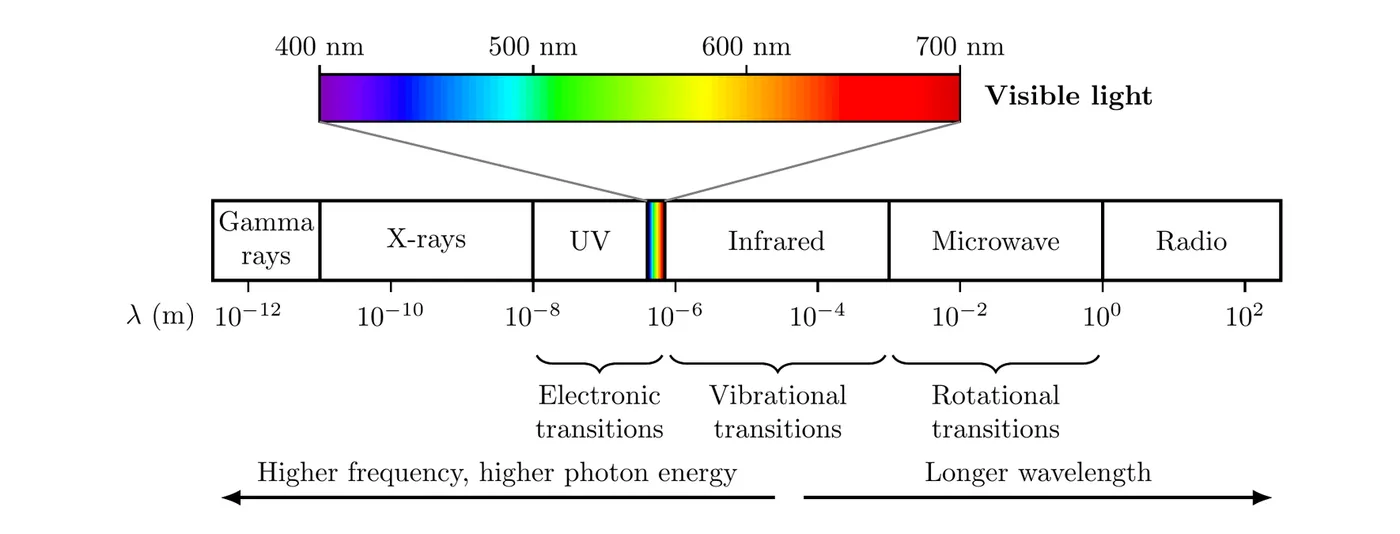
- Shorter wavelength means higher frequency and more energy per photon. Gamma rays and X-rays sit at the high-energy end, and radio waves sit at the low-energy end. Topic 3.12 turns this into equations.
- Visible light is a tiny slice of the spectrum, from about 400 nm (violet) to about 700 nm (red). Just past violet is ultraviolet (UV), and just past red is infrared (IR).
- The boundaries are approximate. Different sources draw them in slightly different places. The order of the regions is what you need to know.
Absorbing and emitting photons
The energy of an atom or molecule is quantized: it can only have certain specific values, called energy levels. A molecule absorbs a photon only if the photon's energy matches the gap between its current level and a higher one. After absorbing, the molecule is in an excited state. When it drops back to a lower level, it can release the extra energy as an emitted photon.
- An absorption spectrum shows how much light a sample absorbs at each wavelength. Peaks appear at wavelengths whose photons match energy gaps in the sample.
- An emission spectrum shows the wavelengths a sample gives off after it has been energized, for example by a flame in a flame test or by electricity in a neon sign.
Each substance has its own set of energy levels, so its spectrum works like a fingerprint. That's how chemists identify substances, and how astronomers know what distant stars are made of.
Three regions, three kinds of transitions
A molecule can hold energy in three ways that matter here: it can rotate (tumble), it can vibrate (its bonds stretch and bend), and its electrons can sit in different energy levels. Each kind of motion has its own set of energy levels, and the gaps between them are very different in size.
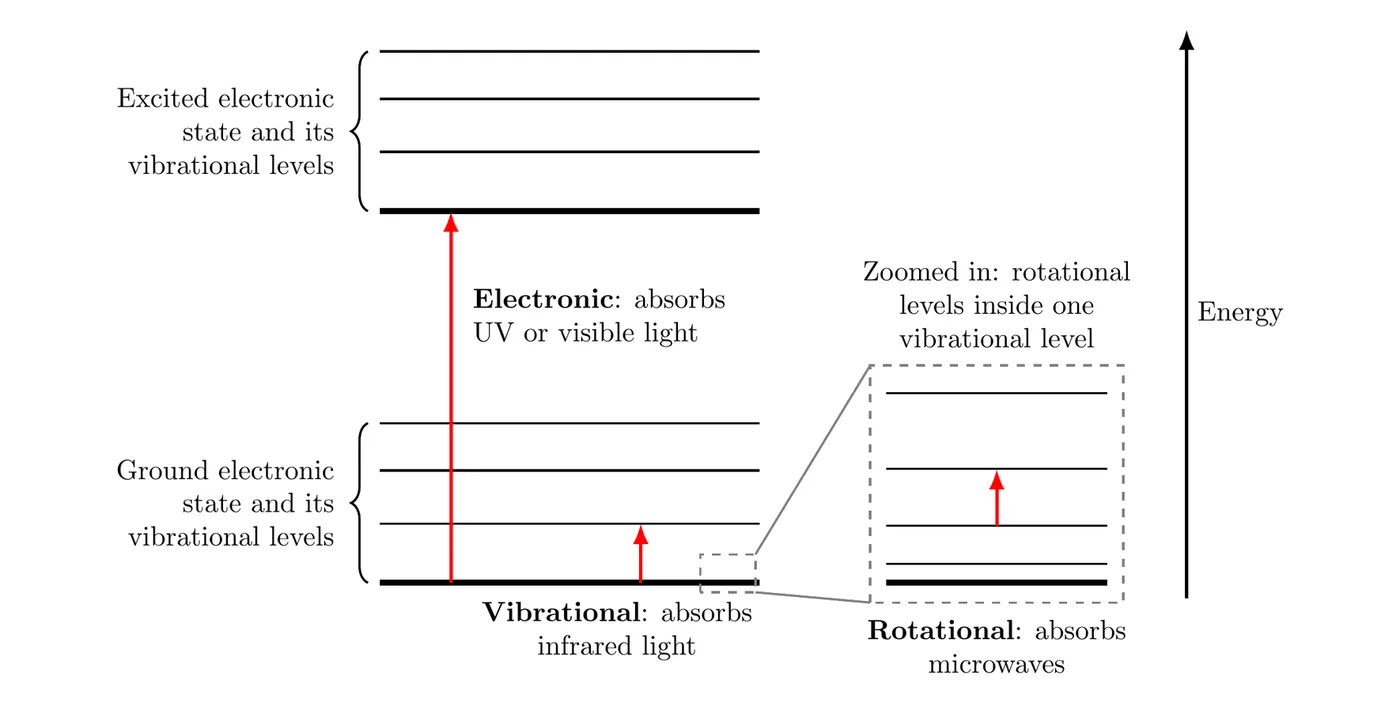
Electronic gaps are the biggest, vibrational gaps are much smaller, and rotational gaps are the smallest of all. A bigger gap needs a more energetic photon. That lines up each kind of transition with one region of the spectrum.
Microwave radiation: rotational levels
Microwave photons carry the least energy of the three regions, just enough to move a molecule to a higher rotational level so it spins faster. Microwave spectroscopy measures these rotational transitions in gas molecules. A microwave oven uses the same kind of radiation: it heats food by making polar water molecules twist back and forth, and that extra motion ends up as thermal energy.
Infrared radiation: vibrational levels
Infrared photons have more energy, enough to move a molecule to a higher vibrational level so its bonds stretch and bend more. Different bonds vibrate at different frequencies: an O-H bond absorbs different infrared wavelengths than a C-H or C=O bond does. So an infrared spectrum tells you which kinds of bonds a molecule contains.
This is also how greenhouse gases work. and molecules absorb infrared radiation given off by Earth's surface, which increases their vibrational energy. They pass that energy to other molecules in collisions or give it off again as infrared radiation, which keeps heat in the atmosphere.
Ultraviolet and visible radiation: electronic levels
UV and visible photons have the most energy of the three, enough to move an electron to a higher energy level. This is an electronic transition, and it's the kind of absorption a spectrophotometer measures in Topic 3.13.
- Color comes from electronic transitions. A colored substance absorbs some visible wavelengths, and you see the light that's left over. A blue dye looks blue because it absorbs mostly orange-red light (around 630 nm).
- UV photons carry more energy than visible photons. That's why UV light from the sun can damage skin cells, while visible light from a lamp doesn't.
- X-ray photons have even more energy. They can knock an inner electron out of an atom completely, which is the basis of photoelectron spectroscopy (Topic 1.6).
Region | Approximate wavelengths | Transition | What happens to the molecule |
Microwave | 1 mm to 1 m | Rotational | It rotates faster |
Infrared | 700 nm to 1 mm | Vibrational | Its bonds stretch and bend more |
Visible | 400 nm to 700 nm | Electronic | An electron moves to a higher energy level |
Ultraviolet | 10 nm to 400 nm | Electronic | An electron moves to a higher energy level |
A quick way to remember the order, from low to high energy: microwaves make molecules spin, infrared makes them shake, and UV or visible light makes electrons jump.
Example 1: Matching radiation to a transition
Identify the region of the spectrum and the type of transition for radiation with each wavelength.
- m (3.0 mm): between 1 mm and 1 m, so microwave. It causes rotational transitions.
- m (4,300 nm): longer than 700 nm but shorter than 1 mm, so infrared. It causes vibrational transitions. Carbon dioxide absorbs strongly near this wavelength, one reason it's a greenhouse gas.
- m (254 nm): shorter than 400 nm, so ultraviolet. It causes electronic transitions.
- m (550 nm): between 400 and 700 nm, so visible (green). It also causes electronic transitions.
Tip: convert to nanometers before comparing ( m). For example, .
Example 2: Reading color as absorption
A solution of a food dye looks blue, and a spectrophotometer shows its strongest absorption near 630 nm. (a) What kind of transition causes this absorption? (b) Why does the solution look blue?
(a) 630 nm is in the visible region (400 to 700 nm), so the absorption comes from an electronic transition: electrons in the dye molecules move to higher energy levels.
(b) Light near 630 nm is orange-red. The dye removes much of the orange and red light, and the wavelengths that pass through look blue to our eyes. The color you see is the light that is not absorbed.
Example 3: Evaluating a claim (AP-style)
A student says: “Infrared heat lamps feel warm and ultraviolet lamps don't, so infrared photons must carry more energy than ultraviolet photons.” Evaluate the claim, and explain what each kind of radiation does to molecules.
The claim is incorrect. Ultraviolet light has a shorter wavelength than infrared light, so each UV photon carries more energy than each IR photon.
A heat lamp feels warm because its infrared photons match the gaps between vibrational levels in molecules, including the molecules in your skin. Absorbing them makes the molecules vibrate more, and faster molecular motion is what we feel as warmth. A heat lamp also gives off a huge number of these photons.
UV photons have enough energy to cause electronic transitions, moving electrons to higher energy levels. A small UV lamp can feel cool because it gives off far fewer photons in total, but each one carries more energy than an infrared photon. That's why UV light, not infrared, causes sunburn. The energy of each photon depends on its wavelength; how warm a source feels also depends on how many photons it gives off.
Common mistakes
- Mixing up the direction. Longer wavelength means lower energy, not higher. Radio waves have the longest wavelengths and the least energetic photons.
- Matching the wrong region to a transition. Microwave goes with rotation, infrared with vibration, and UV or visible with electronic transitions.
- Thinking brighter light has more energetic photons. Brightness depends on how many photons there are. The energy of each photon depends only on its wavelength (or frequency).
- Saying a solution's color is the color it absorbs. You see the light that passes through, not the light that's absorbed.
- Forgetting how small the visible region is. It runs only from about 400 nm to 700 nm, with UV on the short side and infrared on the long side.