

2.1 - African Explorers in the Americas
The Ladinos: The First Africans in the Territory That Became the United States
In the early sixteenth century, some free and enslaved Africans who were already familiar with Iberian culture traveled alongside Europeans on their earliest expeditions into the Americas. Among these travelers were the very first Africans to set foot in the territory that would eventually become the United States. These individuals were known as ladinos.
Ladinos belonged to a broader group historians call "Atlantic creoles." These were Africans who worked as intermediaries during the period before chattel slavery became the dominant system. Because they were familiar with multiple languages, cultural customs, and commercial practices, Atlantic creoles were often able to secure a degree of social mobility that later generations of enslaved people would not have.
Ladinos also played a direct role in European colonization efforts. Black participation in the colonization of the Americas grew out of Spain's early involvement in the slave trade, and enslaved and free Africans were present among the Spanish explorers who claimed the territory Spain called "La Florida," which at the time included present-day Florida, South Carolina, and Georgia.
The Diverse Roles Africans Played in Colonization
During the fifteenth and sixteenth centuries, Africans in the Americas took on three main kinds of roles:
- Conquistadores, participating directly in conquest, often in hopes of earning their freedom
- Enslaved laborers, working mostly in mining and agriculture to generate profit for Europeans
- Free skilled workers and artisans
Two individuals stand out as clear examples of these different paths.
Juan Garrido was born in the Kingdom of Kongo and later moved to Lisbon, Portugal. As a free man, he became the first known African to arrive in North America, exploring present-day Florida during a Spanish expedition in 1513. Garrido kept his freedom by serving in the Spanish military, which included taking part in campaigns against Indigenous populations.
Estevanico, also known as Esteban, followed a very different path. He was an enslaved African healer from Morocco who was forced into service in 1528 as an explorer and translator in Texas and the broader area that would become the southwestern United States. Unlike Garrido, Estevanico was enslaved throughout his time as an explorer, and he was eventually killed by Indigenous groups who were actively resisting Spanish colonization.
Together, Garrido and Estevanico show just how differently African experience during this era could unfold, one gained and maintained freedom through military service, while the other never escaped bondage despite playing a similarly critical exploratory role.
Required Sources
Juan Garrido's Petition, 1538
I, Juan Garrido, black resident [de color negro vecino] of this city [Mexico], appear before Your Mercy and state that I am in need of making a probanza to the perpetuity of the king [a perpetuad rey], a report on how I served Your Majesty in the conquest and pacification of this New Spain, from the time when the Marqués del Valle [Cortés] entered it; and in his company I was present at all the invasions and conquests and pacifications which were carried out, always with the said Marqués, all of which I did at my own expense without being given either salary or allotment of natives [repartimiento de indios] or anything else. As I am married and a resident of this city, where I have always lived; and also as I went with the Marqués del Valle to discover the islands which are in that part of the southern sea [the Pacific] where there was much hunger and privation; and also as I went to discover and pacify the islands of San Juan de Buriquén de Puerto Rico; and also as I went on the pacification and conquest of the island of Cuba with the adelantado Diego Velázquez; in all these ways for thirty years have I served and continue to serve Your Majesty, for these reasons stated above do I petition Your Mercy. And also because I was the first to have the inspiration to sow maize here in New Spain and to see if it took; I did this and experimented at my own expense. Juan Garrido, probanza (petition), Mexico City, 1538. Archivo General de Indias, México 204. English translation as quoted in Matthew Restall, "Black Conquistadors: Armed Africans in Early Spanish America," The Americas 57, no. 2 (2000): 171
This petition is Garrido's own written appeal to Spanish authorities, asking for recognition of his service. It's a valuable firsthand source because it shows Garrido asserting his own status and contributions directly, in his own words, rather than being described only through the accounts of others. It reflects the reality that even free Africans who served the Spanish crown still had to actively fight for acknowledgment and reward for their work.
Image of Juan Garrido on a Spanish Expedition, Sixteenth Century
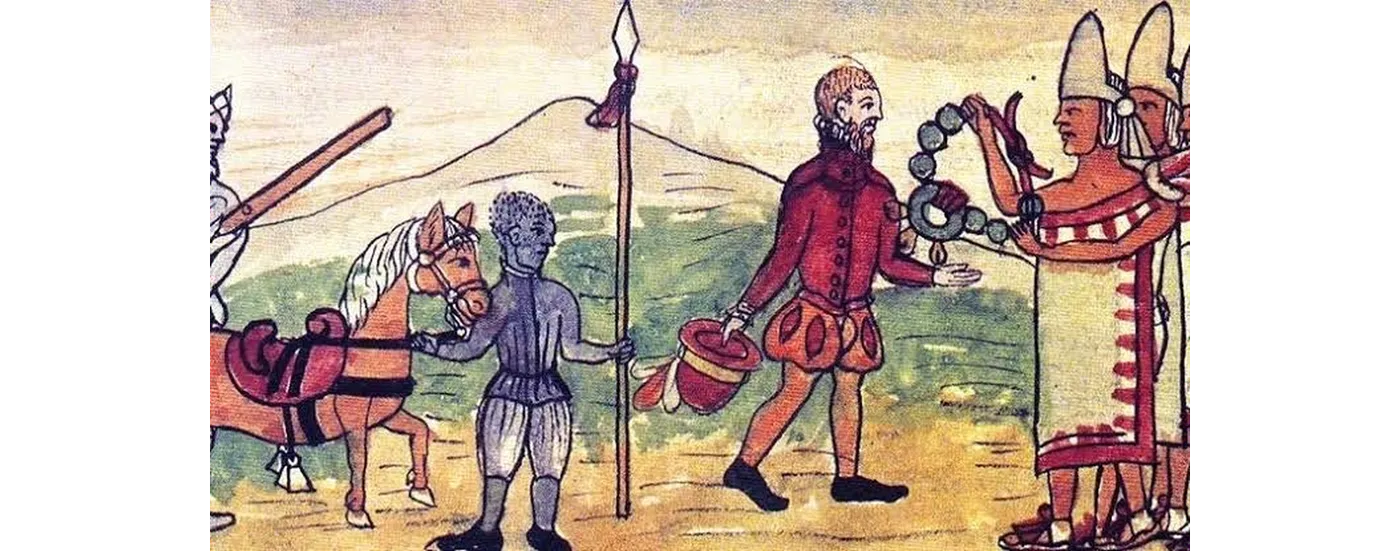
This image visually places Garrido within the context of Spanish exploration, reinforcing his documented role as the first known African to arrive in North America. Seeing him depicted as part of an expedition helps underscore just how directly Africans were involved in the exploration and colonization of the Americas from the very beginning, not as a later addition to the story, but present at its earliest chapters.