

4.1 - The Négritude and Negrismo Movements
Two Movements, One Shared Spirit
In the early to mid-twentieth century, two related movements emerged that affirmed the influence of African heritage and cultural aesthetics among Afro-descendants across the diaspora: Négritude and Negrismo. These movements reinforced one another, and both drew direct influence from the New Negro movement happening simultaneously in the United States.
All three movements, the New Negro movement, Négritude, and Negrismo, shared a core emphasis on cultural pride and the political liberation of Black people. That said, they didn't all envision Blackness or Africa in exactly the same way, each was shaped by its own distinct national, linguistic, and colonial context.
Négritude, meaning "Blackness" in French, was a political, cultural, and literary movement that ran from the 1930s through the 1950s. It began with French-speaking Caribbean and African writers who were directly protesting colonialism and the pressure placed on Black people to assimilate into European culture rather than embrace their own heritage.
The movement's founders met as students in Paris in the 1930s: Aimé Césaire from Martinique, Léopold Sédar Senghor from Senegal, and Léon-Gontran Damas from French Guiana. In 1935 they helped launch the journal L'Étudiant noir (The Black Student), and Césaire is credited with coining the word Négritude, which appears in his long poem Notebook of a Return to the Native Land (1939). Instead of trying to prove they could be fully "French," these writers treated African history, culture, and identity as something to be proud of.
Notably, Négritude took shape largely in Paris, which had become a genuine diasporic hub, home to African American jazz performers, artists, war veterans, and intellectuals from both Africa and the Caribbean all converging in the same city. Afro-descended figures who spent significant time in Paris during this movement included Josephine Baker, Claude McKay, Anna Julia Cooper, Augusta Savage, Countee Cullen, Alain Locke, Langston Hughes, and Nella Larsen, a remarkable overlap between the American Harlem Renaissance and the emerging Négritude movement happening across the Atlantic. Like the New Negro movement itself, both Négritude and Negrismo first took root among educated elites before spreading more broadly.
Langston Hughes played a particularly important connective role across all three movements, translating literary works from French and Spanish into English, and from English into French and Spanish, effectively acting as a bridge that let these parallel movements read and respond to one another directly.
Negrismo emerged around the same time, but in the Spanish-speaking Caribbean. It was embraced by Black and mixed-race Latin Americans and celebrated African contributions specifically within Latin American music, folklore, literature, and art, adapting the broader spirit of Négritude to a distinctly Spanish-speaking Caribbean context.
One of the leading Negrismo voices was Cuban poet Nicolás Guillén. His book Motivos de son (1930) brought the rhythms and everyday speech of Afro-Cuban son music into poetry, treating Black Cuban culture as central to Cuban identity instead of something to hide.
Critiquing Colonialism
Proponents of Négritude and Negrismo, figures like Aimé Césaire from Martinique, firmly rejected the colonial narrative that European rule had somehow "civilized" the people it colonized. Instead, they argued that racial ideology was the real foundation underlying colonial exploitation, violent intervention, and systems of coerced labor, stripping away the moral justification colonial powers used to defend their actions.
This critique resonated strongly with African American writers and activists too. People like Jessie Redmon Fauset, editor of the NAACP's journal The Crisis, saw clear connections between Négritude and Negrismo's anti-colonial arguments and their own critique of global capitalism and racism back home, condemning racism and colonialism as two deeply interrelated systems, both working to dehumanize people of African descent, whether in the Caribbean, Africa, or the United States.
Required Sources
Les Fétiches by Loïs Mailou Jones, 1938
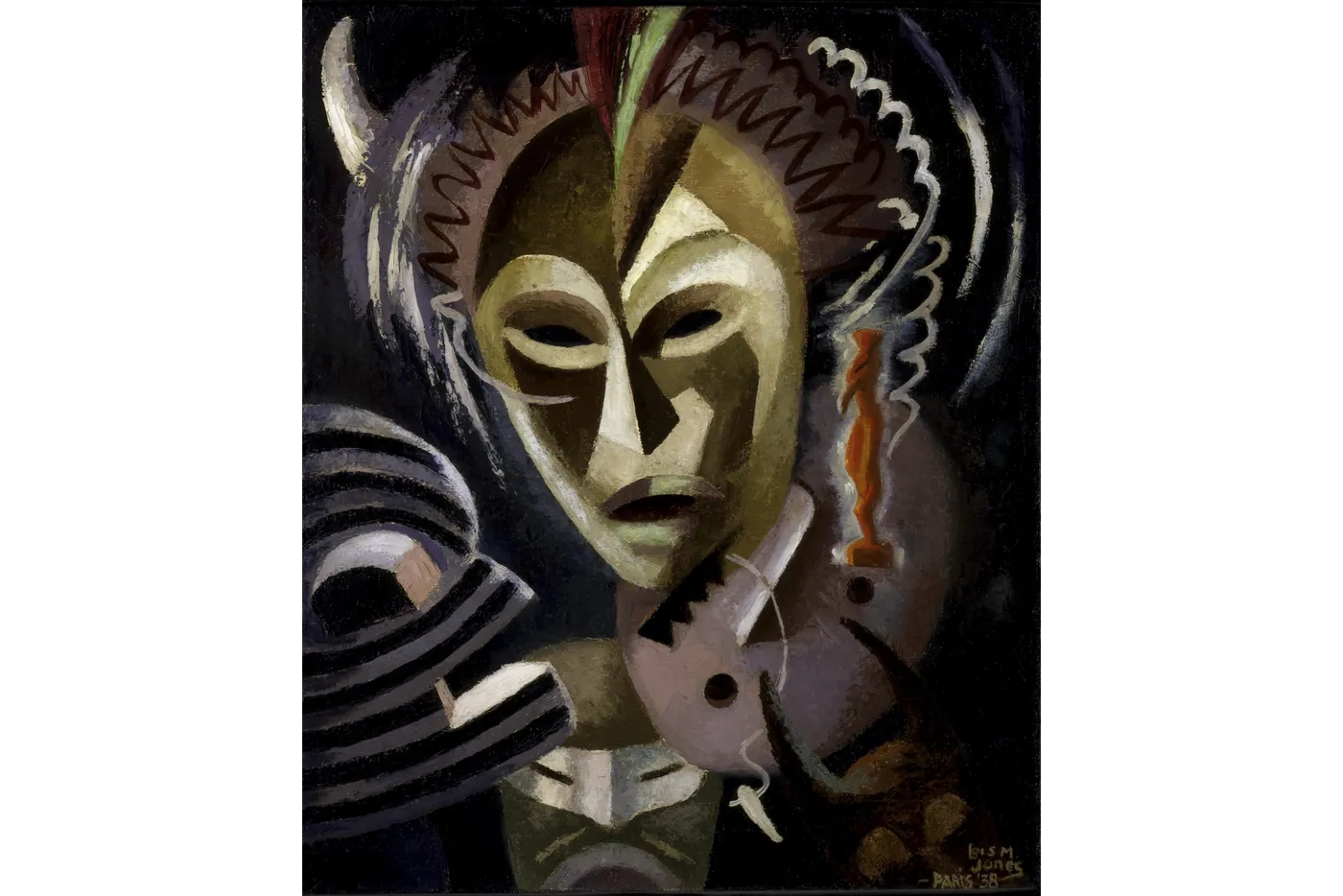
Loïs Mailou Jones began her long career during the Harlem Renaissance, working as an illustrator for some of the earliest Black history magazines published by W.E.B. Du Bois and Carter G. Woodson. She created Les Fétiches while living in Paris, directly inspired by the Négritude movement she encountered there. The painting conveys strength, beauty, and protection rooted in African ancestral heritage, featuring five overlapping masks drawn from different African communities alongside a red religious fetish figure. Her personal path, from the Harlem Renaissance to Paris and into Négritude, embodies exactly the kind of cross-movement connection described above.
The Jungle (La Jungla) by Wifredo Lam, 1943
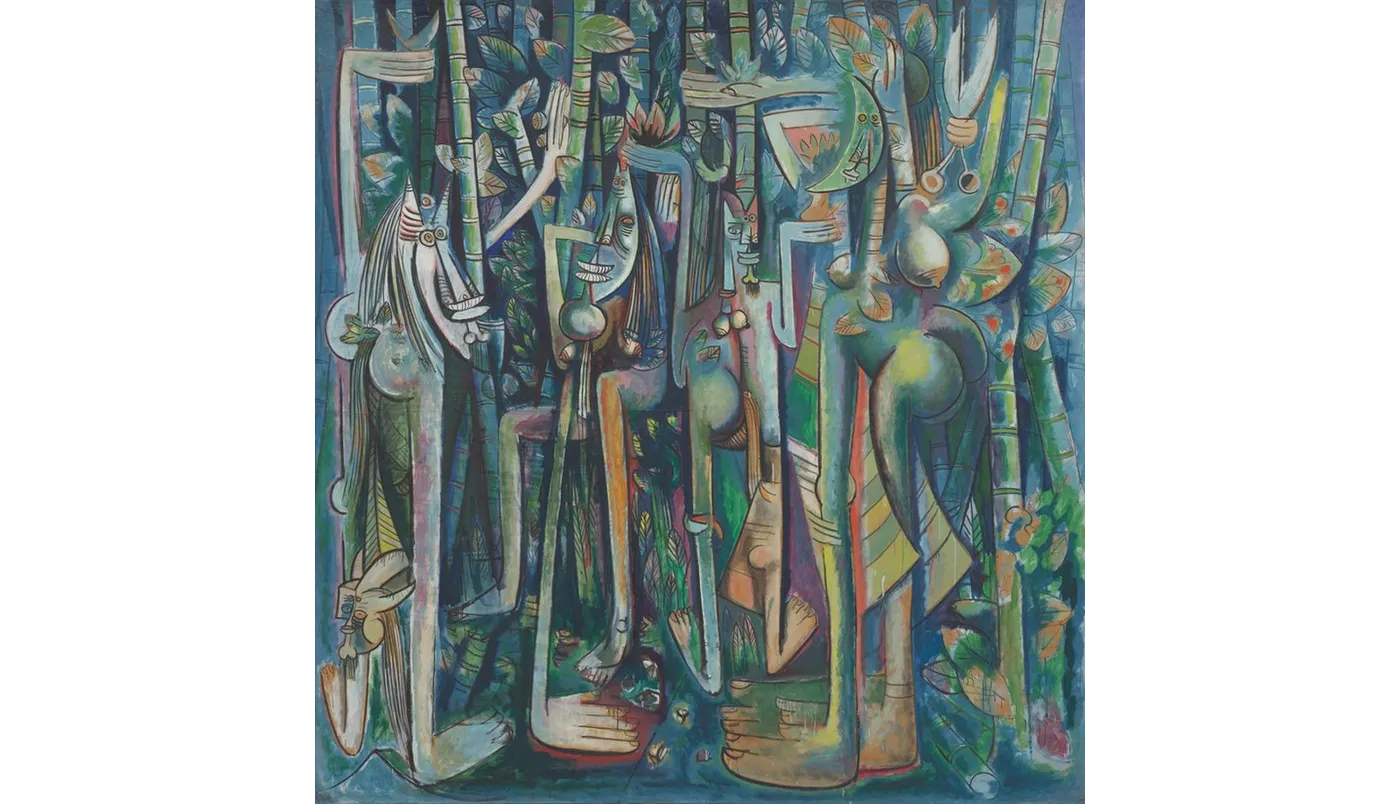
Wifredo Lam, an Afro-Cuban artist who also had Chinese heritage, was one of the leading figures of the Negrismo period. The Jungle reflects on the enduring legacies of slavery and colonialism in Cuba, featuring faces that draw on West and Central African art motifs, particularly mask imagery, set within a sugarcane field, a setting deeply tied to the history of forced labor in the Caribbean. The painting captures Negrismo's core project: reclaiming African aesthetic influence within a distinctly Latin American, and specifically Cuban, artistic context.
Excerpt from Discourse on Colonialism by Aimé Césaire, 1955
Aimé Césaire was a poet and politician from Martinique and one of the founders of Négritude. Discourse on Colonialism is a short, furious essay he first published in 1950 and reissued in a revised edition in 1955. In it he attacks the claim that colonialism brought "civilization" to Africa, Asia, and the Caribbean. He argues that the real relationship between colonizer and colonized was built on forced labor, intimidation, police, taxes, theft, and contempt, and he sums it up in one equation: colonization = "thingification" (colonized people are treated as objects, not humans). He also argues that colonialism degrades the colonizers themselves, and that Europe tolerated these methods for centuries, only condemning them as crimes when Hitler used them against white Europeans. The excerpt shows a Négritude thinker arguing that racist ideas, not a "civilizing mission," drove colonial exploitation and coerced labor, the same link between racism and colonialism that Jessie Redmon Fauset and other African American writers made.
Aimé Césaire, Discourse on Colonialism, translated by Joan Pinkham (New York: Monthly Review Press, 1972; first published in French in 1950, revised edition 1955)
My turn to state an equation: colonization = "thingification."
Césaire, a poet and politician from Martinique, wrote this essay to answer Europe's claim that colonialism brought civilization to Africa, Asia, and the Caribbean. He argues the opposite: colonial rule ran on forced labor, violence, theft, and contempt, it treated colonized people as objects, and it corrupted the colonizers too. The CED includes it as a key text of Négritude, tying Black pride to a direct attack on colonial rule.
Aimé Césaire, Discourse on Colonialism (1955), translated by Joan Pinkham. Source: Monthly Review Press