

1.1 - Introducing Calculus: Can Change Occur at an Instant?
The Origins of Calculus
Two mathematicians are credited with developing calculus independently during the 17th century.
Isaac Newton (England, born 1643)
- Developed calculus methods while studying physics and motion
Gottfried Leibniz (Germany, born 1646)
- Developed similar concepts around the same time
- Much of our modern notation comes from Leibniz
The controversy over who “invented” calculus first still goes on today. Most historians think both developed these ideas at the same time, since math had reached a point where calculus was the natural next step.
The Central Question of Calculus
Can change occur at an instant?
Can we measure how fast something is changing at an exact moment in time, not just over an interval? This question drives everything we study in calculus.
Average Rate of Change
The average rate of change measures how a quantity changes over an interval.
This is just the slope between two points on a curve.
Example: Running a race
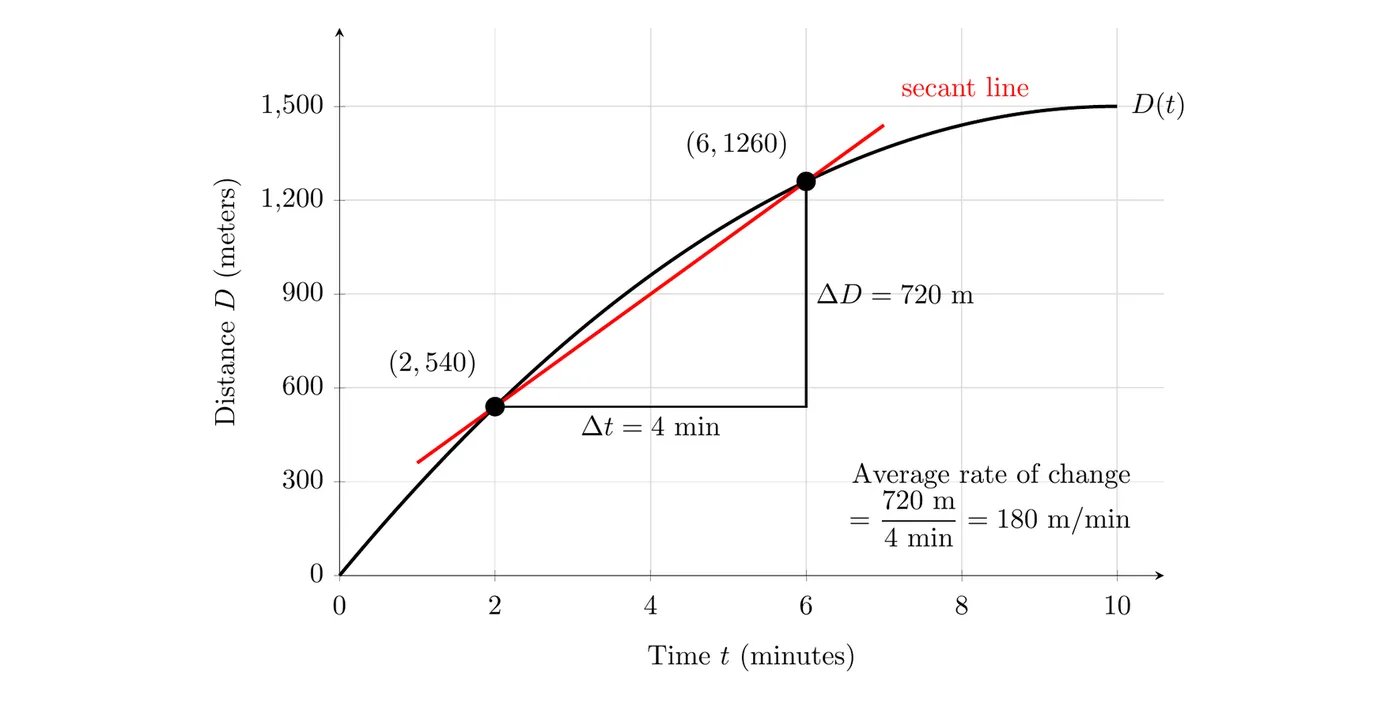
A runner’s distance from the starting line is tracked over time. At minutes, the runner is at meters. At minutes, the runner is at meters.
Average speed for the entire run:
The word “per” always signals a rate of change (miles per hour, dollars per item, and so on).
Secant Lines
When we connect two points on a curve, we get a secant line. The slope of that secant line equals the average rate of change between those two points.
Practice setup
For a function representing height over time:
Average rate of change from to :
Average rate of change from to :
Notice we don’t need to actually compute the answer. Setting up the fraction correctly is what shows you understand the concept.
Instantaneous Rate of Change
Average rate of change tells us what happens over an interval. Instantaneous rate of change tells us what’s happening at a single moment. This is the idea that separates calculus from algebra.
Approximating it
To estimate the instantaneous rate of change at , we can take the average rate of change over a very small interval near :
The smaller the interval, the better the approximation. When the two points are incredibly close together (like 2.9999 and 3), the secant line becomes nearly indistinguishable from the tangent line.
Why not shrink the interval all the way to zero?
If we try to use the same point twice (), the average rate of change turns into
which is undefined. The average rate of change divides by the change in the input, so it only works when that change isn’t zero. One point by itself can’t give us a slope.
Limits fix this. Instead of plugging in , we look at the value the average rates of change approach as gets closer and closer to :
That’s how calculus answers the central question: it uses limits to describe change at an instant. Most of Unit 1 is about how limits work, and in Unit 2 this exact limit becomes the derivative.
Tangent Lines
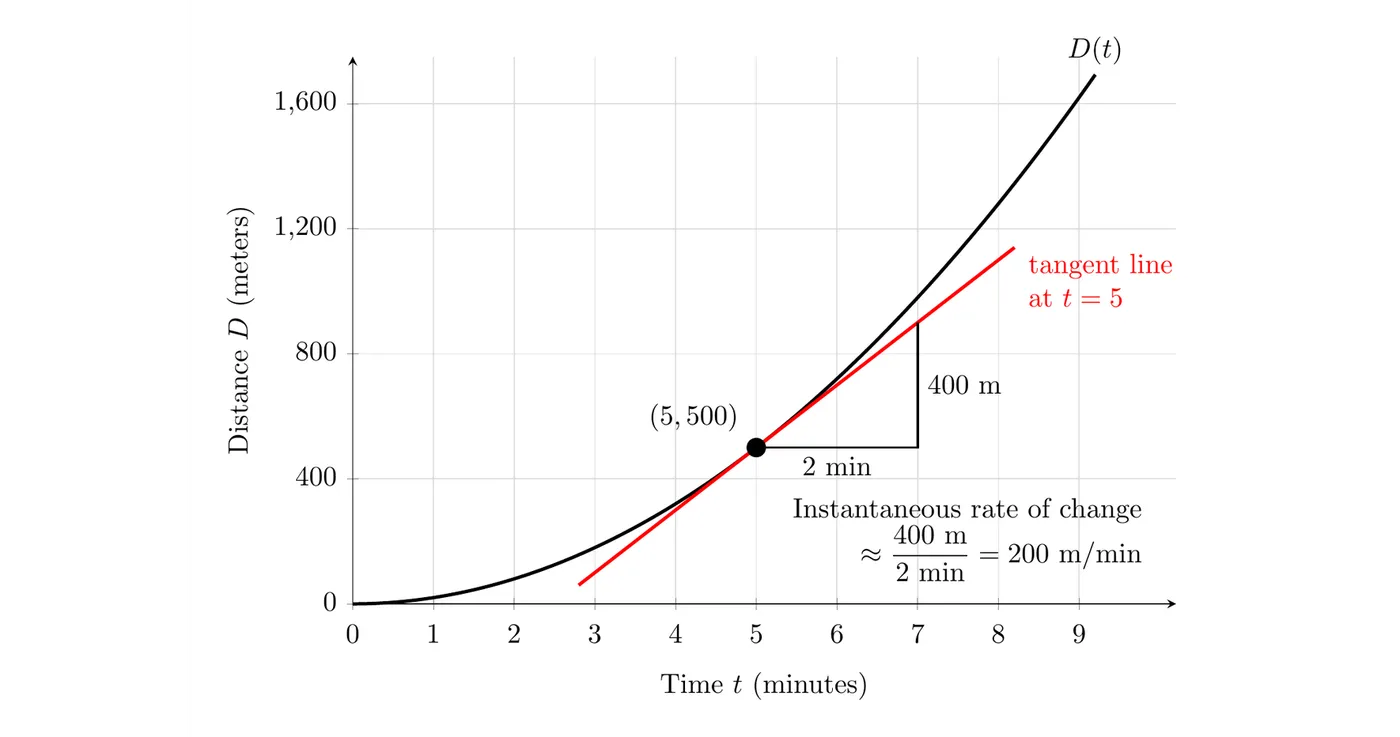
A tangent line touches a curve at exactly one point (locally). The slope of the tangent line at a point equals the instantaneous rate of change at that point.
Example: estimating from a graph
Given a distance vs. time graph, estimate the instantaneous rate of change at minutes:
- Draw the tangent line at the point where
- Find the slope of that tangent line using rise over run
- Include the right units
Suppose the tangent line rises 400 meters when we move 2 minutes to the right:
That approximation represents the speed at exactly minutes.
Function Notation in Context
In real world problems, functions represent meaningful quantities.
Example: deer population
Let represent the deer population in a state forest, where is years since 1900.
- is the deer population in the year 1975.
- is the change in deer population from 1940 to 1960 (could be positive or negative).
- is the average rate of change of the deer population per year from 1940 to 1960.
- is an estimate of the instantaneous rate of change in 1950. Since the interval is only one year, it gives a decent approximation of how quickly the population was changing that year.
- is an even better estimate of the instantaneous rate of change in 1950. The tiny interval makes this nearly equal to the true instantaneous rate.
Average vs. Instantaneous
Average Rate of Change | Instantaneous Rate of Change |
Over an interval | At a specific point |
Slope of a secant line | Slope of a tangent line |
where | Limit as the interval shrinks to zero |
Easy to calculate | Requires calculus (coming soon) |
Key Takeaways
- Average rate of change: measures change over an interval
- The slope of a secant line equals the average rate of change between two points
- Instantaneous rate of change measures how fast something is changing at an exact moment
- The slope of a tangent line equals the instantaneous rate of change at a point
- Using a very small interval gives a good approximation of the instantaneous rate of change
- An interval of zero gives (undefined), so calculus uses a limit of average rates of change to get the instantaneous rate of change
- The word “per” signals a rate of change (velocity, cost per item, population per year)
- Newton and Leibniz both developed calculus independently around 1670