

1.14 - Connecting Infinite Limits and Vertical Asymptotes
Introduction
Earlier we identified vertical asymptotes as non-removable discontinuities that happen when a denominator equals zero and the factor doesn’t cancel. Now we’ll figure out the behavior near those asymptotes: does the function head toward positive or negative infinity?
Identifying Vertical Asymptotes
Definition Using Limits
The line is a vertical asymptote of if goes to or as approaches from at least one side:
This works for any function, not just fractions:
- has a vertical asymptote at , since . There’s no left side here (the log isn’t defined for ), and one side is enough.
- has a vertical asymptote at , since and .
For rational functions, the factoring steps below find these quickly.
Review: How to Find Them
Step 1: Factor both the numerator and denominator completely
Step 2: Cancel any common factors (those create holes, not asymptotes)
Step 3: Set the remaining denominator factors equal to zero and solve
Those -values are your vertical asymptotes.
Example 1: Basic Identification
Find all vertical asymptotes:
Factor the numerator:
Factor the denominator:
Factored form:
The factor cancels, so there’s a hole at .
The factor doesn’t cancel, so there’s a vertical asymptote at .
Answer: vertical asymptote at
Understanding Behavior Near Vertical Asymptotes
Near a vertical asymptote, the function shoots off toward infinity. The question is which direction.
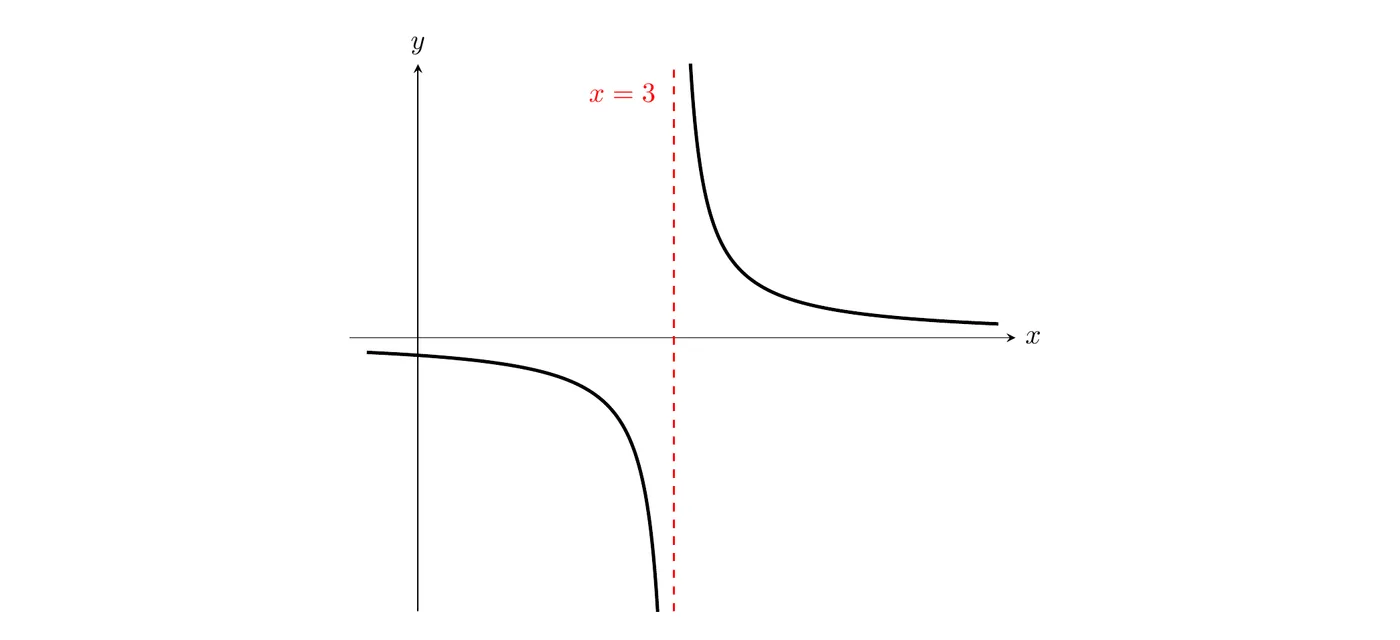
For this graph at :
- From the left:
- From the right:
Two-sided limit:
Since the one-sided limits differ, the two-sided limit doesn’t exist.
Determining Infinite Limits Without a Graph
To find out whether a function heads toward or near a vertical asymptote, plug in values very close to the asymptote and look at the signs.
Strategy
- Identify the vertical asymptote (where the denominator is zero)
- Choose a test value extremely close to it
- Evaluate to see whether the result is positive or negative
- Determine the direction: positive means , negative means
Example 2: Right-Hand Limit
Find .
Vertical asymptote: (denominator is zero, nothing cancels)
Approaching from the right means using values slightly greater than 5. Choose :
- Numerator: (positive)
- Denominator: (positive, very small)
- Result: , a very large positive number
Answer:
Example 3: Left-Hand Limit
Find .
Approaching from the left means using values slightly less than 5. Choose :
- Numerator: (positive)
- Denominator: (negative, very small in absolute value)
- Result: , a very large negative number
Answer:
Example 4: When Both Sides Match
Find .
Vertical asymptote: . Notice the denominator is squared.
From the right (): choose :
- Numerator: (positive)
- Denominator: (positive, extremely small)
- Result:
From the left (): choose :
- Numerator: (positive)
- Denominator: (positive, because it’s squared)
- Result:
Two-sided limit: since both one-sided limits equal
Key insight: when the denominator is squared (or raised to any even power), it’s always positive no matter which side you come from. That often means both sides go to the same infinity.
About the notation: writing doesn’t mean the limit exists. Infinity isn’t a real number, so the limit still does not exist. The just describes how it fails: the function grows without bound from both sides. (This is the “unbounded” case from 1.3.)
Working with Factored Forms
When the function is already factored, the analysis gets easier.
Example 5: Complete Analysis
Find all one-sided limits at the vertical asymptotes of
Identify the vertical asymptote: the denominator is zero when , and nothing cancels, so there’s a vertical asymptote at .
Find : substitute :
- Numerator: negative
- Denominator: positive (squared)
- Result: negative
Answer:
Find : substitute :
- Numerator: negative
- Denominator: positive (squared)
- Result: negative
Answer:
Two-sided limit: since both sides approach
Summary: The Sign Analysis Method
Instead of computing exact decimals, you can just analyze the signs directly.
Quick Method
- Factor completely
- For each factor, decide whether it’s positive or negative near the asymptote
- Combine the signs to get the overall sign
- Tiny denominator plus non-zero numerator means infinity
Example 6: Sign Analysis
Find .
As (approaching from the left, so is slightly less than 3, like ):
Numerator factors:
- : when , this is , so positive
- : when , this is , so negative
- Product: (positive)(negative) = negative
Denominator:
- : when is slightly less than 3, this is negative (like ), so negative
Overall:
A tiny denominator means a huge magnitude.
Answer:
Practice Problems
Problem 1
Find .
Answer:
Numerator at : positive
Denominator as : positive (approaching from the right)
Result:
Problem 2
Find .
Answer:
Numerator: positive (constant)
Denominator: positive (squared, so always positive)
Result:
Problem 3
Find .
Answer:
From both sides, the denominator is positive (squared) and the numerator is negative.
Both sides give , so
Key Takeaways
- Vertical asymptotes happen where the denominator is zero and the factors don’t cancel
- Using limits: is a vertical asymptote if as from at least one side. This works for any function, like at
- Near asymptotes, functions approach or
- To figure out which, substitute values very close to the asymptote
- Sign analysis: if the result is positive you get , if negative you get
- Even powers (like squared terms) are always positive
- If both one-sided limits equal the same infinity, the two-sided limit equals that infinity
- Writing or describes unbounded behavior. The limit still doesn’t exist as a real number
- If the one-sided limits differ, the two-sided limit does not exist (DNE)
- Positive numerator over tiny positive denominator gives
- Positive numerator over tiny negative denominator gives
- Negative numerator over tiny positive denominator gives
- Negative numerator over tiny negative denominator gives
- Work with factored forms when you can, since it makes sign analysis simpler