

1.15 - Connecting Limits at Infinity and Horizontal Asymptotes
Introduction to Horizontal Asymptotes
A horizontal asymptote describes the end behavior of a function, meaning what happens to the -values as heads toward positive or negative infinity.
Key Difference from Vertical Asymptotes
Horizontal asymptotes:
- Describe behavior as
- The graph CAN cross the asymptote
- Represent the value the function approaches in the long run
Vertical asymptotes:
- Occur at specific -values where the function is undefined
- The graph CANNOT cross the asymptote
- The function approaches near the asymptote
Visual Understanding
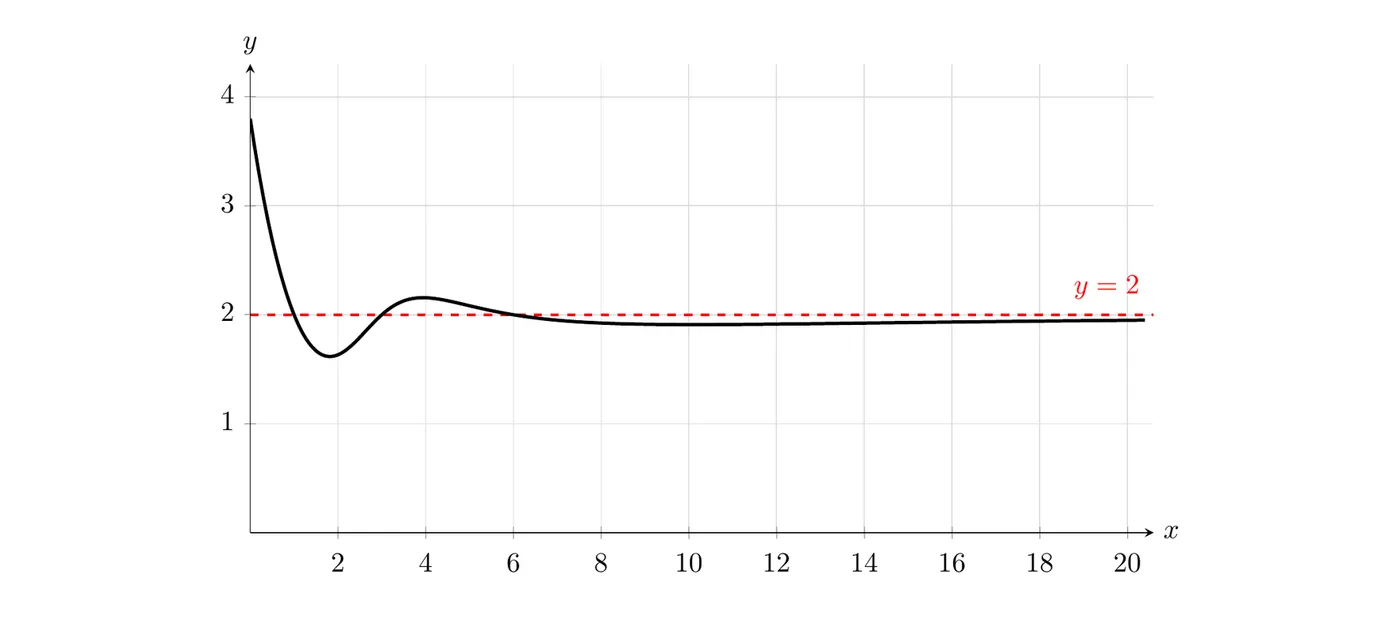
As , the function approaches . Notice the graph crosses the asymptote several times, which is totally allowed for horizontal asymptotes.
Limit Notation for End Behavior
Horizontal asymptotes get written with limits.
Right-end behavior (as goes to positive infinity):
Left-end behavior (as goes to negative infinity):
If either limit equals a finite number , then is a horizontal asymptote.
Growth Rates of Functions
To find horizontal asymptotes of rational functions, you need to know which types of functions grow fastest.
Ranking by Growth Rate (Fastest to Slowest)
Think about very large values of , like .
1. Exponential functions (fastest)
- Examples: , ,
- Growth: extremely rapid
2. Polynomial functions (moderate)
- Examples: , ,
- Growth: depends on the degree (higher degree means faster)
3. Logarithmic functions (slowest)
- Examples: ,
- Growth: very slow, but it never levels off. keeps growing without bound, so it has no horizontal asymptote
Comparison Table
10 | 2.3 | 100 | 1024 | |
100 | 4.6 | 10,000 |
Key insight: for large , exponential functions dominate everything else.
Comparing Growth with Limits
To compare how fast two functions grow, take the limit of their ratio as :
- If , then grows faster than
- If , then grows slower than
- If is a positive number, they grow at the same rate
For example:
- , so grows faster than
- , so grows faster than
- , so and grow at the same rate
The rules below for rational functions are this same comparison: the limit at infinity depends on whether the numerator or the denominator grows faster. (L’Hospital’s Rule in Unit 4 gives a way to prove limits like .)
Rules for Horizontal Asymptotes of Rational Functions
For rational functions :
Rule 1: Denominator Grows Faster
If the denominator grows faster than the numerator:
Horizontal asymptote:
Intuition: a small number divided by a huge number approaches zero.
Rule 2: Same Growth Rate
If the numerator and denominator grow at the same rate:
Intuition: the ratio of the leading terms sets the asymptote.
Rule 3: Numerator Grows Faster
If the numerator grows faster than the denominator:
No horizontal asymptote (the function grows without bound).
Finding Horizontal Asymptotes: Examples
Example 1: Denominator Grows Faster
Find .
Dominant terms:
- Numerator: (degree 1)
- Denominator: (degree 2)
The denominator () grows faster than the numerator (), so by Rule 1:
Answer: horizontal asymptote at
Example 2: Same Growth Rate
Find .
Dominant terms:
- Numerator: (degree 1)
- Denominator: (degree 1)
Both are degree 1, so they have the same growth rate. By Rule 2, look only at the leading coefficients:
Answer: horizontal asymptote at
Note: the constants and don’t matter for end behavior.
Example 3: Higher Degree Polynomials
Find .
Focus only on the highest degree terms:
Answer: horizontal asymptote at
Example 4: Numerator Grows Faster
Find .
Compare degrees:
- Numerator: degree 3
- Denominator: degree 1
The numerator grows faster, so as gets large, the numerator becomes much bigger than the denominator.
Answer: no horizontal asymptote (the function grows without bound)
Square Roots and Radicals
With square roots, you have to be careful about the sign of the result.
Example 5: Square Root in the Numerator
Find .
Simplify the square root for large positive :
Evaluate:
Answer:
Example 6: Negative Infinity with a Square Root
Find .
Critical distinction: when
The absolute value makes this positive, but since is negative, we write it as (which is positive).
Evaluate:
Answer:
Important: this function has TWO different horizontal asymptotes.
- As :
- As :
Example 7: Even Power Under a Radical
Find the horizontal asymptotes of
Simplify the radical:
Note that , which is always positive because it’s an even power.
As :
As : since is always positive (even power),
Answer: only one horizontal asymptote, , in both directions.
Exponential Functions and Limits at Infinity
Example 8: Exponential in the Numerator
Find .
Exponential functions grow much faster than any polynomial, so
Answer: no horizontal asymptote
Example 9: Exponential with a Negative Exponent
Find .
Rewrite with a positive exponent:
As , , so
Answer:
Example 10: Exponential with a Fraction
Find .
Step 1: Evaluate the exponent. As , .
Step 2: Evaluate to that power: .
Step 3: Multiply by the coefficient: .
Answer:
Trigonometric Functions and Limits at Infinity
Special Trig Limit (Review)
This ONLY works when .
Example 11: Sine Over a Large Number
Find .
Common mistake: thinking this equals 1. It doesn’t. That result only applies when .
Correct reasoning:
- Numerator: oscillates between and (bounded)
- Denominator: (unbounded)
Answer:
Example 12: Cosine of a Small Value
Find .
Step 1: As , .
Step 2: Evaluate cosine: .
Step 3: Multiply: .
Answer:
Example 13: Unbounded Oscillation
Find .
The sine function oscillates between and forever and never settles on a single value.
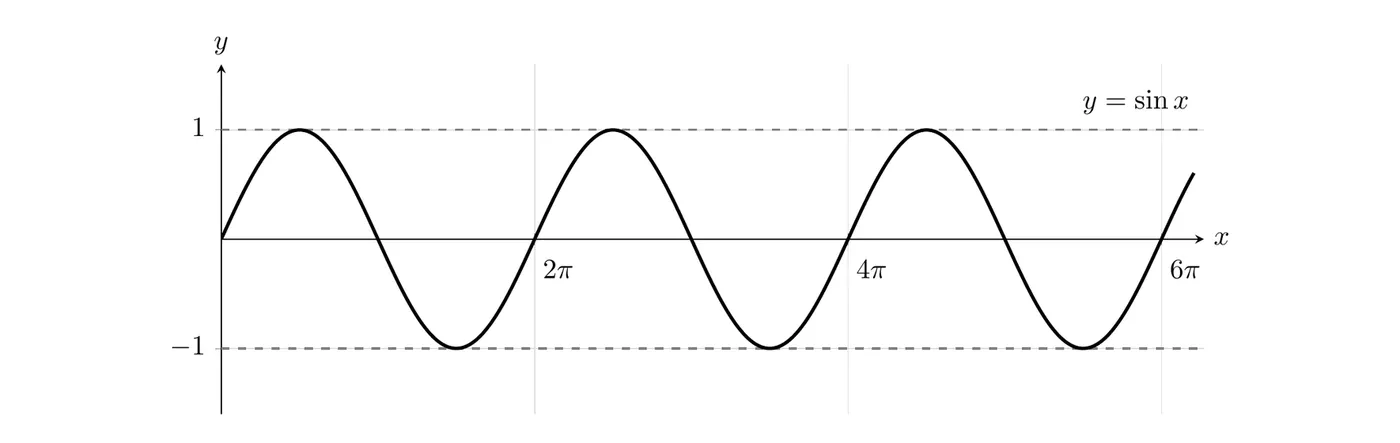
Answer: does not exist (DNE), because the function oscillates without approaching a specific value.
Example 14: Growing Oscillation
Find .
While oscillates between and , the factor grows without bound. The product oscillates with increasing amplitude:
- Sometimes near (when )
- Sometimes near (when )
The oscillation just gets bigger and bigger.
Answer: does not exist (DNE), because it oscillates with unbounded amplitude.
Practice Problems
Problem 1
Find .
Answer: same degree (both ), so the limit is .
Problem 2
Find .
Answer: the denominator grows faster, so the limit is .
Problem 3
Find .
Answer: for , so the result is .
Problem 4
Find .
Answer: for , so the result is .
Problem 5
Find .
Answer: bounded numerator over unbounded denominator, so the limit is .
Key Takeaways
- Horizontal asymptotes describe end behavior as
- Graphs can cross horizontal asymptotes, unlike vertical ones
- Growth rate hierarchy: exponential beats polynomial beats logarithmic
- Compare growth with a limit: if , grows faster; if it’s , grows faster
- For rational functions, compare the degrees of the numerator and denominator
- Only the highest degree terms matter for end behavior
- With square roots, , which equals if and if
- Even powers under radicals are always positive:
- only works for , not
- as (bounded over unbounded)
- Unbounded trig oscillations mean the limit does not exist
- A function can have different horizontal asymptotes on the left and right
- Exponentials with negative exponents approach zero: as