

1.13 - Removing Discontinuities
Introduction
We’ve covered the different types of discontinuities. Now we’ll focus on removable discontinuities (holes) and how to remove them so the function becomes continuous.
Key idea: removing a discontinuity means filling in the hole with the right function value, which makes the function continuous at that point.
What is a Removable Discontinuity?
A removable discontinuity (hole) happens when
or when is undefined entirely.
In plain terms: the function approaches a specific value from both sides, but either there’s an open circle (hole) at that point, or the function is defined at a different value than where the limit is pointing.
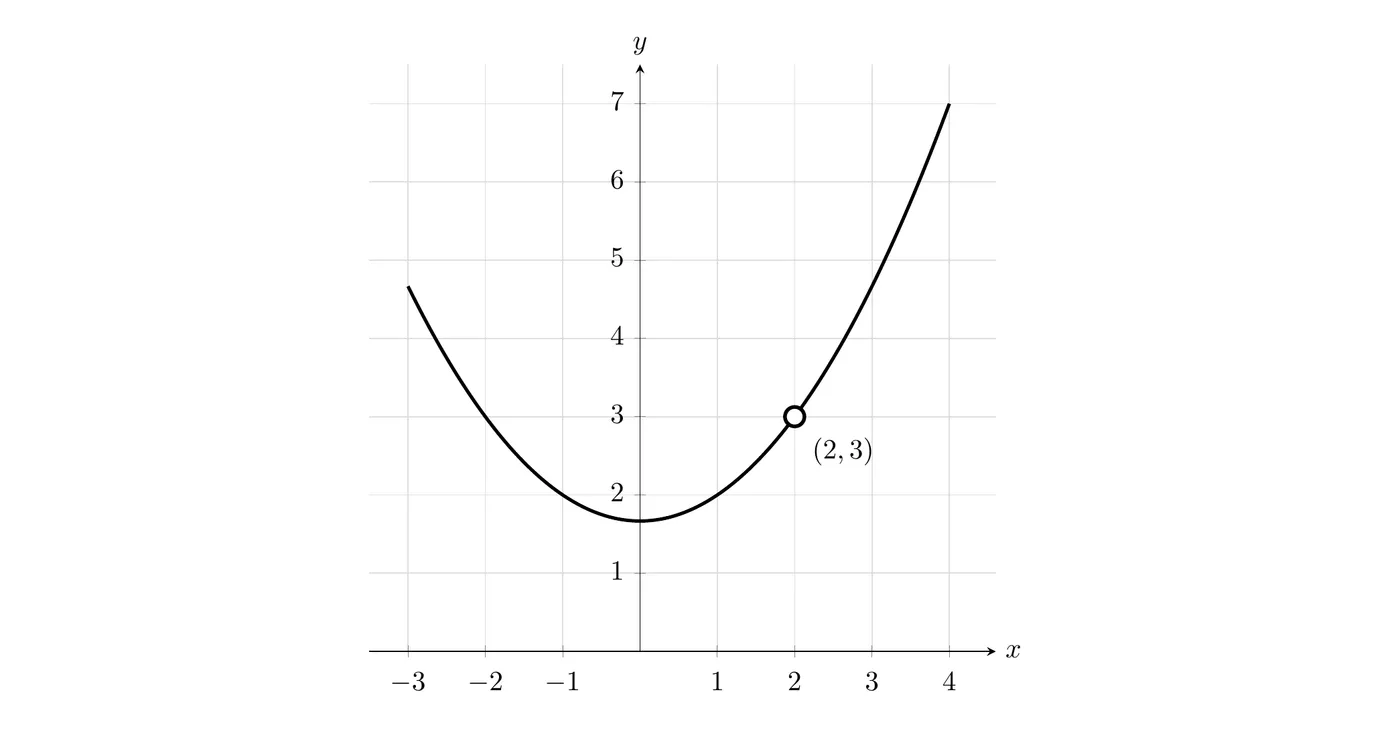
This discontinuity can be removed by defining , which fills in the hole.
Finding the Hole Coordinates
To remove a discontinuity, you need the coordinates of the hole.
Step 1: Find the -value of the hole.
- Factor the function completely
- Identify which factor cancels (that’s what creates the hole)
- Set that factor equal to zero and solve for
Step 2: Find the -value of the hole.
- Take the limit as approaches the hole’s -value
- That limit is the -coordinate of the hole
Step 3: State how to remove the discontinuity.
- Define the function at that point: the limit value
Example 1: Basic Hole
Find the coordinates of the removable discontinuity and state how to remove it:
Step 1: Find the -value of the hole
Factor the numerator:
The factor cancels, which creates a hole. Set the canceled factor equal to zero:
Step 2: Find the -value of the hole
After canceling:
Take the limit:
Step 3: State the hole coordinates
The hole is at the point .
How to remove it: define . That fills in the hole and makes the function continuous.
Example 2: Difference of Squares
Find the removable discontinuity and how to remove it:
Factor the numerator (difference of squares):
Find the -value: the factor cancels, so
Find the -value: after canceling, , so
Answer: hole at . To remove the discontinuity, define .
Example 3: Given That the Function is Continuous
The function is continuous for all real numbers. For
Find .
Since we’re told is continuous, there has to be a value at that fills in what would otherwise be a hole.
Factor the numerator:
Cancel the common factor:
Find the limit:
Since is continuous, .
Answer:
Explanation: for the function to be continuous, the value at has to equal the limit as approaches 3. That’s what removes the discontinuity.
Example 4: Piecewise Function with an Unknown Constant
The function is continuous for all real numbers, where
Find the value of .
For to be continuous at , the value has to equal the limit as approaches 2.
Factor:
Cancel:
Find the limit:
For continuity, .
Answer:
Verification: when , the function value at matches the limit, so is continuous.
Example 5: Piecewise with Two Pieces
The function is continuous everywhere, where
Find the value of that makes continuous.
Step 1: Simplify the first piece.
Step 2: For continuity at , the two pieces have to meet:
Step 3: Evaluate.
Answer:
This makes , which matches the limit, so is continuous.
Example 6: Multiple Factors
Find all removable discontinuities and state their coordinates:
Identify the canceling factor: shows up in both the numerator and denominator, so it cancels.
-value of the hole:
Simplified function:
-value of the hole:
Answer: removable discontinuity (hole) at .
Note: there’s also a vertical asymptote at (non-removable), but that isn’t a hole.
Example 7: Different Expressions on Each Side
When a piecewise function uses a different expression on each side of a boundary, three values have to match for continuity there: the left expression’s value at the boundary, the right expression’s value at the boundary, and the function’s actual value at the boundary.
Find the value of that makes continuous at :
Step 1: Left-hand limit (first piece):
Step 2: Right-hand limit and function value (second piece, since satisfies ):
Step 3: Set the two sides equal and solve:
Answer:
Verification: with , the left piece gives , the right piece gives , and . All three match.
When a Discontinuity Can’t Be Removed
Redefining one point only works when the limit exists. If the limit doesn’t exist, no choice of can fix it:
- Jump: the one-sided limits are different, so no single value matches both. For example, for and for approaches from the left and from the right.
- Vertical asymptote: the function is unbounded, so there’s no finite value to fill in. For example, at .
These are the non-removable discontinuities.
Practice Problems
Problem 1
Find the coordinates of the hole:
Answer:
Factor:
Hole at . Limit: .
Hole at
Problem 2
The function is continuous. For
Find .
Answer:
Factor:
Problem 3
Find so that is continuous:
Answer:
Factor:
Key Takeaways
- A removable discontinuity is a hole you can fill in to make the function continuous
- To find the -coordinate of a hole, identify and solve the canceling factor
- To find the -coordinate of a hole, evaluate the limit after canceling
- To remove the discontinuity, define the function value to equal the limit
- When you’re told a function “is continuous,” the function value has to equal the limit at any potential hole
- For piecewise functions, the value at the boundary has to equal the limit from the continuous piece
- When the pieces use different expressions, set the left expression equal to the right expression at the boundary (and make sure matches too)
- Canceling factors create holes. Factors that don’t cancel create vertical asymptotes (non-removable)
- Jumps and vertical asymptotes can’t be removed, because the limit doesn’t exist
- The notation “ for ” is a signal that there’s probably a hole at
- Always factor completely before identifying holes
- After finding the hole coordinates, state “define ,” where is the limit value