

1.2 - Defining Limits and Using Limit Notation
1.2 Defining Limits and Using Limit Notation
Understanding Limits
A limit describes what value a function approaches as the input approaches a particular number. The key idea: we care about where the function is heading, not necessarily where it actually is.
Formal Notation
This reads: “the limit of as approaches equals .”
What it means: as values get closer and closer to (from both the left and the right), the values get closer and closer to .
Two details make this precise:
- gets close to but never equals . The limit only looks at inputs near , so the value , or whether it even exists, has no effect on the limit. That’s why all three scenarios below have the same limit.
- The limit has to be a single real number. means we can make as close to as we want just by taking close enough to . If no single real number works, the limit does not exist.
Not on the exam: the formal epsilon-delta definition of a limit (the exact, symbol-heavy version of “as close as we want”) isn’t tested on the AP Calculus AB or BC exam.
Three Key Scenarios
Scenario 1: limit equals the function value
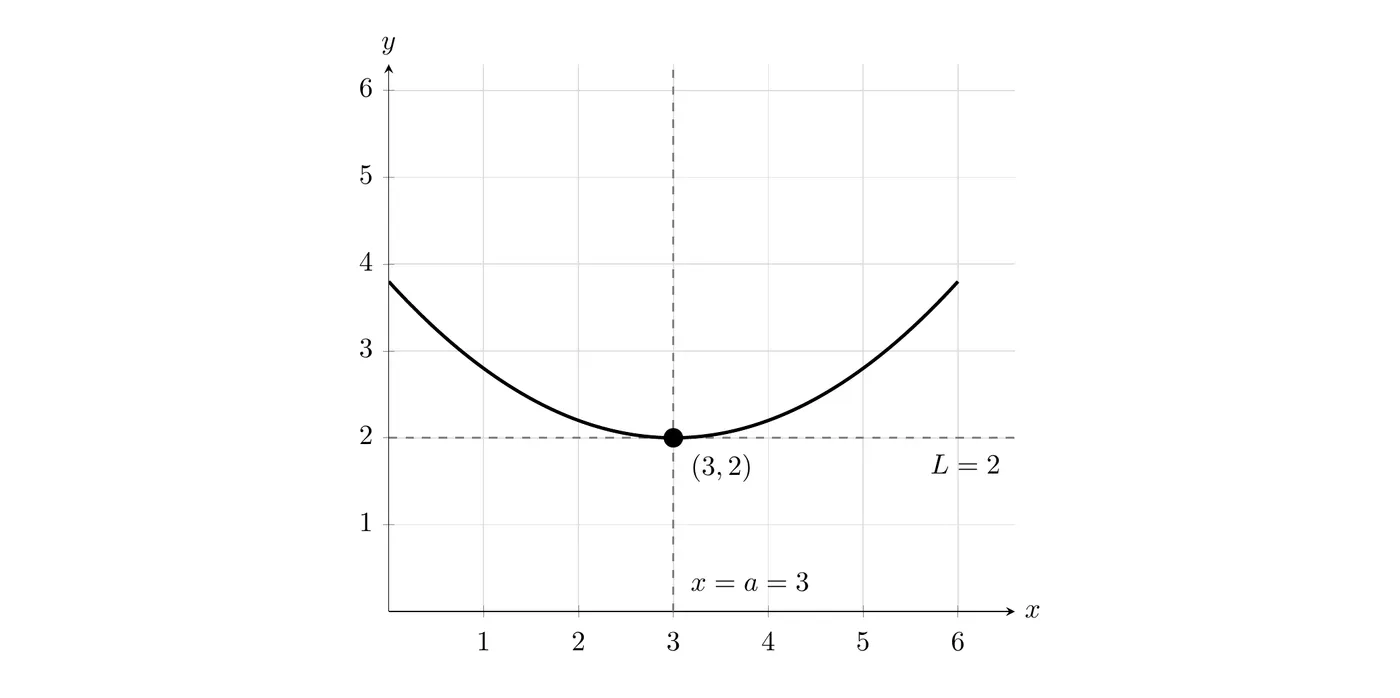
As approaches 3 from both directions, approaches 2. The function is also defined at , and its value there is 2. Limit and function value match.
Scenario 2: limit exists, function undefined
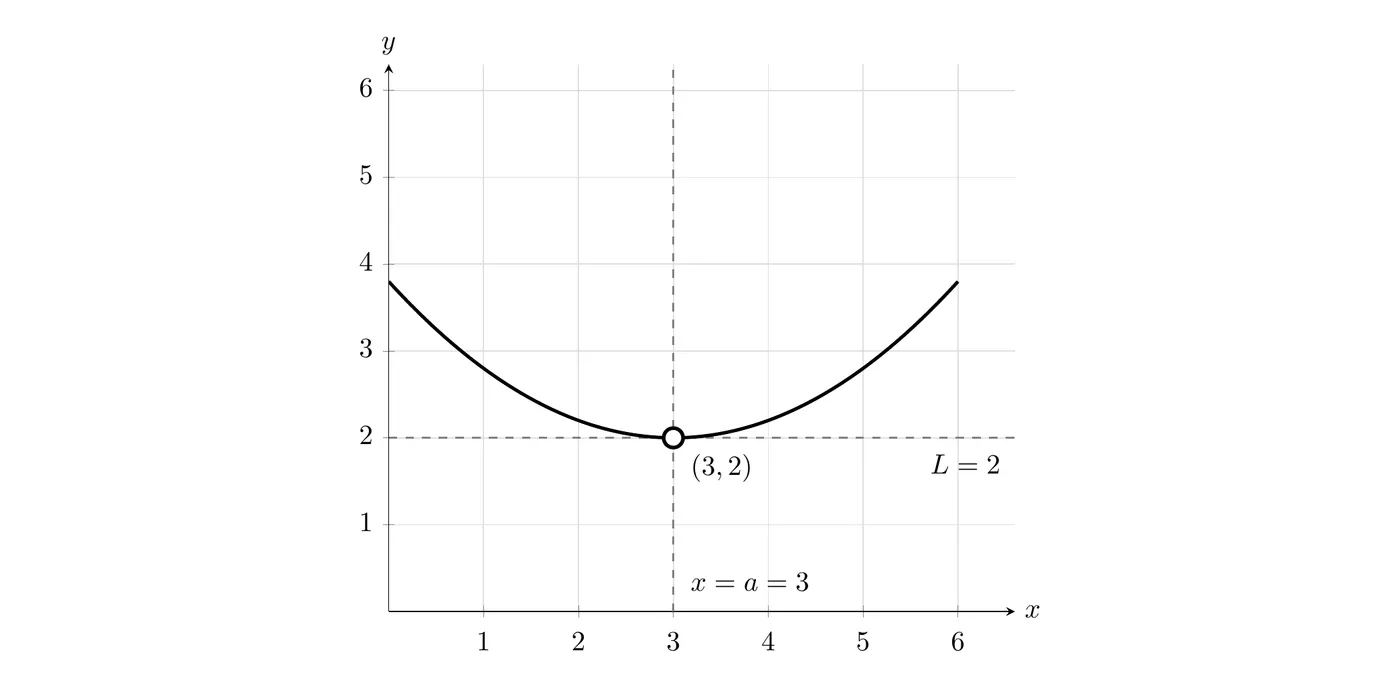
As approaches 3 from both sides, still approaches 2. But at exactly there’s a hole in the graph (open circle), so the function has no value there. The limit exists even though the function value doesn’t.
Scenario 3: limit and function value differ
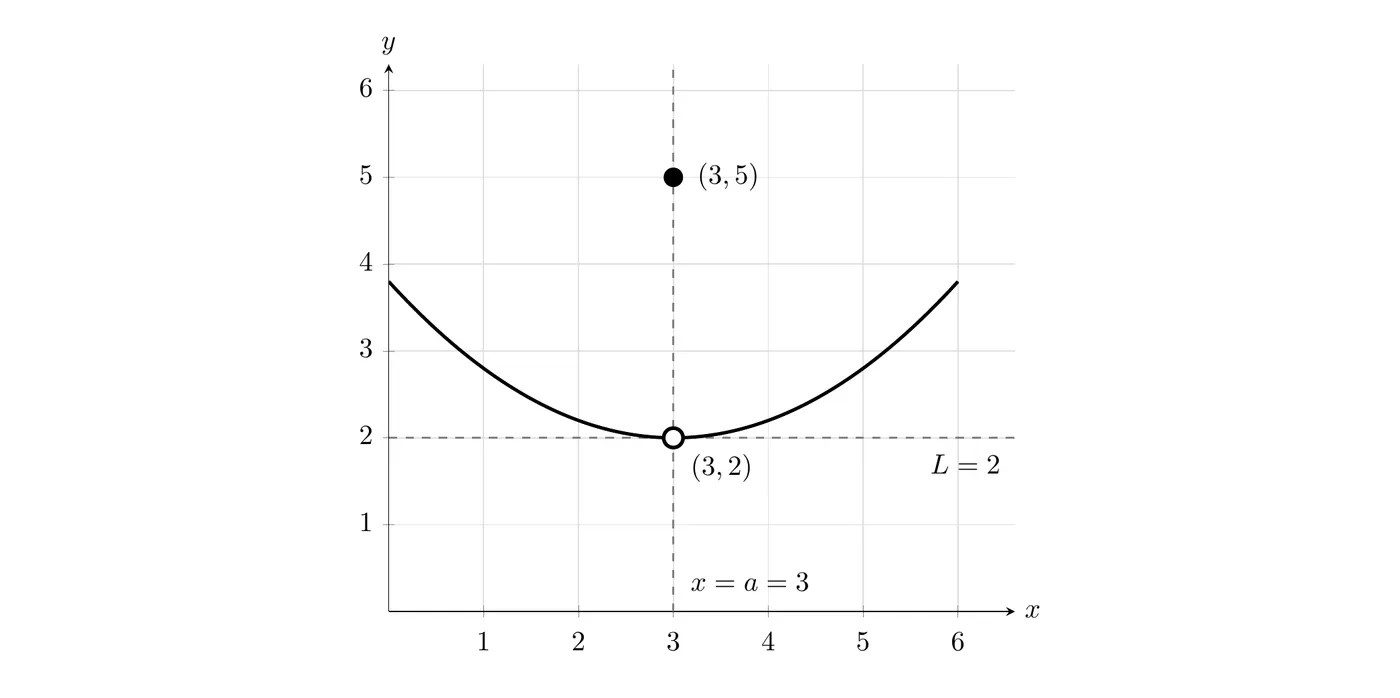
As approaches 3, approaches 2. But the actual value at is 5 (the filled dot above). The limit and function value are different, and that’s completely fine.
Practice Problems
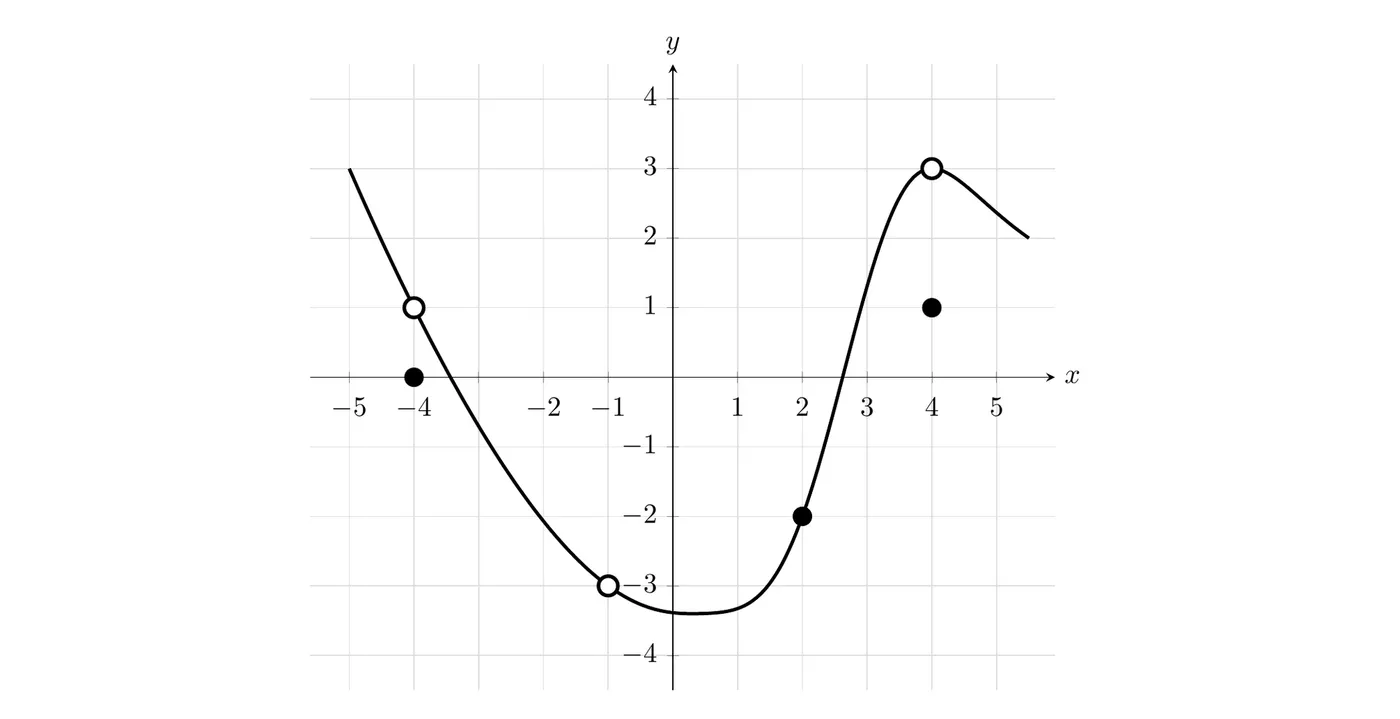
Solutions
- . Approach from both sides. From the left and right, the function heads toward .
- . Look at where . The filled dot is at (ignore the open circle).
- . Both sides approach .
- . At exactly , the filled dot is at .
- . At , the filled dot shows .
- . Approaching from both directions leads to .
- . There’s only an open circle at , no filled dot, so the function doesn’t exist there.
- . From both sides, the function approaches . Notice this is different from .
Interpreting Limit Statements
If we have:
We read it as: “as approaches 5, approaches 12.”
Critical concept: a limit tells you what the function is approaching, not what the function equals at that point.
One Limit, Three Representations
A limit can be shown graphically, numerically, or analytically. Here’s the same limit all three ways, using near :
- Graphically: the graph is the line with a hole at . Following the line toward from either side leads to a height of 2.
- Numerically: , , , and . The outputs close in on 2 from both sides.
- Analytically: factor and cancel, for , so the limit is .
All three tell the same story: . Topics 1.3 to 1.8 go through each method in detail.
True or False
Question 1: in all cases.
FALSE. Counterexample:
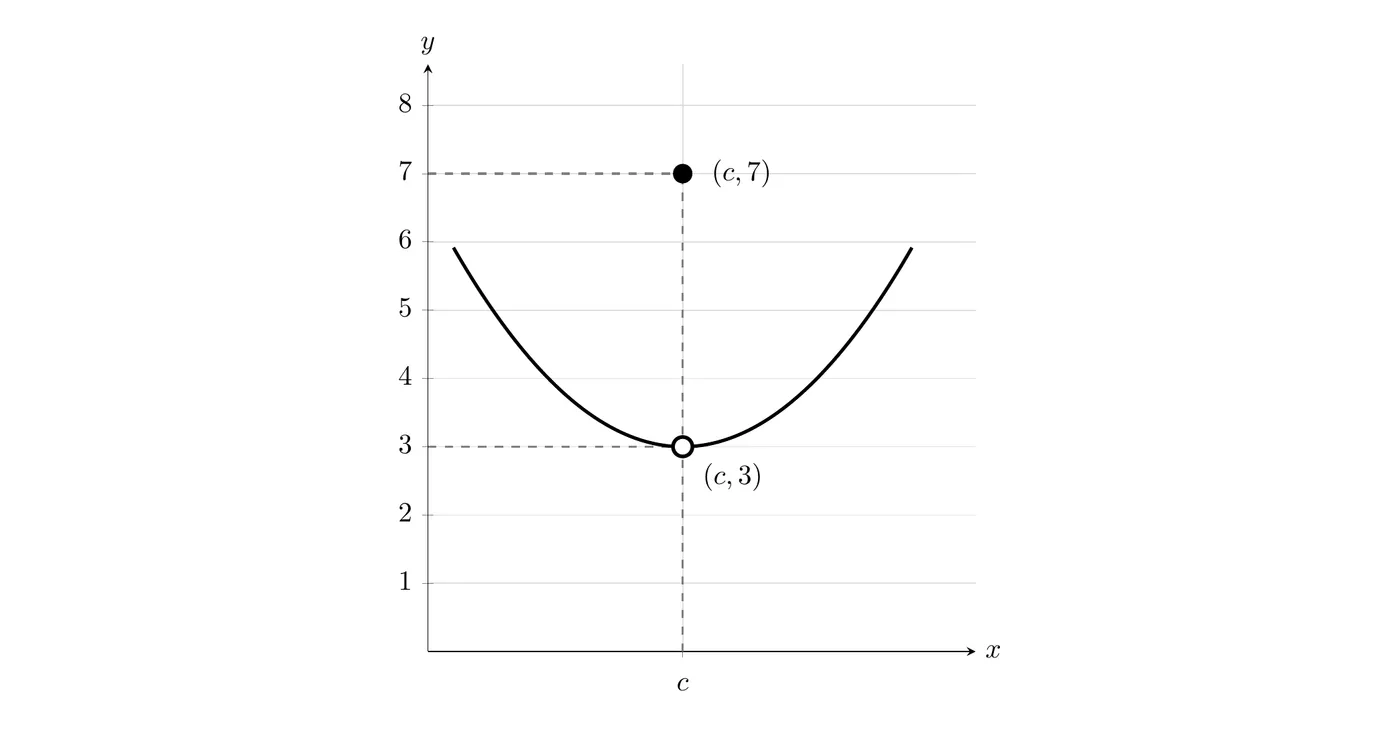
Here but .
Question 2: in all cases.
FALSE. This is also false, because there are plenty of cases where they are equal. Counterexample:
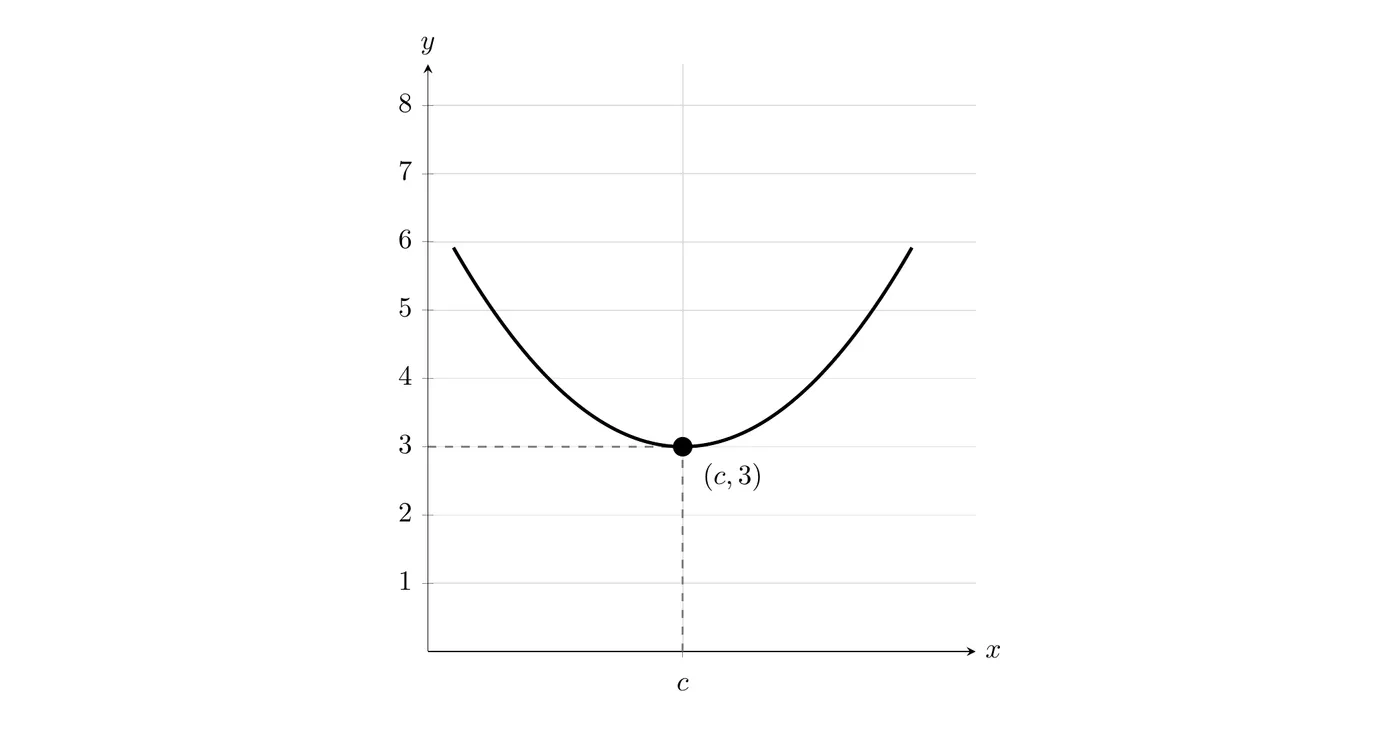
Here AND .
Bottom line: the function value and the limit can be equal, but they don’t have to be. It depends on the function.
Key Takeaways
- Limits describe approaching behavior, not necessarily actual values
- We look at what happens as gets close to a value from both sides
- Three possibilities:
- Limit equals the function value (continuous)
- Limit exists but the function is undefined (removable discontinuity)
- Limit exists but differs from the function value (point discontinuity)
- Open circles mean the function is undefined at that point
- Filled dots show the actual function value at that point
- The limit can exist even when the function value doesn’t
- The same limit can be read from a graph, a table, or an equation