

1.9 - Connecting Multiple Representations of Limits
Overview
Limits can show up in three different forms: algebraically (as functions or piecewise definitions), numerically (as tables), and graphically (as coordinate plots). The skill here is being able to work with all three and connect them to each other.
This lesson covers:
- Analyzing limits across different representations
- Determining when limits do or don’t exist
- Working with absolute value in limits
Connecting Representations
When you get a limit problem, the information could come to you in any of these forms. The limit behavior should be consistent across all representations.
Example 1: Does the Limit Exist?
Problem: A function is piecewise linear such that does not exist.
Which of the following could represent ?
Option A: Graph
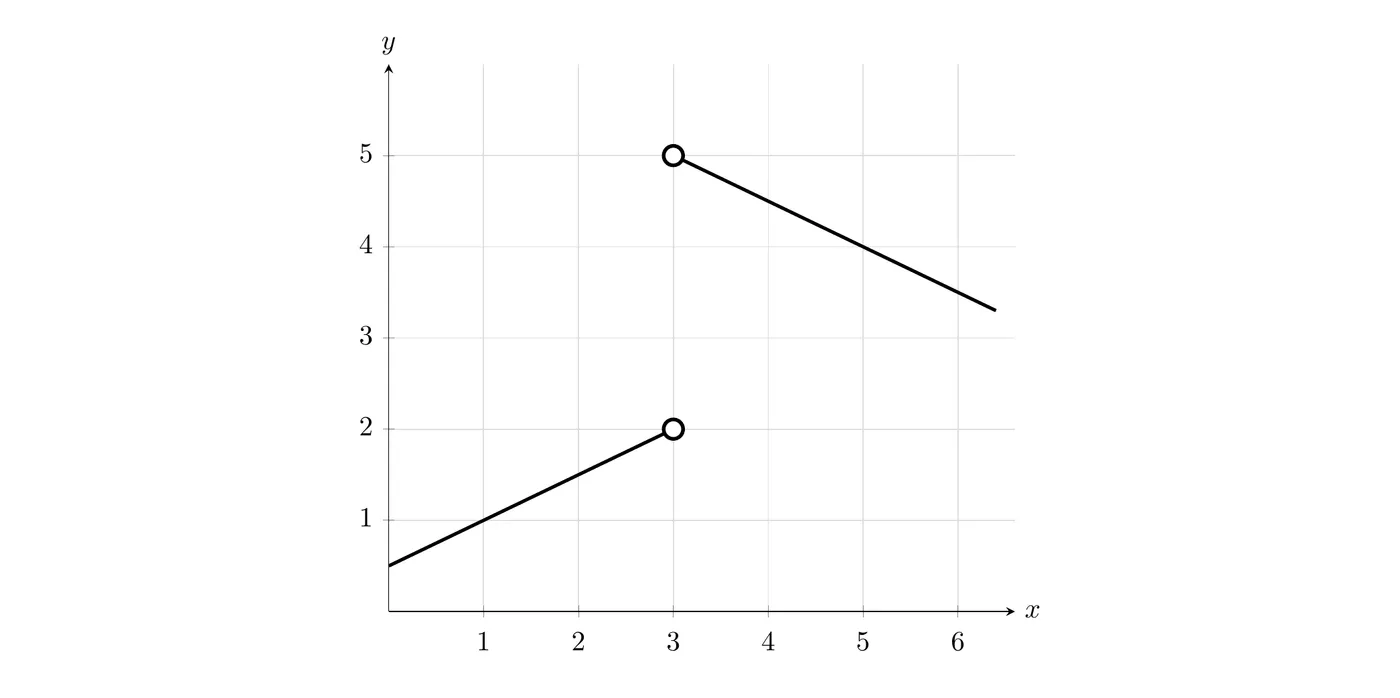
Analysis:
As (from the left), the function approaches .
As (from the right), the function approaches .
Since , the two-sided limit does not exist.
Answer: YES, this could represent because the limit does not exist.
Option B: Piecewise Function
Left-hand limit:
Right-hand limit:
Since , the two-sided limit does not exist.
Answer: YES, this could represent because the left and right limits differ.
Option C: Piecewise Function
Left-hand limit:
Right-hand limit:
Since both limits equal , the two-sided limit exists and equals .
Answer: NO, this cannot represent because the limit exists (it equals 10).
Option D: Table of Values
2.7 | 2.8 | 2.9 | 3 | 3.1 | 3.2 | 3.3 | |
12 | 10 | 8 | 1 | 11 | 9 | 7 |
Analysis:
This is a linear function, so look for the pattern (the slope).
From the left (approaching 3):
- At :
- At : (decrease by 2)
- At : (decrease by 2)
- Pattern: slope is per change
- Continuing: at , we’d expect
So .
From the right (approaching 3):
- At :
- At : (decrease by 2)
- At : (decrease by 2)
- Pattern: slope is per change
- Going backward: at , we’d expect (stepping back from to adds , so )
So .
Since , the limits don’t match.
Answer: YES, this could represent because the left-hand limit (6) and right-hand limit (13) are different.
Limits with Absolute Values
When a limit has an absolute value function in the numerator or denominator, you usually need to look at each side separately, especially when the expression inside the absolute value changes sign.
Key Strategy
To evaluate limits with absolute values, plug in a value very close to the target from each side and watch what happens to the signs.
Example 2: Basic Absolute Value Limit
Find .
Step 1: Substitute a value slightly less than 6.
Let (approaching 6 from the left).
Step 2: Evaluate the numerator.
The absolute value makes this positive.
Step 3: Evaluate the denominator.
This is negative.
Step 4: Determine the sign of the quotient.
Answer:
Example 3: Right-Hand Limit with Absolute Value
Find .
Step 1: Substitute a value slightly greater than 6.
Let (approaching 6 from the right).
Step 2: Evaluate the numerator.
The absolute value makes this positive.
Step 3: Evaluate the denominator.
This is positive.
Step 4: Determine the sign of the quotient.
Answer:
Example 4: Two-Sided Limit with Absolute Value
Find .
From Examples 2 and 3:
Since , the one-sided limits don’t match.
Answer: does not exist (DNE).
Understanding the Pattern
For the general form :
From the left ():
- Inside the absolute value: (negative)
- After absolute value: (positive)
- Result:
From the right ():
- Inside the absolute value: (positive)
- After absolute value: (positive)
- Result:
Conclusion: This limit pattern always produces a jump discontinuity, with a left limit of and a right limit of .
Practice Problems
Problem 1
Which of the following representations shows that exists and equals 5?
Option A:
Option B:
1.8 | 1.9 | 2.0 | 2.1 | 2.2 | |
4.8 | 4.9 | 3 | 5.1 | 5.2 |
Answers:
Option A:
- Left:
- Right:
- YES, the limit exists and equals 5
Option B:
- From the left, approaching about 5
- From the right, approaching about 5
- YES, the limit exists and equals 5 (even though )
Problem 2
Find .
Choose :
Numerator: (positive)
Denominator: (negative)
Result:
Answer:
Problem 3
Find .
Choose :
Numerator: (positive)
Denominator: (positive)
Result:
Answer:
Key Takeaways
- Limits can be represented algebraically, numerically, or graphically
- The limit behavior should be consistent across all representations
- For piecewise functions, evaluate each piece at the boundary point
- For tables, find the pattern (slope, for linear functions) and extend it
- For graphs, look at what -value the function approaches from each side
- Absolute value limits usually require checking both one-sided limits separately
- When evaluating absolute value limits, substitute values very close to the target
- always gives from the left and from the right
- If the one-sided limits differ, the two-sided limit does not exist
- The function value and the limit can be different