

1.12 - Confirming Continuity over an Interval
Introduction
To figure out where a function is continuous, you first have to know where the function is defined, which is its domain. A function can only be continuous where it actually exists.
Important distinction:
- Domain is where the function exists (is defined)
- Continuity is where the function exists AND has no breaks
They’re related, but they’re not always the same thing.
Continuity on an Interval
A function is continuous on an interval if it’s continuous at every point in that interval. One hole, jump, or asymptote anywhere inside the interval, and the function isn’t continuous on that interval.
Good news: you rarely have to check every point one at a time. These types of functions are continuous at every point in their domains:
- Polynomial functions
- Rational functions
- Power functions (like or )
- Exponential functions
- Logarithmic functions
- Trigonometric functions
Sums, differences, products, quotients, and compositions of these are continuous on their domains too, like or . So for these functions, finding where they’re continuous comes down to finding their domain. That’s why the next part of this page is all about domain. Piecewise functions take one extra step: you also have to check where the pieces meet.
Endpoints: at an endpoint of a closed interval, only the side inside the interval counts. For example, is continuous on , because . There’s no left side to check, since isn’t defined for .
Domain Restrictions
There are three main restrictions that limit a function’s domain.
Restriction 1: Denominators Cannot Equal Zero
For any fraction with a variable in the denominator, the denominator can’t be zero, since dividing by zero is undefined.
Example:
Restriction: , so .
Restriction 2: Even Roots Cannot Be Negative
Square roots (and all even roots, like 4th root, 6th root, and so on) can’t have negative arguments in the real number system.
Example:
Restriction: , so .
Important: Odd roots (cube root, 5th root, and so on) have no restriction. You can take the cube root of a negative number:
Restriction 3: Logarithms Require Positive Arguments
The argument of a logarithm has to be strictly greater than zero.
Why? The log graph has a vertical asymptote at the -axis and only exists for positive -values.
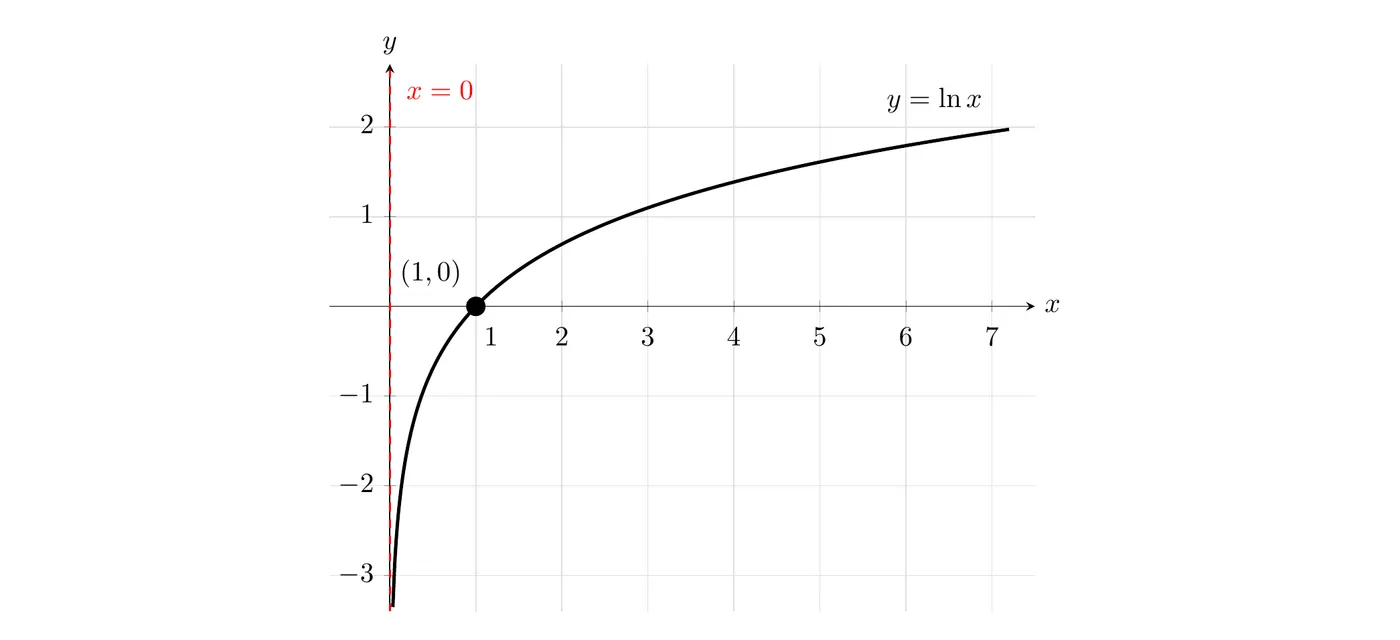
Example:
Restriction: , so .
Note: We use and not because the argument has to be strictly positive, not zero.
Writing Domain Answers: Two Notations
Domain answers can be written two equivalent ways.
Inequality Notation
Uses the standard inequality symbols: .
Interval Notation
Uses brackets and parentheses:
- Brackets or mean the endpoint is included
- Parentheses or mean the endpoint is not included
- The union symbol connects separate intervals
Special note: Infinity symbols always get parentheses, never brackets, because you can never actually reach infinity.
Finding Domain: Examples
Example 1: Fraction with Variable Denominator
Find the domain of
Restriction: the denominator can’t be zero, so .
Inequality notation: all real numbers except , or
Interval notation:
Interpretation: all real numbers from negative infinity up to (but not including) zero, plus all real numbers from (but not including) zero up to positive infinity.
Example 2: Square Root and Denominator
Find the domain of
Restriction 1: the square root needs a non-negative argument.
Restriction 2: the denominator can’t be zero.
Combine both: AND .
Inequality notation:
Interval notation:
Explanation: start at (included, so bracket), go up to (excluded, so parenthesis), skip over zero, then continue from (excluded) out to infinity.
Example 3: Square Root in the Denominator
Find the domain of
Restriction 1: whatever is under the square root has to be non-negative.
Restriction 2: the entire denominator can’t be zero. That happens when:
- , which means , or
- , which means
So and .
Combine: from Restriction 1, , but we have to exclude and .
Inequality notation:
(We can just write instead of .)
Interval notation:
Example 4: Logarithm with a Fraction Inside
Find the domain of
Restriction 1: the argument of the log has to be positive.
For a fraction to be positive, either both the numerator and denominator are positive, or both are negative.
Case 1: both positive
This means (the more restrictive condition).
Case 2: both negative
This means (the more restrictive condition).
Combine both cases: OR .
Restriction 2: the denominator of the fraction can’t be zero, so . That’s already covered by the restriction above.
Inequality notation: or
Interval notation:
Domain vs. Continuity
Domain tells you where the function is defined (where it exists).
Continuity tells you where the function has no breaks, jumps, or holes.
A function can be defined at a point but not continuous there.
Illustrative Example
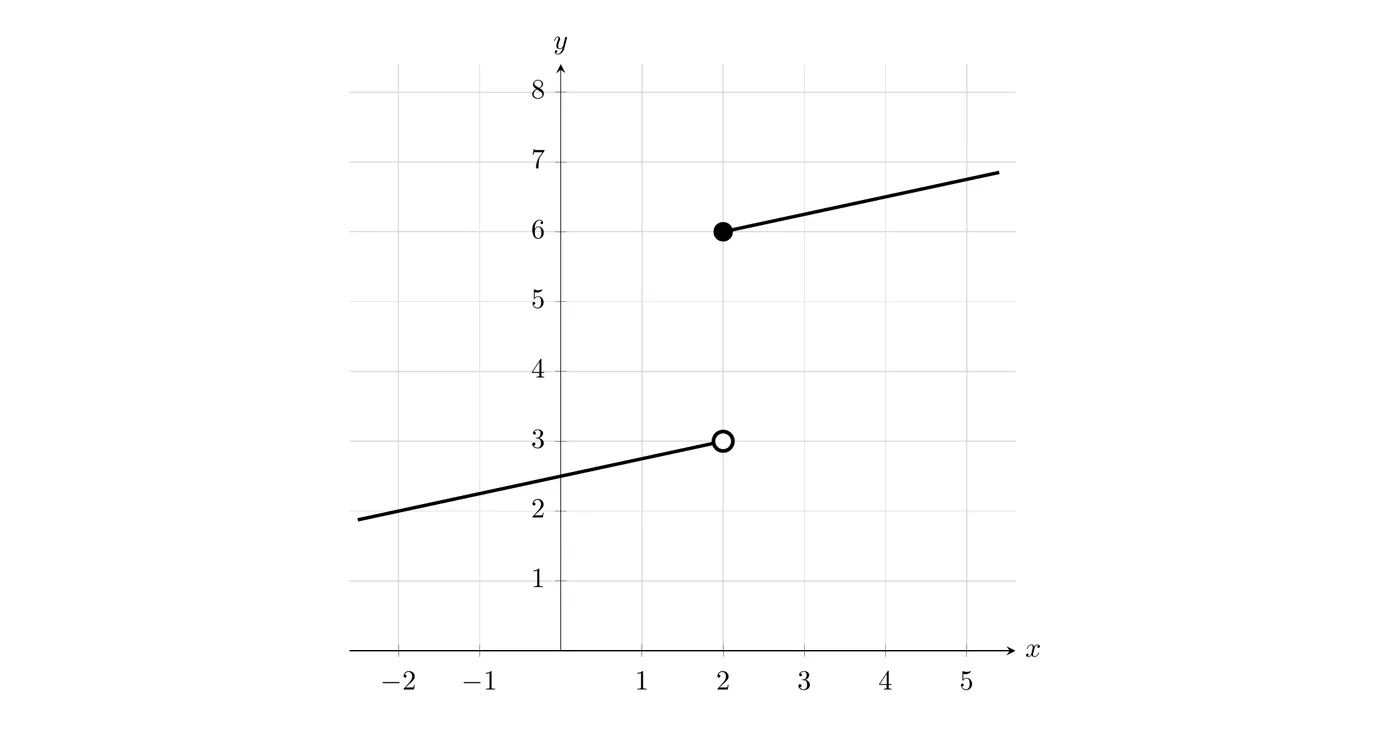
For this function:
Domain: all real numbers (the function is defined everywhere, with no gaps in the -values)
Continuous on: (everywhere except the jump at )
The function exists at , but it isn’t continuous there because of the jump.
Finding Intervals of Continuity for Piecewise Functions
For piecewise functions, you have to check two things:
- Restrictions inside each piece (domain issues)
- Whether the pieces connect at the boundaries (jump discontinuities)
Strategy
Step 1: Find domain restrictions for each individual piece
Step 2: Check for jump discontinuities at the boundary points
Step 3: List all discontinuities and write the intervals where the function IS continuous
Example 5: Complete Analysis
Determine where this function is continuous:
Step 1: Check each piece for domain restrictions
Piece 1: for
This is a polynomial (linear), so no restrictions.
Piece 2: for
The denominator can’t be zero:
This piece is only defined on , and falls in that interval, so there’s a discontinuity at .
Piece 3: for
The denominator can’t be zero:
This piece is defined for , and falls in that range, so there’s a discontinuity at .
Step 2: Check for jump discontinuities at the boundaries
At (boundary between pieces 1 and 2):
From the left (Piece 1):
From the right (Piece 2):
Since , there’s a jump discontinuity at .
At (boundary between pieces 2 and 3):
From the left (Piece 2):
From the right (Piece 3):
Since , there’s a jump discontinuity at .
Step 3: Summarize all discontinuities
- (jump)
- (vertical asymptote from Piece 2)
- (jump)
- (vertical asymptote from Piece 3)
Final answer, intervals of continuity:
Interpretation: the function is continuous everywhere except at and .
Practice Problems
Problem 1
Find the domain of .
Answer:
Domain:
Problem 2
Find the domain of .
Answer:
Domain:
Problem 3
Find the domain of .
Answer:
This means or .
Domain:
Problem 4
Where is continuous?
Answer:
Check at :
Left:
Right:
Since , it’s discontinuous at .
Continuous on:
Key Takeaways
- Three main domain restrictions: denominators , even roots , log arguments
- Two notation systems: inequality notation and interval notation
- In interval notation, use brackets for included endpoints and parentheses for excluded ones
- The union symbol connects separate intervals
- Domain is not the same as continuity. A function can exist at a point and still have a discontinuity there
- Polynomial, rational, power, exponential, logarithmic, and trig functions are continuous on their domains, so for them, continuity comes down to domain
- For piecewise functions, check both individual piece restrictions AND the boundary connections
- Jump discontinuities happen when pieces don’t connect at boundaries
- Always check whether a piece’s discontinuity actually falls inside that piece’s defined interval
- Infinity always gets parentheses, never brackets
- To find where a fraction is positive, think about when the numerator and denominator have the same sign